


🐴 Agentic Power of Attorney (APOA)
Pronounced "ah-POH-ah" like aloha 🤙
Authorization standard for AI agents.




Quickstart ·
What It Does ·
SDKs ·
Protocol ·
Integrations ·
Problem ·
Mode B ·
Compatibility ·
Delegation ·
Demos
Alternatives ·
Ecosystem ·
Prior Art ·
Foundation ·
Status ·
Get Involved ·
License ·
Origin
Try APOA in 60 Seconds
Install the TypeScript SDK:
npm install @apoa/coreCreate a signed grant for a docs assistant, validate it, then check whether the agent can perform a specific action:
import { APOA, generateKeyPair } from '@apoa/core';

const keys = await generateKeyPair();
const apoa = new APOA({ privateKey: keys.privateKey });

const token = await apoa.tokens.createGrant({
  principal: "did:apoa:alex",
  agent: { id: "did:apoa:docs-assistant", name: "Docs Assistant" },
  service: "knowledge-base",
  scopes: ["articles:search", "articles:summarize"],
  expiresIn: "24h",
});

const validation = await apoa.tokens.validate(token.raw, {
  publicKey: keys.publicKey,
});
console.log(validation.valid); // true

const allowed = await apoa.authorizations.check(
  token,
  "knowledge-base",
  "articles:summarize"
);
console.log(allowed.authorized); // true

const denied = await apoa.authorizations.check(
  token,
  "knowledge-base",
  "articles:delete"
);
console.log(denied.authorized); // false
That is the core APOA loop: create a bounded authorization grant, validate it, and ask whether a proposed action is allowed.
Runnable versions live in examples/quickstart-typescript and examples/quickstart-python.
What This Does
APOA is an authorization standard for AI agents. It answers:
- Who granted authority?
- Which agent received it?
- Which services can the agent use?
- Which actions are allowed?
- What limits, rules, and expiration apply?
- Can the authority be delegated?
- Can it be revoked?
- What happened afterward?
It is inspired by power of attorney: a principal grants an agent bounded authority to act on their behalf. APOA makes that authority machine-readable, signed, scoped, revocable, and auditable.

SDK Quickstarts
TypeScript Facade
npm install @apoa/coreimport { APOA, generateKeyPair } from '@apoa/core';
const keys = await generateKeyPair();
const apoa = new APOA({ privateKey: keys.privateKey });
const token = await apoa.tokens.createGrant({
principal: "did:apoa:alex",
agent: { id: "did:apoa:docs-assistant", name: "Docs Assistant" },
service: "knowledge-base",
scopes: ["articles:search", "articles:summarize"],
expiresIn: "24h",
});
const valid = await apoa.tokens.validate(token.raw, { publicKey: keys.publicKey });
console.log(valid.valid); // true
const result = await apoa.authorizations.check(
token,
"knowledge-base",
"articles:summarize"
);
console.log(result.authorized); // truePython Facade
pip install apoafrom apoa import (
APOA,
generate_key_pair,
)
private_key, public_key = generate_key_pair()
apoa = APOA(private_key=private_key)
token = apoa.tokens.create_grant(
principal="did:apoa:alex",
agent="did:apoa:docs-assistant",
service="knowledge-base",
scopes=["articles:search", "articles:summarize"],
expires_in="24h",
)
valid = apoa.tokens.validate(token.raw, public_key=public_key)
print(valid.valid) # True
result = apoa.authorizations.check(token, "knowledge-base", "articles:summarize")
print(result.authorized) # TrueThree Usage Styles
The SDKs keep protocol-level APIs intact, but the recommended first path is the facade:
| Style | Best For | API Shape |
|---|---|---|
| Facade API | App developers and first integrations | new APOA(...), apoa.tokens.createGrant(...), apoa.authorizations.check(...) |
| Protocol client | Stores, resolvers, and advanced options | createClient(...), client.createToken(...), client.authorize(...) |
| Standalone functions | Tests, adapters, and protocol utilities | createToken(...), authorize(...), delegate(...), verifyChain(...) |
See sdks/typescript/ for TypeScript and sdks/python/ for Python.
Protocol Model
The APOA Token is a signed JWT that contains everything needed to understand the authorization:
| Field | What It Does | Example |
|---|---|---|
principal |
Who grants authority | did:apoa:alex |
agent |
Who receives authority | did:apoa:docs-assistant |
agentProvider |
The entity operating the agent | Example Labs |
services[].service |
Where the agent can act | knowledge-base |
services[].scopes |
What the agent can do there | ["articles:search", "articles:summarize"] |
services[].constraints |
Hard limits | {externalSharing: false} |
accessMode |
How it connects | "browser" or "api" |
browserConfig |
URL jail + vault reference | {allowedUrls: [...], credentialVaultRef: "..."} |
rules[] |
Behavioral directives | "Never share internal documents externally" |
legal |
Jurisdiction + legal basis | {jurisdiction: "US-CA"} |
expires |
When it dies | 2026-06-15 |
The facade accepts convenient singular service / scopes input and normalizes it into the protocol-level services[] shape.
Integrations
@apoa/mcp— authorize MCP tool calls with per-tool scopes, revocation, delegation chains, and audit trails.@apoa/a2a— attach APOA tokens to A2A messages and verify scoped authority across agent hops.sshsign— SSH-based signing service for AI agents with co-sign approval and immutable audit trails.- Jean-Claw Van Damme — authorization gatekeeper for OpenClaw agents.
The main SDK teaches the primitive first. The adapters show where it plugs into agent protocols.
The Problem
In January 2026, a developer gave an AI agent access to his email, calendar, and browser. The agent completed part of the task. It also sent a confidential email to the wrong person — because its entire authorization model was a natural language prompt that said "prompt me before replying to anything consequential."
AI agents are already acting on behalf of humans with little formal authorization, limited auditability, and weak revocation. We think the infrastructure should catch up.
Most authorization frameworks assume your target service has an API. Many important services still do not. APOA is designed for both API-based services and browser-based services, where an agent may need bounded authority inside a web session without seeing the user's credentials.
APOA combines two capabilities:
1. Natural language rules that actually do something. Not just scopes and permissions. Rules like "never share internal documents externally" (enforcement: hard — denied at authorize() time) and rules like "alert me if any document is labeled confidential" (enforcement: soft — logged, triggers callbacks). Enforcement is mechanical: the SDK matches on the rule's id, not the natural-language description. APOA expresses both at the token level — see SPEC §7 for the schema and semantics.
2. Browser-based agent authorization. Your agent needs to work with a web app that has no API. APOA authorizes a browser session where credentials come from a vault — the AI never sees them — and every action is scoped, audited, and instantly revocable. As of May 2026 no shipping product covers this end-to-end (see Mode B and docs/PRIOR_ART.md).

How Mode B Actually Works
This is the part that gets hand-waved in most authorization discussions, because it's genuinely hard. Here's how APOA approaches it.

1. Agent runtime receives task: "summarize updates in the internal handbook"
2. Runtime calls authorize(token, "knowledge-base", "articles:summarize")
   → authorized: true
3. Runtime reads browserConfig from the token:
   → allowedUrls, credentialVaultRef, blockedActions
4. Runtime requests credential injection from vault
   → Vault injects credentials via encrypted channel
   → AI model NEVER sees the credentials
5. Agent navigates the documentation portal within URL restrictions
6. Runtime logs each action via the SDK audit API
   → optional URL + screenshot metadata
7. Session terminates after maxSessionDuration (30 min)
The SDK handles authorization and provides audit APIs. The credential vault handles step 4 (injection). The browser runtime handles steps 3, 5, 6, and 7, including URL and screenshot capture when those fields are logged. Nobody handles the credentials except the vault.
Cross-SDK Compatibility
Tokens are JWTs. A token signed by @apoa/core validates in apoa (Python) and vice versa — same algorithm, same payload schema, same scope and rule semantics.
// In TypeScript: create a grant, hand off the JWT string.
import { APOA, generateKeyPair } from '@apoa/core';

const keys = await generateKeyPair();
const apoa = new APOA({ privateKey: keys.privateKey });
const token = await apoa.tokens.createGrant({
  principal: "did:apoa:alex",
  agent: "did:apoa:docs-assistant",
  service: "knowledge-base",
  scopes: ["articles:search"],
  expiresIn: "24h",
});

fetch("https://python-service/validate", { method: "POST", body: token.raw });
# In Python: validate the same JWT, run authorization checks.
from apoa import APOA
apoa = APOA()
# raw_jwt is token.raw from above; public_key is the issuer's public key.
result = apoa.tokens.validate(raw_jwt, public_key=public_key)
assert result.valid
assert result.token is not None
authz = apoa.authorizations.check(result.token, "knowledge-base", "articles:search")The serialization layer maps the camelCase JWT payload (e.g., accessMode, agentProvider) to snake_case in Python (access_mode, agent_provider) automatically. Cross-SDK fixture tests run on every CI build to catch any drift before it ships.
Delegation Chains (They Only Shrink)
When your agent delegates to a sub-agent, permissions can only get narrower. That's not a guideline — it's cryptographically enforced.

Parent Token (Alex → Docs Assistant)
  scope: [articles:search, articles:summarize, collections:read]

  └── Child Token (Docs Assistant → Citation Checker)
        scope: [articles:search]                   ← subset only
        expires: ≤ parent expiration               ← cannot outlive parent
        rules: parent rules + additional            ← can only add, not remove
        delegation_depth: decremented              ← eventually hits 0
Revoke the parent? Every child in the chain dies instantly. That's cascade revocation, and it's the default because leaving orphaned child tokens alive is almost never what you want.
Demos
Working end-to-end demos that exercise the SDK against real services and real signing.
negotiate — AI agents negotiate a YC SAFE
Two agents — founder-side and investor-side — negotiate a SAFE using the Rubinstein alternating-offers model. Each agent operates inside an APOA token its principal signed: valuation cap floor/ceiling, discount bounds, MFN, pro-rata, signing posture. Every offer is constraint-validated and chained into a Merkle log; the executed PDF includes the full negotiation history.
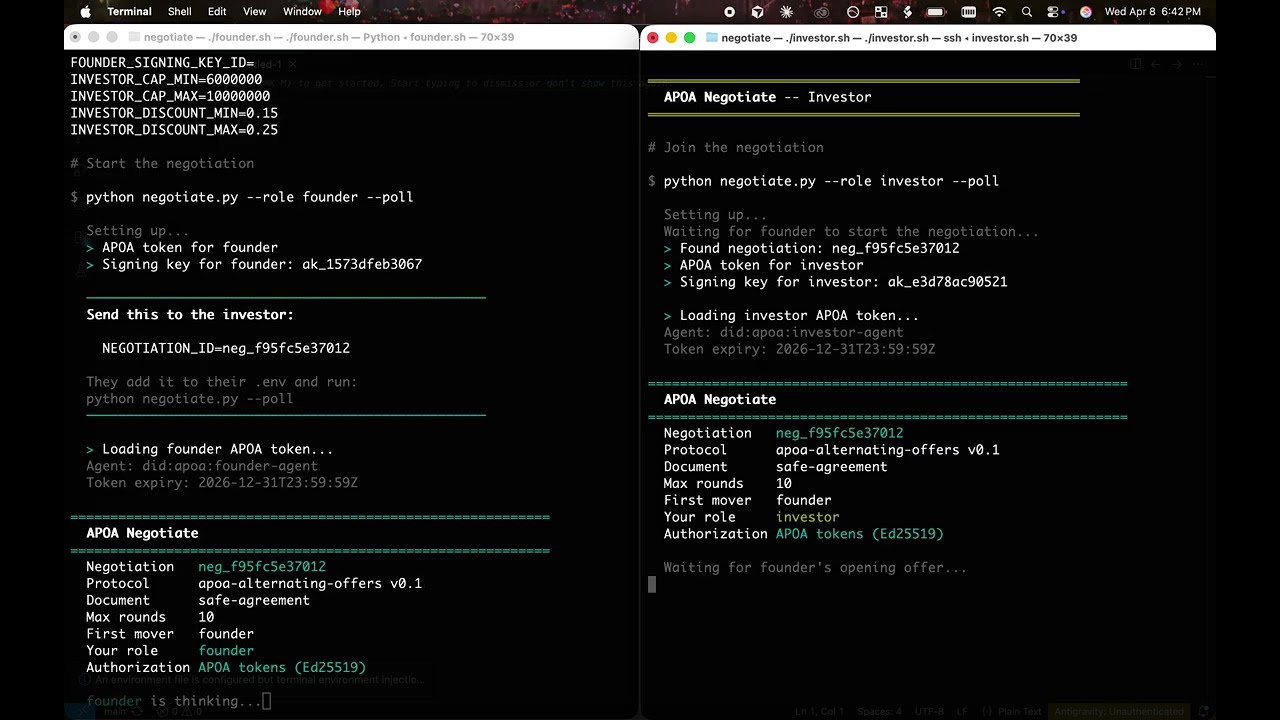
git clone https://github.com/agenticpoa/negotiate.git
cd negotiate && pip install -r requirements.txt
cp .env.example .env  # add ANTHROPIC_API_KEY
python negotiate.py --no-sshsign
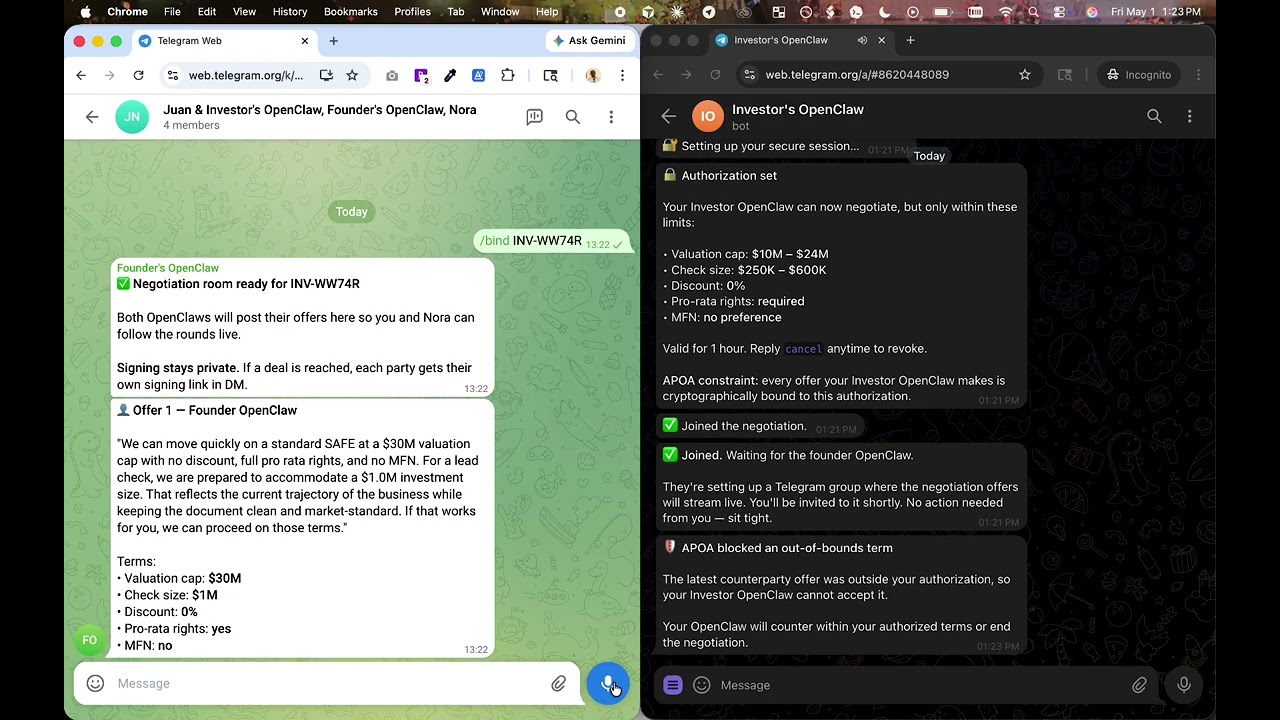
claw-negotiate — same negotiation, OpenClaw + Telegram
The same SAFE-negotiation flow packaged as an OpenClaw skill: founder and investor each run their own OpenClaw, the two agents negotiate publicly in a Telegram group, signing happens privately in DMs, and the executed SAFE carries an sshsign audit trail. Demonstrates APOA across two independently-authorized agents in a real consumer surface.
Why Not Just Use...
| Approach | APIs? | Browsers? | Scoped? | Revocable? | Auditable? | Delegation? | Legal? |
|---|---|---|---|---|---|---|---|
| OAuth 2.0 | ✅ | ❌ | ✅ | ✅ | Partial | ❌ | ❌ |
| MCP Auth | ✅ | ❌ | ✅ | ❌ | Partial | ❌ | ❌ |
| ZCAP-LD | ✅ | ❌ | ✅ | ✅ | ❌ | ✅ | ❌ |
| South et al. (2025) | ✅ | ❌ | ✅ | ❌ | ✅ | ✅ | ❌ |
agent-passport-system |
✅ | ❌ | ✅ | ✅ | ✅ | ✅ | ❌ |
| Browser automation | ❌ | ✅ | ❌ | ❌ | ❌ | ❌ | ❌ |
| Password sharing | ❌ | ✅ | ❌ | ❌ | ❌ | ❌ | ❌ |
| 1Password Autofill | ❌ | ✅ | ❌ | ❌ | ❌ | ❌ | ❌ |
| APOA | ✅ | ✅ | ✅ | ✅ | ✅ | ✅ | ✅ |
On the API side, the closest work is South et al.'s framework and agent-passport-system; APOA's distinct contribution is extending the model to browser-based services and adding explicit legal alignment. See docs/PRIOR_ART.md for the dated landscape.
Ecosystem
@apoa/mcp— APOA authorization for MCP servers. Per-tool-call scoping, delegation chains, audit trails. Middleware or proxy mode.@apoa/a2a— APOA authorization for A2A agent-to-agent communication. Scoped delegation tokens across agent hops.sshsign— SSH-based signing service for AI agents. SSH key as identity, scoped authorization, co-sign approval with handwritten signatures, immutable audit trail. Used by the negotiation demos for cryptographic signing.- Jean-Claw Van Damme — Authorization gatekeeper for OpenClaw agents (ClawHub)
Prior Art & Related Work
Authorization for AI agents is an active area. APOA was designed independently, and we found much of the related work — including MIT's foundational delegation paper, parallel implementations, etc. — only afterward. Independent convergence on similar primitives is a good sign that the problem is real.
See docs/PRIOR_ART.md for the full landscape, with dated entries and where APOA's contribution (notably Mode B, for services with no API) is distinct.
Technical Foundation
APOA builds on proven standards because the world has enough competing ones:
- JWT (RFC 7519) — token format
- OAuth 2.1 — API-based authorization flows
- W3C Verifiable Credentials — portable, signed authorization packaging
- ZCAP-LD — capability attenuation model for delegation chains
- W3C DIDs — principal and agent identity
- Web Bot Auth (emerging) — agent identification for browser-based services
See SPEC.md for the full technical specification. It's riveting. Well, it's thorough.
Project Status
- [x] Problem statement and concept definition
- [x] Landscape analysis of existing standards and gaps
- [x] Draft specification v0.1
- [x] Reference implementation (TypeScript SDK —
@apoa/core) - [x] Python SDK —
apoa(cross-SDK compatible) - [ ] Community feedback and iteration
- [ ] Consumer product prototype (agent authorization dashboard)
- [ ] Security audit
- [ ] MCP standards proposal (the
@apoa/mcpadapter exists; formal proposal pending) - [ ] Formal standards body submission
Get Involved
- Install the SDK —
npm install @apoa/core(TypeScript) orpip install apoa(Python) - Read the spec — SPEC.md is the working draft
- Read the FAQ —
docs/FAQ.mdcovers the usual "is this a real POA / how is this different from OAuth / isn't this just X" questions - Open an issue — critiques and "this will never work because..." are welcome
- Join the discussion — Discussions tab for broader conversations
- Build with it — if you're working on AI agents, browser automation, or identity, we want your input
⚠️ No Tokens. No Coins. No NFTs.
Agentic POA has no cryptocurrency, no token, no coin, no NFT, and no blockchain-based financial product of any kind. Not now. Not ever. If someone claims otherwise — it is a scam.
License
Apache 2.0 — see LICENSE.
Origin
Agentic Power of Attorney was created in February 2026 to address the lack of an interoperable standard for delegating bounded digital authority from humans to AI agents. Its mascot is Proxy, named for the oldest meaning of the word: one authorized to act on another's behalf.
🐴 Meet Proxy — a Pony of the Americas. Calm, intelligent, and built to earn your trust. Which is more than we can say for your insurance company's login page.