
Continuous-Time Distribution Matching for Few-Step Diffusion Distillation





Algorithm Overview • Results • Inference • Training • Evaluation • Citation

Algorithm Overview
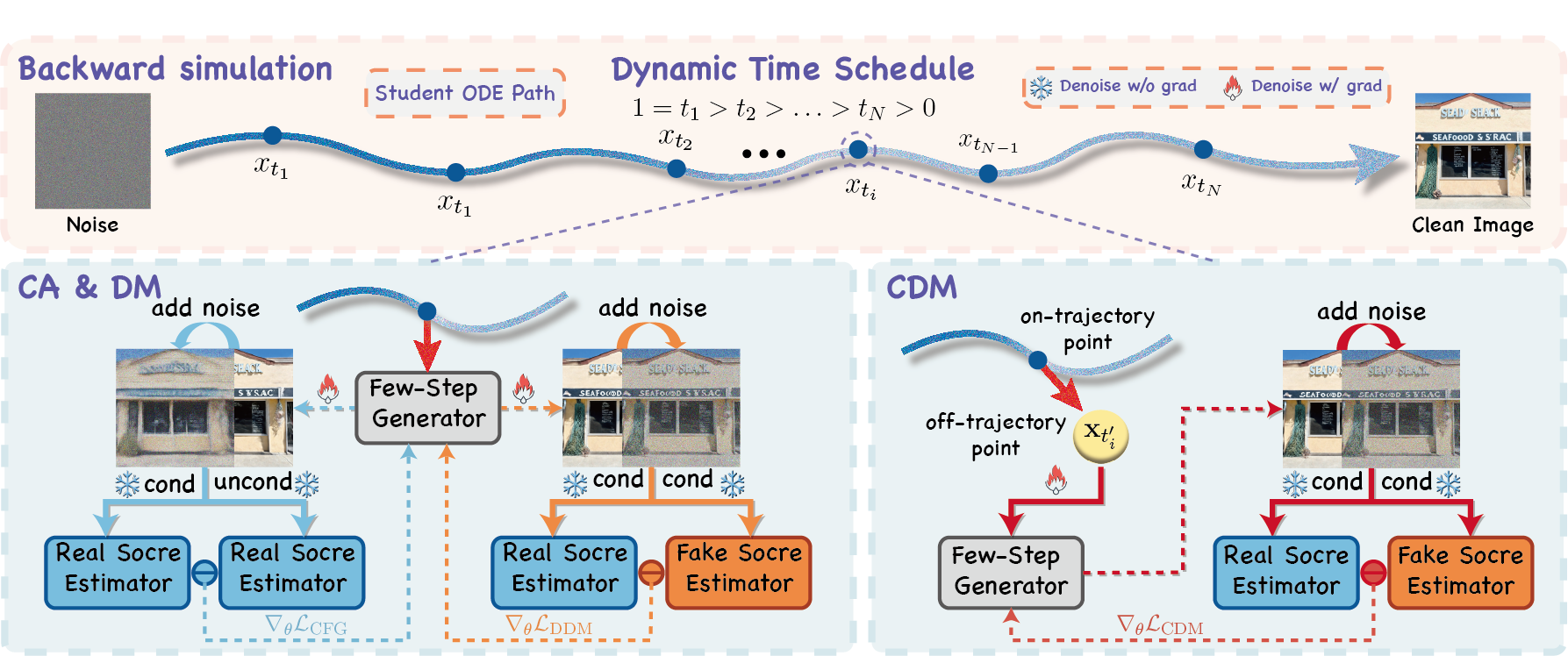
Overview of Continuous-Time Distribution Matching (CDM). Top: Our approach employs a dynamic continuous time schedule during backward simulation, sampling intermediate anchors uniformly from (0, 1]. Bottom Left: CFG augmentation (CA) and distribution matching (DM) operate on this dynamic schedule to align text-image conditions and data distributions at on-trajectory anchors. Bottom Right: To address inter-anchor inconsistency, the proposed CDM objective explicitly extrapolates off-trajectory latents using the predicted velocity.
4-NFE Generation Results
SD3-Medium

LongCat

Inference
# Clone this repository
git clone https://github.com/byliutao/cdm.git
cd cdm

# [Optional] Use HuggingFace mirror if huggingface.co is not accessible
export HF_ENDPOINT="https://hf-mirror.com"
export HF_TOKEN="hf_xxx"

# Create and activate the inference environment
conda create -n cdm_infer python=3.10
conda activate cdm_infer
pip install -r config/requirements_infer.txt

# Run inference
python scripts/infer/sd3_m.py   # SD3-Medium
python scripts/infer/longcat.py # LongCat
Training
# Create and activate the training environment
conda create -n cdm_train python=3.10
conda activate cdm_train
pip install -r config/requirements_train.txt
pip install flash-attn==2.7.4.post1 --no-build-isolation  # May take 1-2 hours

# Launch training with FSDP2
accelerate launch --config_file config/accelerate_fsdp2.yaml \
    --num_processes 8 -m scripts.train \
    --config config/config.py:sd3      # SD3-Medium

accelerate launch --config_file config/accelerate_fsdp2.yaml \
    --num_processes 8 -m scripts.train \
    --config config/config.py:longcat  # LongCat
Evaluation
Evaluation is split into two phases: image generation and metric computation.
Step 1 — Export a checkpoint to a pipeline
conda activate cdm_train

python -m scripts.save \
    --experiment_dir "logs/experiments/sd3/test" \
    --output_dir "logs/pipelines/test" \
    --checkpoint_steps "2000"
Step 2 — Generate images
accelerate launch --num_processes 8 -m scripts.eval \
    --phase generate \
    --model_path "logs/pipelines/test/checkpoint-2000" \
    --eval_metrics imagereward clipscore pickscore hpsv2 hpsv3 aesthetic ocr dpgbench \
    --output_dir "logs/evaluations/test" \
    --base_model sd3 \
    --save_images
Step 3 — Compute metrics
# Create a separate environment for evaluation dependencies
conda create -n cdm_eval python=3.10
conda activate cdm_eval
pip install -r config/requirements_eval.txt
pip install image-reward --no-deps
pip install fairseq --no-deps

# NOTE: If running on multiple GPUs, download checkpoints on 1 GPU first.
# For FID evaluation, place download ref image from byliutao/coco2014val_10k and put it under dataset/coco2014val_10k

accelerate launch --num_processes 8 -m scripts.eval \
    --phase evaluate \
    --eval_metrics imagereward clipscore pickscore hpsv2 hpsv3 aesthetic ocr dpgbench \
    --output_dir "logs/evaluations/test"
License
This project is licensed under the MIT License — see the LICENSE file for details.
Citation
If our work assists your research, please consider giving us a star ⭐ or citing us:
@misc{liu2026continuoustimedistributionmatchingfewstep,
      title={Continuous-Time Distribution Matching for Few-Step Diffusion Distillation},
      author={Tao Liu and Hao Yan and Mengting Chen and Taihang Hu and Zhengrong Yue and Zihao Pan and Jinsong Lan and Xiaoyong Zhu and Ming-Ming Cheng and Bo Zheng and Yaxing Wang},
      year={2026},
      eprint={2605.06376},
      archivePrefix={arXiv},
      primaryClass={cs.CV},
      url={https://arxiv.org/abs/2605.06376},
}