
A Geometric Computer
A complete cognitive architecture on one manifold: S³, the unit 3-sphere. Every brain state is a unit quaternion. Every update is a Hamilton product. One arithmetic operation. Five layers. Turing-complete.
Paper: A Geometric Computer · Zenodo Zeroth Law: Sequence Integrity · Zenodo
What this is
The brain runs a single loop: ingest a carrier, compare the current state against what the genome predicts, measure the geodesic distance σ. When σ crosses π/4 — the BKT phase boundary on S³, the Hopf equator — the brain closes: writes to the genome, updates the hierarchy, corrects its prediction. Learning is repeated closure. Convergence is a fixed-point theorem.
Five layers build upward from S³:
substrate → memory → execution → brain → learning
Each layer uses only the layer beneath it. The same Hamilton product that encodes a unit quaternion rotation also runs a Minsky machine, reads the genome, and integrates the perceptual field. There is no other arithmetic.
Benchmarks
Closure against the standard tools for the same jobs:
find the 1 corrupted record in a million      ~1.8× faster than a Merkle tree
find all 50 corrupted records in 100,000        50× faster than a Merkle tree
Closure DNA queries, vs SQLite with indexes    7–10× faster
Closure DNA integrity check, vs SQLite     ~19,000× faster
Experiments
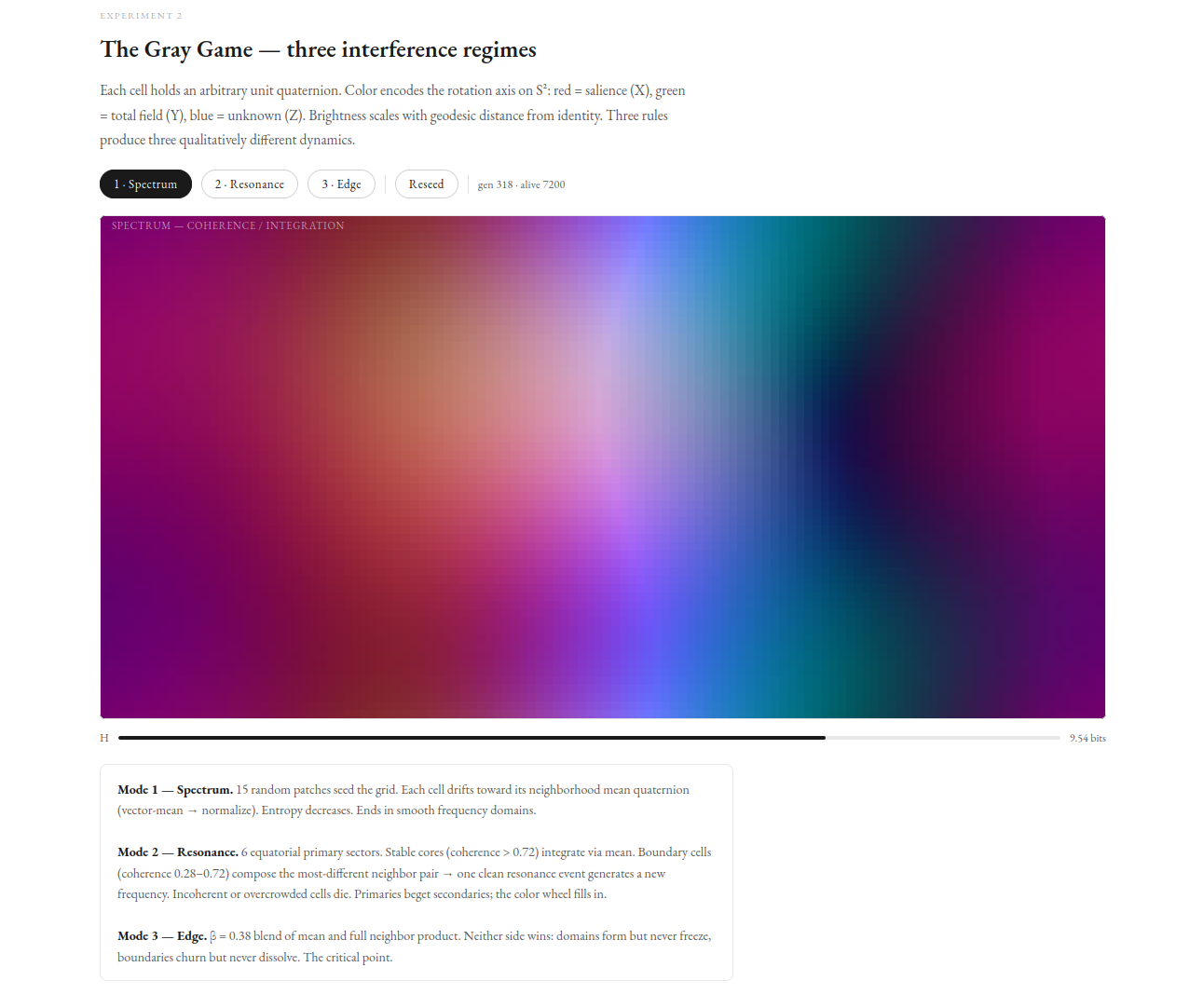
Run in the browser → Conway's GoL on S³ and the Gray Game (three interference modes) running live in JS — no install required.
Terminal visualizers (require true-color support):
cargo run --example gol_live --release           # Conway's GoL on S³, pattern selector
cargo run --example gray_game_live --release     # Gray Game: spectrum / resonance / edge
| # | experiment | subject |
|---|---|---|
| 1 | exp_arithmetic |
Exact modular arithmetic on S³ for Z/nZ orbits |
| 2 | exp_bkt_phase_transition |
BKT phase boundary at σ = π/4 |
| 3 | exp_riemann_zeros |
Riemann zeros as local minima in the carrier field |
| 4 | exp_associative_memory |
Associative recall by σ-radius |
| 5 | exp_turing |
Turing completeness via 2-counter Minsky machine |
| 6 | exp_fractran |
FRACTRAN: Turing-complete prime-native computation |
| 7 | exp_prime_resonance |
Riemann zeros as prime eigenstates on S³ |
| 8 | exp_collatz |
Collatz sequence: orbit convergence on the carrier lattice |
| 9 | exp_fiber_memory |
Fiber memory: axis and angle as independent address channels |
| — | exp_su2_gates |
SU(2) gate dictionary and single-qubit completeness |
| — | exp_neuromodulated_learning |
Arousal and coherence modulation of the learning regime |
Architecture
SUBSTRATE
├── sphere      Hamilton product · inverse · sigma · slerp · IDENTITY
├── embed       bytes → carrier on S³ (hashing optional)
├── verify      A?=A · σ · VerificationEvent · Hopf decomposition
└── hopf        S³ → S² × S¹ · factorized addressing · AddressMode

MEMORY
├── buffer      Transient input window (EMBED writes, ZREAD reads)
├── genome      DNA · Epigenetic · Category · nearest-neighbor reads · BKT control
└── field       zread · resonate · coalition accumulation · cos(σ) falloff

EXECUTION
├── carrier     VerificationCell · EulerPlane · TwistSheet · CouplingState
├── execution   MinskyMachine · FractranMachine · OrbitRuntime
└── zeta        Zeta functions over the carrier lattice

BRAIN
├── hierarchy   Recursive closure detection · genome emission
├── localization O(log n) minimal closure interval search
├── consolidation Merge · prune · reorganize epigenetic · DNA is permanent
├── neuromodulation arousal_tone · coherence_tone (observational, session-ephemeral)
└── three_cell  ThreeCell::ingest → buffer → ZREAD → RESONATE → VERIFY
                → Cell A composition → closure → Cell C integration → genome

LEARNING
└── teach       (input, target) pairs · σ-gap error · geometric convergence
Running
cargo run --example exp_arithmetic --release
cargo run --example exp_fiber_memory --release
cargo run --example gol_live --release
cargo run --example gray_game_live --release

cargo test --release     # 55 tests, all passing
What you get
Identity maintenance      A?=A at any scale. One comparison.
                          σ = 0 at perfect coherence.
                          σ = π/4 at the Hopf equator — the closure threshold.

Two incident types        Missing record (W axis breaks) or reorder (RGB axes break).
                          Algebraic inverses. There is no third type.

Carrier channels          R = salience (X) — the [Total, Unknown] commutator.
                          G = total    (Y) — the full field; the prior.
                          B = unknown  (Z) — what has not been integrated.
                          Known = G − B. Yellow = learned. Blue = novel.

Factorized addressing     Axis queries find semantic type (S²).
                          Angle queries find cyclic position (S¹).
                          Full queries find the exact carrier (S³).

Field resonance           ZREAD reads the genome by proximity, not exact match.
                          Query strength falls as cos(σ), cuts off at σ = π/3.

Genome persistence        DNA layer bootstraps from orbit seeds. Permanent.
                          Epigenetic layer learns from ingest. Consolidates.

Turing completeness       2-counter Minsky machine and FRACTRAN on the carrier substrate.

BrainState serialization  Full state serializes to JSON. Exact round-trip.
Enkidu-Alive
An agent with two drives: hunger σ(state, food) and cold σ(state, shelter). Both are geodesic distances on S³. When both are zero the agent is at IDENTITY — the algebraic identity element is homeostasis. One comparison per tick. No reward function. No learned policy. The geometry produces the gradient.
The SDK
The same Hamilton product applied to data integrity. Any ordered byte sequence composes on S³; if the sequence is intact the product closes; if not, the gap tells you exactly what broke and where. Built on the same Rust core.
pip install closure-sdk
Full SDK documentation · CLI documentation
What's in this repo
| Path | What it is |
|---|---|
closure_ea/ |
The Geometric Computer — Rust crate. Paper |
docs/ |
Site + live experiments — experiments.html |
closure_sdk/ |
pip install closure-sdk — data integrity SDK |
closure_dna/ |
pip install closure-dna — geometric database |
closure_cli/ |
CLI surface |
rust/ |
Shared Rust core |
Tests
cargo test --release --manifest-path closure_ea/Cargo.toml   # 55 tests
pytest closure_sdk/tests -q
pytest closure_dna/tests -q
Support
Independent research, done on personal time, released for free.
| Method | Address |
|---|---|
| BTC | 155jaKugGGhdwX2Dp55bfHWpWbWD3Gr3PG |
| ETH (ERC-20) | 0x31f0253180b03c16a0aa2d7091311d7363ef22a4 |
| SOL | HdGFaL6A8z8AetnyPn6vKPU4QJGaSHBtoqPK32qbe6wV |
| PIX (Brazil) | [email protected] |
License
AGPL-3.0-only