

Patent Pending | MIT License | Patent Details
Comfy Cozy
Talk to ComfyUI like a colleague. It talks back.
You describe what you want in plain English. The agent loads workflows, swaps models, tweaks parameters, installs missing nodes, runs generations, analyzes outputs, and learns what works for you -- all without you touching JSON or hunting through menus. Workflow edits don't wait for permission -- it makes the change, reports what it did, and every change is undoable. The one thing it always asks first: installing node packs or downloading models, because that pulls code and files onto your machine.
graph LR
    You([You]) -->|"make it dreamier"| Agent[Comfy Cozy]
    Agent -->|loads, patches, runs| ComfyUI[ComfyUI]
    ComfyUI -->|image| Agent
    Agent -->|"Done. Lowered CFG to 5,<br/>switched to DPM++ 2M Karras.<br/>Here's your render."| You

    classDef orange fill:#d99458,color:#1a1a1a,stroke:#1a1a1a
    classDef yellow fill:#d9c958,color:#1a1a1a,stroke:#1a1a1a
    class You,ComfyUI orange
    class Agent yellow
Session 1 is a capable tool.
Session 100 is a capable tool that knows your style.
TL;DR
- Plain-English co-pilot for ComfyUI. You describe the change; the agent loads workflows, swaps models, patches parameters, runs generations, evaluates output.
- 129 MCP tools across 4 LLM providers — Claude, GPT-4o, Gemini, Ollama. Swap providers with one env var.
- Every mutation is a reversible delta layer (LIVRPS). Full undo stack. Nothing destructive lands without your say-so.
- Experience persists. Session 1 ships with built-in knowledge. After ~30 runs the agent starts biasing toward what's actually worked for you.
- Ships three ways: inside Claude Code/Desktop (MCP), standalone CLI, native ComfyUI sidebar. Pick one.
Demo
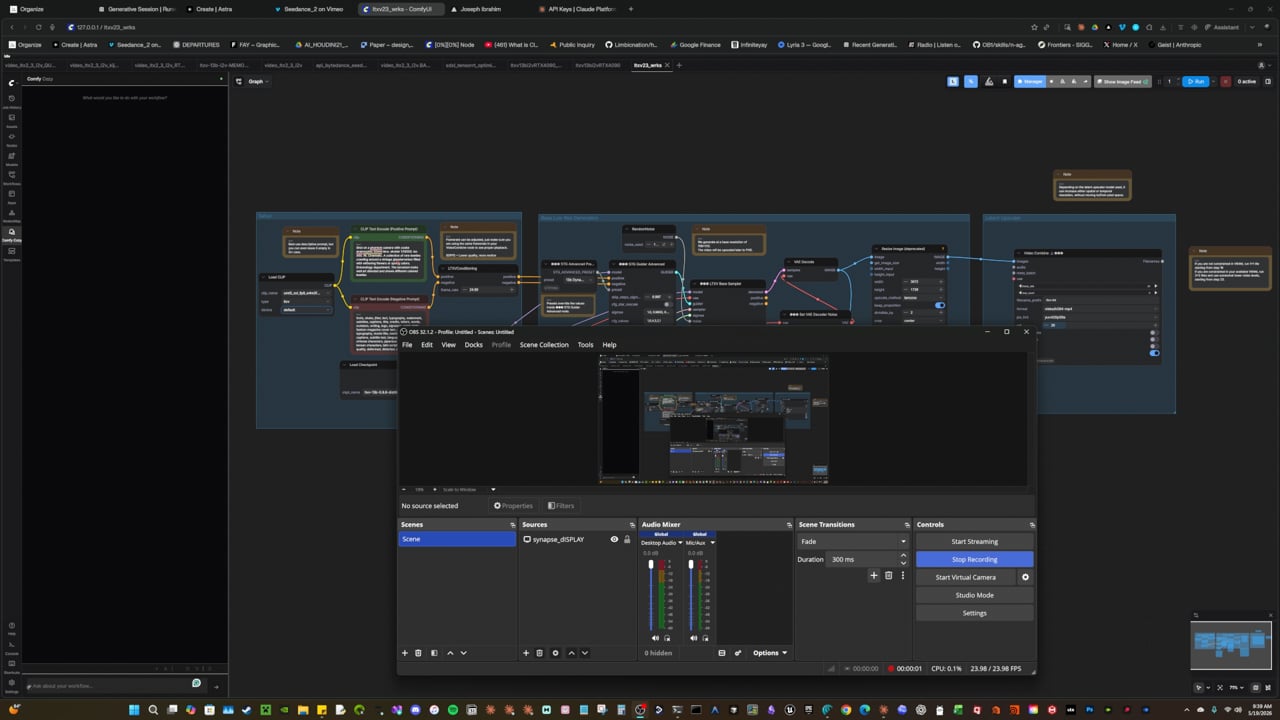
Demo 1 — overview
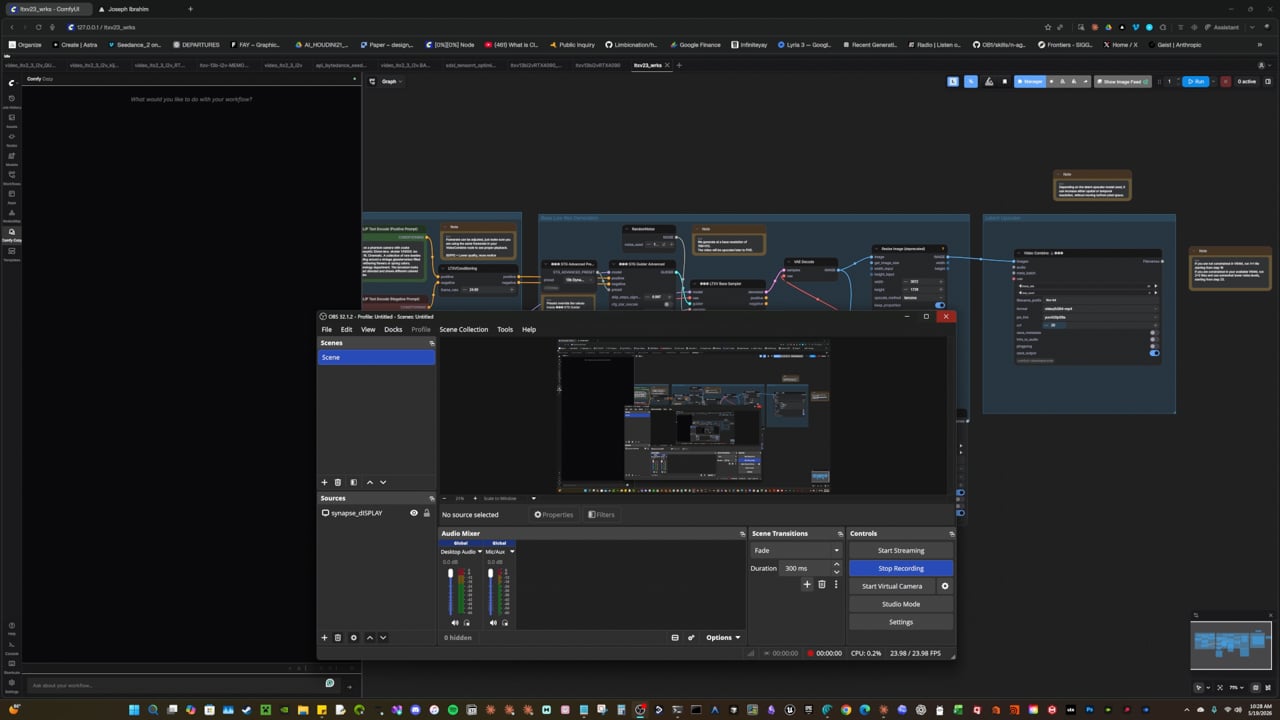
Demo 2 — walkthrough
See It In Action
| You say | What happens |
|---|---|
| "Load my portrait workflow and make it dreamier" | Loads the file, lowers CFG, switches sampler, saves with full undo |
| "I want to use Flux" | Searches CivitAI + HuggingFace, downloads the model on your go-ahead, wires it into your workflow |
| "Repair this workflow" | Finds missing nodes, shows you the packs it needs, installs them once you approve, fixes connections, migrates deprecated nodes |
| "Run this with 30 steps" | Patches the workflow, validates it, queues it to ComfyUI, shows progress |
| "Analyze this output" | Uses Vision AI to diagnose issues and suggest parameter changes |
| "What model should I use for anime?" | Searches CivitAI + HuggingFace + your local models, recommends the best fit |
| "Optimize this for speed" | Profiles GPU usage, checks TensorRT eligibility, applies optimizations |
| "Repair and run this" | Finds missing nodes, asks once to install the packs, validates, executes |
Sponsor This Project
Comfy Cozy is production software. 4,400+ tests (all mocked, runnable in under a minute) cover the 129 MCP tools that drive the workflow lifecycle end-to-end. Four LLM providers — Anthropic, OpenAI, Gemini, Ollama — sit behind a single abstraction with parity across all four. The CHANGELOG tracks active hardening and new work.
If Comfy Cozy saves you time inside ComfyUI, sponsorship is the most direct way to keep it moving.
Sponsorship funds:
- Continued development of the MCP agent layer
- Priority response on sponsor-filed issues
- New intelligence-layer tools — vision evaluators, provisioning, planning
A separate Pro tier with additional offerings is planned. Details when it's ready, not before.
Become a sponsor → · Acknowledgments
Get Running
flowchart LR
    A["Clone"] -->|30 sec| B["Install"]
    B -->|10 sec| C["Paste key"]
    C -->|done| D(["agent run"])

    classDef orange fill:#d99458,color:#1a1a1a,stroke:#1a1a1a
    classDef yellow fill:#d9c958,color:#1a1a1a,stroke:#1a1a1a
    class D orange
    class A,B,C yellow
Three prerequisites, four copy-paste steps. Under 2 minutes start to finish.
| What you need | Where to get it | Time | |
|---|---|---|---|
| 1 | Python 3.11+ | python.org/downloads | already have it? skip |
| 2 | ComfyUI running | github.com/comfyanonymous/ComfyUI | already have it? skip |
| 3 | One LLM backend | API key (Anthropic / OpenAI / Google) OR Ollama (free, local, no key) | 1 min to grab a key |
Already have all three? Copy-paste these four blocks. That's it.
1. Clone
git clone https://github.com/JosephOIbrahim/Comfy-Cozy.git
cd Comfy-Cozy
2. Install
pip install -e .
One command. No build step. No Docker. No conda. Just pip.
Want the test suite too? (optional, click to expand)
pip install -e ".[dev]"           # + 4,400+ passing tests
pip install -e ".[dev,stage]"     # + USD stage subsystem (~200MB, most users skip)
3. API key
cp .env.example .env
Open .env in any text editor, paste your key on the first line:
ANTHROPIC_API_KEY=sk-ant-your-key-here
Using OpenAI, Gemini, or Ollama instead? (click to expand)
Pick one block, paste into .env:
# --- OpenAI ---
LLM_PROVIDER=openai
OPENAI_API_KEY=sk-your-key-here
# first time only: pip install openai

# --- Gemini ---
LLM_PROVIDER=gemini
GEMINI_API_KEY=your-key-here
# first time only: pip install google-genai

# --- Ollama (fully local, free, no key) ---
LLM_PROVIDER=ollama
AGENT_MODEL=llama3.1
# first time only: ollama pull llama3.1
ComfyUI installed somewhere non-default? (click to expand)
Add one more line to .env:
COMFYUI_DATABASE=C:/path/to/your/ComfyUI
Step 4 of 4 -- Go
agent run
Type what you want. Type quit when you're done.
Connect the Sidebar to ComfyUI
The agent also lives inside ComfyUI as a native sidebar panel. To enable it, create two symlinks from ComfyUI's custom_nodes/ folder to Comfy-Cozy:
Windows (run as Administrator):
cd C:\path\to\ComfyUI\custom_nodes
mklink /D comfy-cozy-panel C:\path\to\Comfy-Cozy\panel
mklink /D comfy-cozy-ui C:\path\to\Comfy-Cozy\ui
Linux / macOS:
cd /path/to/ComfyUI/custom_nodes
ln -s /path/to/Comfy-Cozy/panel comfy-cozy-panel
ln -s /path/to/Comfy-Cozy/ui comfy-cozy-ui
Restart ComfyUI. The Comfy Cozy chat panel appears in the left sidebar.
graph LR
    CN["ComfyUI/custom_nodes/"] --> P["comfy-cozy-panel/ (symlink)"]
    CN --> U["comfy-cozy-ui/ (symlink)"]
    P -->|"canvas sync (headless)"| Panel["panel/__init__.py"]
    U -->|"sidebar + chat"| UI["ui/__init__.py"]

    classDef orange fill:#d99458,color:#1a1a1a,stroke:#1a1a1a
    classDef yellow fill:#d9c958,color:#1a1a1a,stroke:#1a1a1a
    class CN,U orange
    class P,sync,Panel,UI yellow
Both symlinks are required:
comfy-cozy-panel-- Canvas sync bridge (runs headlessly -- keeps the agent in sync with your live graph)comfy-cozy-ui-- The visible sidebar: chat window, quick actions, status
Optional: the Agent Bridge node pack (live canvas + render timing)
Want the agent to load workflows straight onto your canvas, see the edits you make by hand, and tell you exactly which node ate your render time? Install the one extra node pack. It's optional -- everything else works without it -- but it unlocks three things ComfyUI's stock API can't give the agent.
graph LR
    Agent[Comfy Cozy] -->|"push_workflow_to_canvas"| Push["POST /agent/push_workflow"]
    Push --> Canvas["Your ComfyUI canvas<br/>(every open tab reloads)"]
    Canvas -->|"you hand-edit a node"| Buf["POST /agent/canvas_changed"]
    Buf -->|"get_canvas_state"| Agent
    Render["Your render finishes"] -->|"per-node timing"| Prof["GET /agent/exec_profile/{id}"]
    Prof -->|"get_execution_profile"| Agent

    classDef orange fill:#d99458,color:#1a1a1a,stroke:#1a1a1a
    classDef yellow fill:#d9c958,color:#1a1a1a,stroke:#1a1a1a
    class Canvas,Render orange
    class Agent,Push,Buf,Prof yellow
What you get:
- "Load my portrait workflow onto the canvas" -- it appears in your browser, no file juggling
- "What did I just change?" -- the agent reads your hand edits back off the canvas
- "Why was that render slow?" -- real per-node timing, so optimization stops being guesswork
Install (one symlink, then restart):
Windows (run as Administrator):
cd C:\path\to\ComfyUI\custom_nodes
mklink /D comfy_agent_bridge C:\path\to\Comfy-Cozy\node_pack\comfy_agent_bridge
Linux / macOS:
cd /path/to/ComfyUI/custom_nodes
ln -s /path/to/Comfy-Cozy/node_pack/comfy_agent_bridge comfy_agent_bridge
Restart ComfyUI. You'll see comfy_agent_bridge: routes registered in the log -- that's it. If a bridge feature ever returns a "node pack not installed" message, it means ComfyUI needs a restart to pick the pack up.
Under the hood: these three routes are covered by a live contract test suite (
tests/integration/test_bridge_routes_integration.py) that boots against a real ComfyUI and asserts each route answers correctly -- so "installed but silently broken" can't slip through. Run it withpython -m pytest tests/integration/test_bridge_routes_integration.py -vwhile ComfyUI is running.
Pick Your LLM
Comfy Cozy is provider-agnostic. Same 129 tools, same streaming, same vision analysis -- swap one env var.
Anthropic (default)
# .env
ANTHROPIC_API_KEY=sk-ant-your-key-here

# Optional overrides (defaults shown):
#   AGENT_MODEL=claude-opus-4-7                  -- main loop
#   FAST_MODEL=claude-haiku-4-5-20251001         -- low-stakes triage
#   VISION_MODEL=claude-opus-4-7                 -- analyze/compare images
#   THINKING_BUDGET=4000                         -- agent reasoning budget (tokens)
#   VISION_THINKING_BUDGET=2000                  -- vision reasoning budget

# Run
agent run
Ships as the default with Opus 4.7 + extended thinking + three-tier prompt caching.
The agent runs on Opus 4.7 with a 4K reasoning budget; vision analysis (analyze_image,
compare_outputs, suggest_improvements) runs the same model with its own budget. Set
FAST_MODEL if you want to route triage / classification tools to Haiku 4.5.
OpenAI
# Install the SDK (one time)
pip install openai

# .env
LLM_PROVIDER=openai
OPENAI_API_KEY=sk-your-key-here
AGENT_MODEL=gpt-4o           # or gpt-4o-mini for faster/cheaper

# Run
agent run
Full tool-use support with streaming. Works with any OpenAI-compatible endpoint.
Google Gemini
# Install the SDK (one time)
pip install google-genai

# .env
LLM_PROVIDER=gemini
GEMINI_API_KEY=your-key-here
AGENT_MODEL=gemini-2.5-flash  # or gemini-2.5-pro

# Run
agent run
Function declarations mapped automatically. Supports Gemini's thinking mode.
Ollama (fully local, no API key)
# Install Ollama: https://ollama.com
# Pull a model
ollama pull llama3.1

# .env
LLM_PROVIDER=ollama
AGENT_MODEL=llama3.1          # or any model you've pulled

# Run (no API key needed)
agent run
Uses Ollama's OpenAI-compatible endpoint at localhost:11434. Override with OLLAMA_BASE_URL if running remotely. No data leaves your machine.
Architecture
All four providers share the same abstraction layer (agent/llm/):
graph LR
    Agent[Agent Loop<br/>129 tools] --> LLM{LLM_PROVIDER}
    LLM -->|anthropic| A["Claude<br/>Streaming + Cache"]
    LLM -->|openai| B["GPT-4o<br/>Tool Calls"]
    LLM -->|gemini| C["Gemini<br/>Function Decl."]
    LLM -->|ollama| D["Ollama<br/>Local + Private"]

    classDef orange fill:#d99458,color:#1a1a1a,stroke:#1a1a1a
    classDef yellow fill:#d9c958,color:#1a1a1a,stroke:#1a1a1a
    class B,D orange
    class Agent,A,C,LLM yellow
Common types (TextBlock, ToolUseBlock, LLMResponse), unified error hierarchy, provider-specific format conversion handled internally. Switch providers with one env var -- no code changes. All 4 providers have dedicated test suites (132 tests) plus a parameterized conformance suite that verifies protocol compliance across providers. Every stream() and create() call is instrumented with llm_call_total and llm_call_duration_seconds metrics (per-provider labels).
Reasoning + caching (Opus 4.7)
The Anthropic path uses two Opus-4.7-specific features the other providers ignore:
- Extended thinking. Every agent turn ships
thinking={"type": "enabled", "budget_tokens": THINKING_BUDGET}. The streamedThinkingBlocks include a cryptographicsignature; we capture it and replay it on the next turn so tool-use loops stay valid (without the signature, Anthropic 400s the next request). - Three-tier system prompt.
system_prompt.build_system_prompt_blocks()returns a list of cache blocks instead of one big string. Two blocks are markedcache_control: ephemeral; the third (volatile session context) is deliberately not cached. Combined with the last-tool cache pin, three of Anthropic's four cache breakpoints stay hot across a session.
flowchart TB
    classDef stable   fill:#d99458,stroke:#1a1a1a,color:#1a1a1a,stroke-width:1.2px
    classDef volatile fill:#d9c958,stroke:#d99458,color:#1a1a1a,stroke-width:1.2px

    subgraph SYS[" system prompt blocks "]
        b1["<b>Block 1 · stable prefix</b><br/>identity · paths · RULES<br/>+ comfyui_core.md<br/><i>cache_control: ephemeral</i>"]
        b2["<b>Block 2 · topical knowledge</b><br/>3d / flux / controlnet / video / ...<br/><i>cache_control: ephemeral</i>"]
        b3["<b>Block 3 · session tail</b><br/>notes · recommendations<br/>last-output context<br/><i>uncached</i>"]
    end

    subgraph TOOLS[" tools[] "]
        t1[tool 1]
        t2[tool 2]
        tN[... 100+ tools]
        tL["<b>last tool</b><br/><i>cache_control: ephemeral</i>"]
    end

    subgraph LOOP[" agent turn loop "]
        m1[messages · user input]
        think["<b>ThinkingBlock</b><br/>thinking text<br/>+ signature ✓"]
        tu[ToolUseBlock]
        tr[ToolResultBlock]
        api[(claude-opus-4-7<br/>thinking enabled)]
    end

    b1 --> api
    b2 --> api
    b3 --> api
    t1 --> api
    t2 --> api
    tN --> api
    tL --> api
    m1 --> api
    api --> think --> tu --> tr --> m1

    class b1,b2,tL stable
    class b3,t1,t2,tN,m1,think,tu,tr,api volatile
Tone key. Blue = blocks pinned in the prompt cache (the stable prefix, the
topical knowledge, and the last-tool breakpoint). Amber = the per-turn volatile
tail: session context, the message log, and the streaming agent loop itself.
Signature-bearing ThinkingBlocks are replayed verbatim on each turn so the
API accepts the next request.
Three Ways to Use It
A. Inside Claude Code / Claude Desktop (recommended)
The agent runs as an MCP server -- Claude can use all 129 tools directly.
Add this to your Claude Code or Claude Desktop MCP config:
{
  "mcpServers": {
    "comfyui-agent": {
      "command": "agent",
      "args": ["mcp"]
    }
  }
}
Now talk to Claude about your ComfyUI workflows. It has full access.
B. Standalone CLI
agent run                        # Start a conversation
agent run --session my-project   # Auto-saves so you can pick up later
agent run --verbose              # See what's happening under the hood
C. One-click launcher (ComfyUI + agent together)
If you use the ComfyUI CLI launcher (ComfyUI CLI.lnk), Comfy Cozy is the default mode:
[ 1 ]  STABLE          Balanced. Works with everything.
[ 2 ]  DETERMINISTIC   Same prompt = same pixels.
[ 3 ]  FAST            Sage attention + async offload.
[ 4 ]  COMFY COZY  *   Talk to your workflow. (auto-selects in 10s)
Select 4 (or wait 10 seconds) -- ComfyUI starts in a background window, then the agent launches ready to talk.
Handy CLI Commands (no API key needed)
agent inspect                    # See your installed models and nodes
agent parse workflow.json        # Analyze a workflow file
agent sessions                   # List your saved sessions
What the Agent Knows About Your Models
The agent ships with built-in knowledge about how each model family actually behaves. It won't use SD 1.5 settings on a Flux workflow.
| Model | Resolution | CFG | Notes |
|---|---|---|---|
| SD 1.5 | 512x512 | 7-12 | Huge LoRA ecosystem. Negative prompts matter. |
| SDXL | 1024x1024 | 5-9 | Better anatomy. Tag-based prompts work best. |
| Flux | 512-1024 | ~1.0 (guidance) | No negative prompts. Needs FluxGuidance node + T5 encoder. |
| SD3 | 1024x1024 | 5-7 | Triple text encoder (CLIP-G, CLIP-L, T5). |
| LTX-2 (video) | 768x512 | ~25 | 121 steps. Frame count must be (N*8)+1. |
| WAN 2.x (video) | 832x480 | 1-3.5 | Dual-noise architecture. 4-20 steps. |
The agent will never mix model families -- no SD 1.5 LoRAs on SDXL checkpoints, no Flux ControlNets on SD3.
Artist-Speak Translation
| You say | What the agent adjusts |
|---|---|
| "dreamier" or "softer" | Lower CFG (5-7), more steps, DPM++ 2M Karras |
| "sharper" or "crisper" | Higher CFG (8-12), Euler or DPM++ SDE |
| "more photorealistic" | CFG 7-10, realistic checkpoint, negative: "cartoon, anime" |
| "more stylized" | Lower CFG (4-6), artistic checkpoint or LoRA |
| "faster" | Fewer steps (15-20), LCM/Lightning/Turbo, smaller resolution |
| "higher quality" | More steps (30-50), hires fix, upscaler |
| "more variation" | Higher denoise, different seed, lower CFG |
| "less variation" | Lower denoise, same seed, higher CFG |
How It Works
graph TB
    subgraph Browser ["ComfyUI Browser"]
        Sidebar["Comfy Cozy Sidebar<br/>Native left panel -- Chat -- Quick Actions"]
    end
    subgraph Backend ["Agent Backend (Python)"]
        Routes["49 REST Routes<br/>+ WebSocket"]
        Tools["129 Tools<br/>workflow -- models -- vision -- session -- provision"]
        Engine["IAIEngine<br/>ComfyUIAdapter<br/>queue / interrupt / history / ws"]
        Cog["Cognitive Engine<br/>LIVRPS delta stack -- CWM -- experience"]
    end
    subgraph ComfyUI ["ComfyUI"]
        API["/prompt -- /history -- /ws"]
        Canvas["Live Canvas"]
    end
    subgraph Disk ["Persistence"]
        EXP[("experience.jsonl<br/>cross-session learning")]
        Sessions[("sessions/<br/>workflow state")]
    end

    Sidebar <-->|"WebSocket + REST"| Routes
    Sidebar <-->|"canvas sync"| Canvas
    Routes --> Tools
    Tools --> Cog
    Tools -->|execution path| Engine
    Engine -->|httpx + websockets| API
    Cog --> EXP
    Tools --> Sessions

    style Browser fill:#d9c958,color:#1a1a1a,stroke:#d99458
    style Backend fill:#d9c958,color:#1a1a1a,stroke:#d99458
    style ComfyUI fill:#d9c958,color:#1a1a1a,stroke:#d99458
    style Disk fill:#d9c958,color:#1a1a1a,stroke:#d99458

    classDef orange fill:#d99458,color:#1a1a1a,stroke:#1a1a1a
    classDef yellow fill:#d9c958,color:#1a1a1a,stroke:#1a1a1a
    class Engine orange
    class Sidebar,Routes,Tools,Cog,API,Canvas,EXP,Sessions yellow
graph LR
    You([You]) --> Agent[129 Tools]
    Agent --> Understand[UNDERSTAND<br/>What do you have?]
    Understand --> Discover[DISCOVER<br/>What do you need?]
    Discover --> Pilot[PILOT<br/>Make the changes]
    Pilot --> Verify[VERIFY<br/>Did it work?]
    Verify -->|learn| Agent

    classDef orange fill:#d99458,color:#1a1a1a,stroke:#1a1a1a
    classDef yellow fill:#d9c958,color:#1a1a1a,stroke:#1a1a1a
    class You,Verify orange
    class Understand,Discover,Pilot,Agent yellow
Four phases, always in order:
- UNDERSTAND -- Reads your workflow, scans your models, checks what's installed
- DISCOVER -- Searches CivitAI, HuggingFace, ComfyUI Manager (31k+ nodes)
- PILOT -- Makes changes through safe, reversible delta layers (never edits your original)
- VERIFY -- Runs the workflow, checks the output, records what worked
When validation finds errors, the agent auto-repairs. Workflow fixes flow without stopping; installing missing packs pauses exactly once for your go-ahead:
flowchart TD
    Run(["You: 'run this'"]) --> Validate["validate_before_execute"]
    Validate --> Check{"Errors?"}
    Check -->|No| Execute["execute_workflow"]
    Check -->|"Missing nodes"| Repair["repair_workflow<br/>identifies the packs"]
    Check -->|"Missing inputs"| SetInput["set_input<br/>fill required fields"]
    Check -->|"Wrong model name"| Discover["discover<br/>find correct model"]
    Repair --> Confirm{"Pack list shown —<br/>you approve?"}
    Confirm -->|"yes → confirm=true"| Install["install packs"]
    Confirm -->|no| Report
    Install --> Revalidate["re-validate"]
    SetInput --> Revalidate
    Discover --> SetInput
    Revalidate --> Check2{"Still errors?"}
    Check2 -->|No| Execute
    Check2 -->|Yes| Report["Report unfixable<br/>issue + ask"]
    Execute --> Done(["Done — image ready"])

    classDef orange fill:#d99458,color:#1a1a1a,stroke:#1a1a1a
    classDef yellow fill:#d9c958,color:#1a1a1a,stroke:#1a1a1a
    class Run,Execute,Done,Report orange
    class Validate,Repair,Confirm,Install,SetInput,Discover,Check,Revalidate,Check2 yellow
Every change is undoable. Every generation teaches the agent something. The agent is a doer, not a describer -- say "wire the model" and it wires the model. Say "run it" and it validates, fixes anything broken, then executes. Workflow edits never stop to ask. The deliberate exception is anything that pulls code or files onto your machine: repair_workflow, install_node_pack, and download_model first return needs_confirmation with the list of what they want to fetch, and only proceed when re-called with confirm=true after you say yes. Under the hood, the repair path reads the live find_missing_nodes contract directly, and a cross-module seam test (tests/test_seam_repair_discover.py) runs the real discovery producer against the real repair consumer so the two can never silently drift apart. Execution has its own seatbelt: once you've changed the session workflow, the safety gate denies execute_workflow until a fresh validate_before_execute passes (running an explicit file path is exempt -- the session flag says nothing about an external file).
Event Triggers
Register callbacks (or webhooks) that fire automatically when ComfyUI events happen. Built into the execution pipeline -- no polling.
flowchart LR
    WS["ComfyUI<br/>WebSocket"] -->|event| Parse["ExecutionEvent<br/>.from_ws_message()"]
    Parse --> Dispatch["TriggerRegistry<br/>.dispatch()"]
    Dispatch --> CB1["on_complete<br/>→ auto-evaluate"]
    Dispatch --> CB2["on_error<br/>→ log to session"]
    Dispatch --> CB3["on_progress<br/>→ custom callback"]
    Dispatch --> WH["Webhook<br/>→ POST JSON to URL"]

    classDef orange fill:#d99458,color:#1a1a1a,stroke:#1a1a1a
    classDef yellow fill:#d9c958,color:#1a1a1a,stroke:#1a1a1a
    class WS,CB1,CB3,WH orange
    class Parse,Dispatch,CB2,from_ws_message,dispatch yellow
from cognitive.transport.triggers import on_execution_complete, register_webhook

# Python callback
on_execution_complete(lambda event: print(f"Done in {event.elapsed:.1f}s"))

# External webhook (POSTs JSON on every execution_complete + execution_error)
register_webhook("https://your-server.com/hook", ["execution_complete", "execution_error"])
Autonomous Mode
Write a creative intent. Hit go. No workflow file needed, no parameters to tune -- the agent composes a workflow, runs it on ComfyUI, scores the result, and learns from it automatically.
flowchart TD
    You(["Creative Intent<br/>'cinematic portrait, golden hour'"]) --> INTENT["INTENT<br/>Parse + validate"]
    INTENT --> COMPOSE["COMPOSE<br/>Load template<br/>Blend with experience"]
    COMPOSE --> PROVISION{"PROVISION CHECK<br/>Models on disk?"}
    PROVISION -->|"missing"| WARN["Warning logged<br/>(continues)"]
    PROVISION -->|"all present"| PREDICT
    WARN --> PREDICT["PREDICT<br/>CWM estimates quality<br/>(SNR-adaptive alpha)"]
    PREDICT --> GATE{"GATE<br/>Arbiter:<br/>proceed?"}
    GATE -->|Yes| CB{"CIRCUIT BREAKER<br/>ComfyUI healthy?"}
    GATE -->|Interrupt| STOP(["Interrupted<br/>+ reason"])
    CB -->|Open| FAIL(["Failed: infra down"])
    CB -->|Closed| EXECUTE["EXECUTE<br/>Post to ComfyUI<br/>Monitor WebSocket"]
    EXECUTE --> EVALUATE["EVALUATE<br/>Vision AI or rule-based<br/>(auto-wired)"]
    EVALUATE --> LEARN["LEARN<br/>Record to accumulator<br/>Recalibrate CWM"]
    LEARN --> DONE(["Complete<br/>Experience recorded"])
    EVALUATE -->|"score < threshold<br/>retries remaining"| CB

    classDef orange fill:#d99458,color:#1a1a1a,stroke:#1a1a1a
    classDef yellow fill:#d9c958,color:#1a1a1a,stroke:#1a1a1a
    class You,CB,EXECUTE,DONE orange
    class GATE,EVALUATE,LEARN,STOP,FAIL,PROVISION,INTENT,COMPOSE,WARN,PREDICT yellow
Use from Python:
from cognitive.pipeline import create_default_pipeline, PipelineConfig

pipeline = create_default_pipeline()   # fresh accumulator, CWM, arbiter
result = pipeline.run(PipelineConfig(
    intent="cinematic portrait, golden hour",
    model_family="SD1.5",              # optional -- agent detects from intent
))
print(result.success, result.quality.overall, result.stage.value)
if result.warnings:
    print("warnings:", result.warnings)  # e.g. template family fallback
- No executor required. The pipeline calls ComfyUI directly via the real
execute_workflowimplementation. - Vision evaluator auto-wires. Set
brain_available=Trueand the pipeline auto-imports VisionAgent for multi-axis quality scoring (technical, aesthetic, prompt adherence). Falls back to rule-based scoring when vision is unavailable. - Auto-retry on low quality. If score < threshold, adjusts parameters (steps +10, CFG nudged toward 7), and re-executes. Up to 3 attempts. Circuit breaker prevents retrying against a dead ComfyUI.
- Provision check. Before execution, scans for referenced models (
ckpt_name,lora_name,vae_name). Missing models generate warnings without halting. - Template library. 8 workflows: txt2img (SD 1.5 / SDXL), img2img, LoRA, multi-pass compositing (depth + normals + beauty), ControlNet depth, LTX-2 video, WAN 2.x video. Hardcoded SD 1.5 fallback if no template matches.
- Adaptive learning. CWM alpha blending responds to signal quality -- low variance in experience = more trust, high variance = more prior. Recalibrator adjusts confidence thresholds after every 10 predictions.
- Experience persists across sessions -- crash-safe. Every run saved atomically (write-to-tmp then
os.replace()). After 30+ runs, the agent starts using your personal history to bias parameter selection. - Pipeline failures are graceful. Circuit breaker, CWM exceptions, and template mismatches all produce clean
PipelineStage.FAILEDwithresult.warnings.
graph LR
    subgraph Session1 ["Session 1"]
        I1["Intent"] --> C1["Compose"] --> E1["Execute"] --> S1["Score"]
    end
    subgraph Session2 ["Session 2+"]
        I2["Intent"] --> C2["Compose<br/>(+prior runs)"] --> E2["Execute"] --> S2["Score"]
    end
    S1 -->|"atomic save"| JSONL[("experience.jsonl<br/>crash-safe")]
    JSONL -->|"load on startup"| C2
    S2 -->|"atomic save -- cumulative"| JSONL

    classDef orange fill:#d99458,color:#1a1a1a,stroke:#1a1a1a
    classDef yellow fill:#d9c958,color:#1a1a1a,stroke:#1a1a1a
    class C2 orange
    class JSONL,Session1,I1,C1,E1,S1,Session2,I2,E2,S2 yellow
Cozy Constitution + MoE Chain
The pipeline above runs as one shot per intent. For long-running, self-healing autonomy across many experiments, Cozy adds two things on top: a constitutional MoE specialist team and a bounded-failure ladder. Doctrine lives in .claude/COZY_CONSTITUTION.md. Specialists are in .claude/agents/cozy-*.md. Code in agent/stage/constitution.py (commandments + classifier), agent/stage/moe_profiles.py (specialists + chain), and agent/harness/cozy_loop.py (the runner).
MoE chain -- Article II of the constitution mandates that every state-mutating chain ends in Scribe. Each specialist owns one concern and produces one typed handoff artifact. The chain dispatcher (agent/stage/moe_dispatcher.py) routes by TASK_CHAINS; the default chain shown below is the full build-execute-judge-persist sequence.
flowchart LR
    Intent(["Intent<br/>'cinematic portrait'"]) --> Scout
    Scout["Scout<br/>recon: nodes,<br/>models, interfaces"] -->|recon_report| Architect
    Architect["Architect<br/>plan: params,<br/>graph structure"] -->|design_spec| Provisioner
    Provisioner["Provisioner<br/>fetch missing<br/>models / packs"] -->|provision_manifest| Forge
    Forge["Forge<br/>validated<br/>RFC6902 patches"] -->|build_artifact| Crucible
    Crucible["Crucible<br/>execute + verify<br/>(comfy_execute)"] -->|execution_result| Vision
    Vision["Vision<br/>judge quality<br/>(analyze_image)"] -->|quality_report| Scribe
    Scribe["Scribe<br/>save_session +<br/>record_experience"] -->|persistence_receipt| Done(["Stage flushed"])

    classDef orange fill:#d99458,color:#1a1a1a,stroke:#1a1a1a
    classDef yellow fill:#d9c958,color:#1a1a1a,stroke:#1a1a1a
    class Intent,Scout,Architect,Provisioner,Forge,Crucible,Vision,Scribe,Done yellow
Self-healing ladder -- Article III mandates that every error gets classified once by self_healing_ladder() and routed to one of three policies. TERMINAL is the only path that halts; everything else burns iteration budget and continues. This is what makes a 24-hour autonomous run survivable: ComfyUI hiccups, missing assets, and rate-limit blips never stop the loop.
flowchart TD
    Try["execute_fn(change_context)"] -->|success| Ratchet[Ratchet decides keep/reject]
    Try -->|exception| Class["self_healing_ladder<br/>classify(error)"]
    Class -->|"TRANSIENT<br/>timeout, 5xx,<br/>ConnectionError"| Backoff["Exponential backoff<br/>1s → 2s → 4s<br/>(max 3 retries)"]
    Backoff --> Try
    Class -->|"RECOVERABLE<br/>FileNotFoundError,<br/>validation"| Repair{repair_fn<br/>provided?}
    Repair -->|yes, returns ctx| Try
    Repair -->|no / returns None| Counter["Signature counter +1<br/>(>3 same sig →<br/>promote to TERMINAL)"]
    Class -->|"TERMINAL<br/>AnchorViolation,<br/>disk-full,<br/>repeated-recoverable"| Halt["Final checkpoint<br/>+ BLOCKER.md<br/>+ Halt"]

    classDef orange fill:#d99458,color:#1a1a1a,stroke:#1a1a1a
    classDef yellow fill:#d9c958,color:#1a1a1a,stroke:#1a1a1a
    class Try,execute_fn,Ratchet,Class,classify,Backoff,Repair,Counter,Halt yellow
Run it: agent autonomous --execute-mode real --workflow path/to/wf.json --hours 24. Per-iteration checkpoint to STAGE_DEFAULT_PATH (atomic via .tmp + os.replace). On TERMINAL halt, BLOCKER.md is written with the full classification trail. See CLAUDE.md "Cozy Autonomous Harness" for the full CLI surface.
Comfy Cozy Sidebar (Native ComfyUI Integration)
A typography-forward chat panel in ComfyUI's native left sidebar. No floating buttons, no separate windows. Uses ComfyUI's own CSS variables -- adapts to any theme automatically.
graph TB
    subgraph ComfyUI_App ["ComfyUI"]
        subgraph Sidebar ["Left Sidebar"]
            Tab["Comfy Cozy Tab<br/>registerSidebarTab()"]
            Chat["Chat Window<br/>WebSocket -- streaming -- rich text"]
            QA["Quick Actions<br/>Run -- Validate -- Repair -- Optimize -- Undo"]
        end
        Canvas["Canvas"]
    end

    subgraph Bridge ["Bidirectional Canvas Bridge"]
        C2A["Canvas --> Agent<br/>Auto-sync on change"]
        A2C["Agent --> Canvas<br/>Push mutations + highlights"]
    end

    Tab --> Chat
    Tab --> QA
    Sidebar <--> Bridge
    Bridge <--> Canvas

    style ComfyUI_App fill:#d9c958,color:#1a1a1a,stroke:#d99458
    style Sidebar fill:#d9c958,color:#1a1a1a,stroke:#d99458
    style Bridge fill:#d9c958,color:#1a1a1a,stroke:#d99458

    classDef orange fill:#d99458,color:#1a1a1a,stroke:#1a1a1a
    classDef yellow fill:#d9c958,color:#1a1a1a,stroke:#1a1a1a
    class Tab,registerSidebarTab,Chat,QA,Canvas,C2A,A2C yellow
What you get:
- Native sidebar tab --
app.extensionManager.registerSidebarTab(), sits alongside ComfyUI's built-in panels - Design system v3 -- Inter + JetBrains Mono, ComfyUI CSS variables, Pentagram-inspired: hairline borders, generous whitespace, 2px radii, zero ornamentation
- Chat -- Auto-growing textarea, streaming responses, rich text (code blocks, bold, inline code), collapsible tool results
- Node pills -- Clickable inline node references, color-coded by slot type. Click = select + center on canvas.
- Quick actions -- Context-aware chips: Run, Validate, Repair, Optimize, Undo
- Canvas bridge -- Agent changes sync to canvas live with node highlighting; canvas re-syncs after each execution
- Self-healing -- Missing node warnings with one-click repair, deprecated node migration
51 panel routes expose the full tool surface: discovery, provisioning, repair, sessions, execution. (Write-back v1 added /get-workflow-api-with-touched and /ack-push to the existing 49.)
Every request passes through a three-layer security chain:
flowchart TD
    REST([REST Request]) --> Guard["_guard(request, category)"]
    WS([WebSocket /ws]) --> Guard
    Guard --> Auth{check_auth}
    Auth -->|"no token configured"| Rate{check_rate_limit}
    Auth -->|"bearer matches"| Rate
    Auth -->|"missing / wrong"| R401(["401 Unauthorized"])
    Rate -->|"tokens available"| Size{check_size}
    Rate -->|"bucket empty"| R429(["429 -- Retry-After: 1s"])
    Size -->|"Content-Length OK"| Handler(["Route handler"])
    Size -->|"> 10 MB"| R413(["413 Too Large"])
    Size -->|"chunked -- no length"| R411(["411 Length Required"])

    classDef orange fill:#d99458,color:#1a1a1a,stroke:#1a1a1a
    classDef yellow fill:#d9c958,color:#1a1a1a,stroke:#1a1a1a
    class R401,R413,Handler orange
    class R429,R411,Guard,REST,_guard,WS,Auth,Rate,Size yellow
Write-back v1 -- touched-set push to the live canvas
The canvas bridge is bidirectional. The canvas → agent direction has worked since launch (the panel POSTs the live graph to the agent on every change). The agent → canvas direction shipped Tier 1 only -- widget edits -- and silently dropped every link the agent emitted (panel/web/js/superduperPanel.js:89-92, :106 pre-v1). Write-back v1 closes that gap with a touched-set delta-merge.
flowchart LR
    Event["comfy-cozy:workflow-changed<br/>(agent mutated cache)"] --> Debounce["debounce(100ms)<br/>coalesce burst events"]
    Debounce --> Run["runPushAgentToCanvas<br/>(_pushOrchestrator.js)"]
    Run --> Clear["clearDeltaFailures<br/>(L-7 lifecycle)"]
    Clear --> Fetch["GET /comfy-cozy/<br/>get-workflow-api-with-touched<br/>→ {workflow, touched}"]
    Fetch --> Pause["withObserverPause<br/>(L-6 try/finally<br/>+ refcount)"]
    Pause --> Apply["applyTouchedSet<br/>iterate touched ONLY"]
    Apply --> Kind{"entry.kind"}
    Kind -->|widget| W["widget.value = new_value"]
    Kind -->|link| L["fromNode.connect /<br/>toNode.disconnectInput"]
    Kind -->|"Tier-3 / stale /<br/>missing / malformed"| S["addDeltaFailure<br/>(P3 surface)"]
    W --> Dirty["app.canvas.setDirty"]
    L --> Dirty
    S --> Dirty
    Dirty --> Restore["observer restored<br/>(finally)"]
    Restore --> Ack["POST /comfy-cozy/ack-push<br/>(rotates server snapshot)"]

    classDef orange fill:#d99458,color:#1a1a1a,stroke:#1a1a1a
    classDef yellow fill:#d9c958,color:#1a1a1a,stroke:#1a1a1a
    class W,L,Dirty,Restore,Ack orange
    class Event,Debounce,Run,Clear,Fetch,Pause,Apply,Kind,S yellow
F-1 mitigation -- touched-set diff. The push iterates a server-computed touched-set (the diff between the agent's current cache and the last successfully-pushed snapshot) instead of the full workflow. Untouched canvas slots are never read or written -- director hand-edits on neighbour nodes survive every push, by construction.
flowchart LR
    Load["/load-workflow-data<br/>(canvas-sync POST)"] -->|"record_last_pushed"| Snap[("snapshot:<br/>last-pushed workflow<br/>panel/server/touched.py")]
    Agent["agent mutation<br/>(connect_nodes / set_input)"] -->|"updates"| Cache[("server cache:<br/>current_workflow")]
    Cache --> Diff["compute_touched<br/>= diff(cache, snapshot)"]
    Snap --> Diff
    Diff --> Touched["touched = [<br/>  {node_id, input_name,<br/>   kind, old, new}<br/>]<br/>= what the AGENT changed"]
    Director["director hand-edits<br/>node 5 cfg = 8.0"] -.->|"never iterated<br/>by frontend push"| Survives["node 5 survives<br/>(P2 / F-1 closed)"]
    Touched -->|"push touched only"| Survives

    classDef orange fill:#d99458,color:#1a1a1a,stroke:#1a1a1a
    classDef yellow fill:#d9c958,color:#1a1a1a,stroke:#1a1a1a
    class Survives orange
    class Load,Snap,Agent,Cache,Diff,Touched,Director yellow
P3 surface -- no silent drops. Every emitted delta is either applied or routed to the panel's status bar as a "N delta(s) not applied" warning with a Details modal listing each entry. Six categories surface:
| Type | Trigger | Action |
|---|---|---|
tier3_add |
server workflow has a node the canvas doesn't | surface only -- Tier 3 deferred per SPEC |
tier3_delete |
canvas has a node the server doesn't | surface only |
stale_node_ref |
touched references a node not on canvas (and not in workflow) | surface only |
missing_slot |
node found, but input / widget name doesn't match | surface only |
malformed |
unparseable node id, unknown kind, or non-conforming shape | surface only |
link_rejected |
LiteGraph's connect / disconnectInput returned false |
surface only |
Echo + concurrency. withObserverPause is module-level refcounted, so the push pauses app.graph.onAfterChange exactly once even under nested / overlapping invocations and restores in finally -- no echo back into the agent (P4), no observer leak (F-4), no concurrent-push race (F-5).
Verifier stack. 111 tests guard the contract -- 24 pytest cases for the server-side touched-set module + 87 Vitest cases across seven JS test files (unit, property, integration, stress, pipeline orchestrator, surface accumulator, stubs). See harness/SHIP_REPORT.md for predicate-by-predicate evidence and harness/CAPSULE.md for the F-1..F-8 verification status table.
npm install --include=dev          # one-time -- pulls Vitest
npm test                            # 87 Vitest cases (~250ms)
python -m pytest tests/test_touched.py -v   # 24 pytest cases
One-Click Model Provisioning
The agent handles the entire pipeline from "I want Flux" to a wired workflow:
flowchart LR
    Search["Search<br/>CivitAI + HF + Registry"] --> Confirm["Your go-ahead<br/>(what + where shown)"]
    Confirm --> Download["Download<br/>to correct folder"]
    Download --> Verify["Verify<br/>family + compat"]
    Verify --> Wire["Auto-Wire<br/>find loader -- set input"]
    Wire --> Ready["Ready to<br/>Queue"]

    classDef orange fill:#d99458,color:#1a1a1a,stroke:#1a1a1a
    classDef yellow fill:#d9c958,color:#1a1a1a,stroke:#1a1a1a
    class Verify,Ready orange
    class Search,Confirm,Download,Wire yellow
provision_model -- one tool call that discovers, downloads, verifies compatibility, finds the right loader node in your workflow, and wires the model in. Downloads escalate through the safety gate: the agent shows you what it's about to fetch and waits for your confirmation before anything hits disk.
NVIDIA NIM Containers (preflight → run → warm state)
Running Flux through NVIDIA's NIM microservice nodes instead of a raw checkpoint? Three tools manage the lifecycle -- built around one hard-won fact: a cold NIM container pull can sit silent for many minutes and still be perfectly healthy.
flowchart LR
    Pre["nim_preflight<br/>pack? VRAM? warm?<br/>ComfyUI alive?"] --> Run["nim_run<br/>queue install → load → generate"]
    Run --> Warm["WARMUP<br/>cold pull ≤ 15 min<br/>silence ≠ failure"]
    Warm --> Cook["COOKING<br/>separate inference deadline"]
    Cook --> Done(["Images +<br/>warm state recorded"])
    Done -.->|"nim_state reads it<br/>next session"| Pre

    classDef orange fill:#d99458,color:#1a1a1a,stroke:#1a1a1a
    classDef yellow fill:#d9c958,color:#1a1a1a,stroke:#1a1a1a
    class Done orange
    class Pre,Run,Warm,Cook yellow
nim_preflight-- read-only readiness probe: NIM node pack present, free VRAM, warm state, ComfyUI alive. Run it first; it never changes anything.nim_run-- queues the NIM workflow (its install → load → generate nodes) on the live execution engine and watches it with two separate deadlines: a warm-up budget (15 min cold, 3 min if the container image is already pulled) so the silent pull doesn't read as a failure, then a fresh inference budget once cooking starts.nim_state-- reads the newest warm-state record for a model on this host (valid for 24 h), so the agent knows whether your next run pays the cold-pull tax or starts hot.
The safety gate classifies these like everything else: nim_preflight and nim_state are read-only; nim_run is execution-class, same as execute_workflow.
Architecture Deep Dive (click to expand)
Seven Structural Subsystems
The agent is built on seven architectural subsystems. Each one degrades independently -- if one breaks, the rest keep working.
graph TB
    subgraph Foundation ["Foundation Layer"]
        DAG["Workflow Intelligence DAG<br/>6 pure computation nodes"]
        OBS["Time-Sampled State<br/>Monotonic step index"]
        CAP["Capability Registry<br/>129 tools indexed"]
    end

    subgraph Safety ["Safety Layer"]
        GATE["Pre-Dispatch Gate<br/>5 checks, default-deny"]
        BRIDGE["Mutation Bridge<br/>LIVRPS composition + audit"]
    end

    subgraph Integration ["Integration Layer"]
        ADAPT["Inter-Module Adapters<br/>Pure-function translators"]
        DEGRADE["Degradation Manager<br/>Per-subsystem fallbacks"]
    end

    Foundation --> Safety --> Integration

    style Foundation fill:#d9c958,color:#1a1a1a,stroke:#d99458
    style Safety fill:#d9c958,color:#1a1a1a,stroke:#d99458
    style Integration fill:#d9c958,color:#1a1a1a,stroke:#d99458

    classDef orange fill:#d99458,color:#1a1a1a,stroke:#1a1a1a
    classDef yellow fill:#d9c958,color:#1a1a1a,stroke:#1a1a1a
    class DAG,OBS,CAP,GATE,BRIDGE,ADAPT,DEGRADE yellow
Workflow Intelligence DAG
Before any workflow runs, a DAG of pure functions analyzes it:
graph LR
    C[Complexity<br/>TRIVIAL to EXTREME] --> M[Model Requirements<br/>VRAM, family, LoRAs]
    M --> O[Optimization<br/>TensorRT, batching]
    O --> R[Risk<br/>SAFE to BLOCKED]
    R --> RD[Readiness<br/>go / no-go]

    classDef orange fill:#d99458,color:#1a1a1a,stroke:#1a1a1a
    classDef yellow fill:#d9c958,color:#1a1a1a,stroke:#1a1a1a
    class R,RD orange
    class C,M,O yellow
Pre-Dispatch Safety Gate
Every tool call passes through a default-deny gate. Read-only tools bypass it (zero overhead). Destructive tools are always locked. The gate auto-detects loaded workflows AND USD stages: if either kind of workspace state exists for the current connection, mutation tools are allowed without explicit session context. Stage tools (stage_write, stage_add_delta) are recognized separately from workflow tools — a USD stage can exist independently of any loaded workflow.
The gate runs on live state, not defaults. The real ComfyUI circuit-breaker state feeds the system-health check, and a per-session action history (the last 50 dispatched calls) feeds the constitution checks. Every one of the 129 dispatched tools carries an explicit risk classification — a completeness test (tests/test_gate_completeness.py) pins the registry so a new tool can't ship unclassified. And the gate fails closed: if the gate package itself can't import, every tool is denied until it can (it used to degrade silently, which meant ungated dispatch). One more consent rule rides on the same checks: after any workflow mutation, execute_workflow / execute_with_progress on the session workflow are denied until a validate_before_execute passes — validate, then run, enforced by the gate itself. (Executing an explicit file path is exempt; the session flag says nothing about an external file.)
flowchart LR
    Tool([Tool Call]) --> Gate{"Gate\nimports?"}
    Gate -->|"No — fail closed"| Closed["Denied:\ngate unavailable"]
    Gate -->|Yes| Type{"Stage\ntool?"}
    Type -->|No| WF{"Workflow\nloaded?"}
    Type -->|Yes| ST{"Stage\nexists?"}
    WF -->|Yes| Risk{Risk Level?}
    WF -->|No| Deny["Denied:\nno active session"]
    ST -->|Yes| Risk
    ST -->|No| Deny
    Risk -->|"Read-only"| Pass[Pass through]
    Risk -->|"Mutation / Execute"| Checks["5 safety checks\nlive breaker + history"]
    Risk -->|"Install / Download"| Escalate["Needs your\nconfirmation"]
    Risk -->|"Uninstall / Delete"| Block[Blocked]

    Checks --> OK{All pass?}
    OK -->|Yes| Go[Execute]
    OK -->|No| Stop[Denied + reason]

    classDef orange fill:#d99458,color:#1a1a1a,stroke:#1a1a1a
    classDef yellow fill:#d9c958,color:#1a1a1a,stroke:#1a1a1a
    class Pass,Go,Stop,Block,Deny,Closed orange
    class Escalate,Tool,Gate,Type,WF,ST,Risk,Checks,OK yellow
Per-Connection Session Isolation (all 4 transports)
Every sidebar conversation, every panel chat, every MCP client connection, and every agent run --session foo invocation gets its own isolated WorkflowSession + CognitiveWorkflowStage. State never leaks across tabs, clients, or named sessions. Isolation is propagated via a single _conn_session ContextVar set at every entry point — and by the per-session dicts inside the four stage modules (provision, foresight, compositor, hyperagent).
flowchart LR
    SB["Sidebar tabs<br/>conv.id"] --> H1["_spawn_with_session<br/>(shared helper)"]
    PNL["Panel chats<br/>conv.id"] --> H1
    MCP["MCP clients<br/>conn_xxxxxxxx"] --> H2["mcp_server._handler<br/>sets _conn_session"]
    CLI["agent run --session foo<br/>(CLI)"] --> H3["cli.run<br/>+ _save_and_exit"]
    H1 --> CV[("_conn_ctx<br/>ContextVar")]
    H2 --> CV
    H3 --> CV
    CV --> WP["workflow_patch._get_state()"]
    CV --> ST["stage_tools._get_stage()"]
    CV --> FT["foresight_tools._get_*()"]
    CV --> PV["provision_tools._get_provisioner()"]
    CV --> CT["compositor_tools._scenes[sid]"]
    CV --> HY["hyperagent_tools._meta_agents[sid]"]
    WP --> WS[("Per-session<br/>WorkflowSession + Stage")]
    ST --> WS
    FT --> WS
    PV --> WS
    CT --> WS
    HY --> WS

    classDef orange fill:#d99458,color:#1a1a1a,stroke:#1a1a1a
    classDef yellow fill:#d9c958,color:#1a1a1a,stroke:#1a1a1a
    class WS orange
    class CV,WP,ST,FT,PV,CT,HY,SB,H1,PNL,MCP,H2,CLI,H3,_get_state,_get_stage,_get_provisioner,_scenes,_meta_agents yellow
The same connection id is also installed as the per-thread correlation ID via set_correlation_id, so every log entry from a single conversation is greppable end-to-end. Parallel tool calls inside a single turn inherit the contextvar via contextvars.copy_context() per ThreadPoolExecutor.submit(). And _save_and_exit() (called on normal exit, atexit, or SIGTERM) self-sets the contextvar before saving so the user's named session never gets corrupted with empty default workflow state.
LIVRPS -- How Conflicts Get Resolved
All workflow changes are non-destructive layers. When two opinions conflict:
| Priority | Layer | Example |
|---|---|---|
| 6 (strongest) | Safety | "CFG above 30 is degenerate" -- always wins |
| 5 | Local (your edit) | "Set CFG to 9" |
| 4 | Inherits (experience) | "CFG 7.5 worked better last time" |
| 3 | VariantSets | Creative profile presets |
| 2 | References | Learned recipes |
| 1 (weakest) | Payloads | Default template values |
Your edit beats experience. Safety beats everything. Every conflict is deterministic, transparent, and reversible.
This is an intentional inversion of USD's native LIVRPS (where Specializes is weakest). Safety is promoted to strongest for safety-critical override -- the architectural decision documented in the patent application.
Cognitive State Engine (Phase 0.5 -- live in production)
LIVRPS is no longer a table on a slide. Since Phase 0.5 the engine is a real top-level package (cognitive/) installed alongside agent/, and agent/tools/workflow_patch.py imports it directly at module load -- no try/except, no silent fallback. Every PILOT mutation is recorded as a delta layer with SHA-256 tamper detection, then resolved on demand. The engine is session-scoped via the _conn_session ContextVar described above, so each sidebar tab and MCP connection mutates its own delta stack.
graph LR
    User([Tool Call<br/>via MCP]) --> WP["agent/tools/<br/>workflow_patch.py"]
    WP -->|"_get_state() reads<br/>_conn_session ContextVar"| CGE["CognitiveGraphEngine<br/>(per-session)"]
    CGE --> Stack["Delta Stack<br/>P -- R -- V -- I -- L -- S"]
    Stack -->|"sort weakest to strongest<br/>apply, preserve link arrays"| Resolved["Resolved WorkflowGraph"]
    Resolved -->|"to_api_json()"| Comfy["ComfyUI /prompt"]

    classDef orange fill:#d99458,color:#1a1a1a,stroke:#1a1a1a
    classDef yellow fill:#d9c958,color:#1a1a1a,stroke:#1a1a1a
    class User,Resolved,Comfy orange
    class WP,CGE,Stack,_get_state,to_api_json yellow
The cognitive/ package is layered by phase -- the core engine (Phase 1) is fully tested at 54/54 adversarial cases. Phase 6 is complete: the autonomous pipeline is fully wired with real executor, template loading, rule-based evaluator, and experience persistence.
graph TB
    Cognitive["cognitive/<br/>(installed top-level package)"]
    Cognitive --> Core["core/<br/>graph -- delta -- models<br/>54/54 tests passing"]
    Cognitive --> Exp["experience/<br/>chunk -- signature -- accumulator"]
    Cognitive --> Pred["prediction/<br/>cwm -- arbiter -- counterfactual"]
    Cognitive --> Trans["transport/<br/>schema_cache -- events -- interrupt"]
    Cognitive --> Pipe["pipeline/<br/>autonomous -- create_default_pipeline<br/>Phase 6 complete"]
    Cognitive --> CogTools["tools/<br/>analyze -- compose -- execute<br/>(cycle 9 deleted 5 dead modules)"]

    classDef orange fill:#d99458,color:#1a1a1a,stroke:#1a1a1a
    classDef yellow fill:#d9c958,color:#1a1a1a,stroke:#1a1a1a
    class Core,Trans,Pipe orange
    class Cognitive,Exp,Pred,CogTools yellow
Each delta layer carries its creation_hash (SHA-256 of opinion + sorted-JSON mutations). verify_stack_integrity() walks the stack and flags any layer whose layer_hash no longer matches its creation_hash -- making post-hoc tampering detectable. Link arrays (["node_id", output_index]) are preserved through every parse/mutate/serialize round-trip, which is the #1 failure mode in ComfyUI agents.
LLM Provider Hardening
The agent supports four LLM providers (Anthropic, OpenAI, Gemini, Ollama). Cycles 7+18+20 closed six real bugs in the streaming, retry, and multi-turn paths, and the Opus 4.7 upgrade (commit c61c65f) refined the multi-turn ThinkingBlock policy on Anthropic. After this work, every provider correctly: extracts streaming token usage, doesn't duplicate text on retry, doesn't fire callbacks with empty content, doesn't leak reasoning into user-visible text, and handles ThinkingBlock correctly on multi-turn replay — Anthropic re-sends signature-bearing thinking blocks (required by the API when extended thinking runs alongside tool use), while OpenAI / Gemini / Ollama drop them (those APIs don't model replayable thinking).
graph TB
    Stream["_stream_with_retry<br/>(agent/main.py)"] --> Track["content_emitted = [False]<br/>per attempt — closure-captured"]
    Track --> Wrap["_wrap_safe + tracking<br/>on_text / on_thinking"]
    Wrap --> Provider{Which provider?}

    Provider -->|Anthropic| A["✓ thinking blocks preserved<br/>in _to_response (with signature)<br/>✓ empty deltas filtered<br/>✓ signature-bearing ThinkingBlock<br/>replayed verbatim in convert_messages<br/>(c61c65f — supersedes cycle 20)"]
    Provider -->|OpenAI| O["✓ stream_options=<br/>{include_usage: true}<br/>✓ ThinkingBlock skipped<br/>in convert_messages (cycle 20)"]
    Provider -->|Gemini| G["✓ thinking / text branches<br/>mutually exclusive (if/elif)<br/>✓ ThinkingBlock skipped<br/>(was sending repr as text)"]
    Provider -->|Ollama| OL["✓ stream_options=<br/>{include_usage: true}<br/>✓ ThinkingBlock pre-filtered<br/>from content list (cycle 20)"]

    Track -->|content emitted + transient error| NoRetry["RAISE — don't retry<br/>(would duplicate text in UI)"]
    Track -->|no content + transient error| Retry["Retry with backoff<br/>RateLimit / Connection / 5xx"]

    classDef orange fill:#d99458,color:#1a1a1a,stroke:#1a1a1a
    classDef yellow fill:#d9c958,color:#1a1a1a,stroke:#1a1a1a
    class A,O,G,OL,NoRetry,Retry orange
    class Stream,Track,Wrap,Provider,_to_response,convert_messages,exclusive,list yellow
Cycle 20 — ThinkingBlock multi-turn bug. When Claude 3.7+ or Claude 4 returns a ThinkingBlock in its response, the agent stores it in message history. On the next turn, convert_messages must translate that block back to the provider's native format. Before cycle 20, all 4 providers mishandled it: Anthropic sent the raw Python dataclass to the API (400 error), OpenAI silently dropped it, Gemini converted str(ThinkingBlock(...)) to user-visible text, and Ollama sent raw objects. Fix: all providers now skip ThinkingBlock in convert_messages (the API requires a signature field we don't capture; thinking content is already delivered via the streaming on_thinking callback).
Opus 4.7 evolution (c61c65f → 3261318). The cycle-20 fix above strips ThinkingBlock across the board. The Opus 4.7 upgrade refined Anthropic's branch: extended-thinking responses now include a cryptographic signature on each thinking block, and the API requires the signature on the next turn whenever a tool_use block follows. agent/llm/_anthropic.py:convert_messages now replays signature-bearing blocks verbatim; signature-less blocks (legacy paths, manually-constructed test fixtures) are dropped — and 3261318 made that drop loud: a WARNING-level log now names the dropped content, the API constraint, and the next-turn 400 risk. The same commit extracted a _build_thinking_kwarg helper and made the clamp formula raise ValueError early when thinking_budget > 0 and max_tokens <= 1024 (the prior clamp produced budget_tokens == max_tokens, which the API rejects). OpenAI, Gemini, and Ollama retain the cycle-20 behavior; their APIs don't model replayable thinking, so the strip remains correct.
graph LR
    LLM["LLM Response<br/>[TextBlock, ThinkingBlock]"] --> Store["main.py:293<br/>messages.append(content)"]
    Store --> NextTurn["Next turn<br/>convert_messages()"]
    NextTurn -->|"Anthropic, signature ✓"| Replay["ThinkingBlock<br/>→ replay verbatim"]
    NextTurn -->|"Anthropic, no signature"| WarnDrop["ThinkingBlock<br/>→ drop + log.warning"]
    NextTurn -->|"OpenAI / Gemini / Ollama"| Skip["ThinkingBlock<br/>→ skip (continue)"]
    NextTurn --> Keep["TextBlock / ToolUseBlock<br/>→ convert to native format"]
    Replay --> Safe
    WarnDrop --> Safe
    Skip --> Safe["API receives only<br/>valid native blocks"]
    Keep --> Safe

    classDef orange fill:#d99458,color:#1a1a1a,stroke:#1a1a1a
    classDef yellow fill:#d9c958,color:#1a1a1a,stroke:#1a1a1a
    class Replay,WarnDrop,Skip,Keep,Safe orange
    class LLM,Store,append,NextTurn,convert_messages,skip yellow
The retry tracker pattern is the key insight: an on_text("Hello ") followed by a transient LLMRateLimitError USED TO retry from scratch, calling on_text("Hello ") again, then on_text("world!") — the user saw "Hello Hello world!" in the UI. After cycle 7, any error fired AFTER content was emitted raises immediately instead of retrying. Tested across all 4 providers via tests/test_main.py::TestStreamRetryDuplication + provider-specific regression tests.
Vision Cost Controls
Vision analysis is the agent's most expensive habit, so the spend path is tightened at three points:
- One client, reused. Per-call timeouts derive from the cached Anthropic client via
with_options(microseconds) instead of constructing a fresh client per vision call — the old path burned ~0.3 s and leaked a file descriptor every time. - Downscale before upload. Images are resized so the longest side is ≤ 1568 px before encoding (the Vision API resizes anything bigger server-side anyway — full resolution only burned bandwidth and tokens). Your original file on disk is never touched, and a post-downscale 5 MB encoded-payload guard catches images the API would reject.
- Prompt-aware caching.
analyze_image_cachedkeys on the image bytes and the prompt. Same image + same question answers instantly from cache; a different question about the same image re-analyzes — it no longer serves the stale previous answer.
Execution Engine Adapter
The agent's execution path (POST /prompt, POST /interrupt, GET /history, WS /ws) routes through an abstraction layer that mirrors agent/llm/ discipline exactly. agent/engine/ defines an IAIEngine ABC with four keyword-only methods — queue_prompt, interrupt, get_history, subscribe_ws — and ships a ComfyUIAdapter(IAIEngine) that owns every direct HTTP/WS call to a running ComfyUI instance. agent/tools/comfy_execute.py delegates through get_engine(); the call sites it owned before (queue, poll, websocket monitoring, execution status) now translate engine exceptions back to their established string/tuple return shapes, so caller behavior is byte-for-byte identical and the existing test suite passes unchanged.
graph LR
    Tool["agent/tools/comfy_execute.py<br/>queue / poll / ws / status"] --> Get["get_engine()<br/>thread-safe cache<br/>env var AI_ENGINE"]
    Get --> IFace{IAIEngine}
    IFace -->|comfyui| Adapter["ComfyUIAdapter<br/>httpx + websockets<br/>circuit breaker"]
    Adapter -->|POST| P["/prompt"]
    Adapter -->|POST| I["/interrupt"]
    Adapter -->|GET| H["/history"]
    Adapter -.->|WS| W["/ws"]

    classDef orange fill:#d99458,color:#1a1a1a,stroke:#1a1a1a
    classDef yellow fill:#d9c958,color:#1a1a1a,stroke:#1a1a1a
    class Adapter,P,I,H,W orange
    class Tool,Get,IFace yellow
The split is deliberate: execution operations live behind IAIEngine because they're the path that a future backend (a remote queue, a hosted ComfyUI fleet, a mock for tests) would re-implement. Introspection endpoints (/object_info, /system_stats, /queue status, /userdata) stay as direct httpx calls in their existing tool modules — they're discovery-only and not part of the execution surface. Engine errors form a hierarchy that parallels the LLM error hierarchy: EngineError base + EngineConnectionError, EngineTimeoutError, EngineValidationError (carries node_errors), EngineServerError (carries status_code), EngineUnavailableError (circuit-breaker open). The subscribe_ws context manager yields EngineEvent(type, data, raw) objects plus a __timeout__ sentinel event that lets the caller re-check its deadline without losing the connection.
Graceful Degradation
Every subsystem has an independent kill switch. Set any of these to 0 in your .env to disable:
BRAIN_ENABLED DAG_ENABLED GATE_ENABLED OBSERVATION_ENABLED
All default to ON. The agent works fine with any combination disabled -- features gracefully disappear.
One deliberate exception: turning the gate off with GATE_ENABLED=0 is your call, but if the gate is ON and breaks (an import failure), tool dispatch is denied rather than quietly running unguarded. Safety fails closed; everything else fails soft.
Experience Loop
Every generation is an experiment. The agent tracks what worked:
- Sessions 1-30: Uses built-in knowledge only
- Sessions 30-100: Blends knowledge with what it's learned from your renders
- Sessions 100+: Primarily driven by your personal history
Semantic Knowledge Retrieval
The agent ships with 12 knowledge files (1,300+ lines) covering ControlNet preprocessor selection and strength scheduling (174 lines), Flux guidance and T5 encoder tuning (172 lines), multi-pass compositing for Nuke/AE/Fusion (119 lines), video workflows, 3D pipelines, and more. Retrieval is hybrid: keyword triggers fire first (fast path), then TF-IDF semantic search fills gaps when keywords miss. Pure Python, zero external dependencies -- no vector DB required.
flowchart LR
    Context["Workflow context<br/>+ session notes"] --> KW{"Keyword<br/>triggers"}
    KW -->|"≥ 2 files"| Done["Load knowledge"]
    KW -->|"< 2 files"| TFIDF["TF-IDF<br/>cosine similarity"]
    TFIDF --> Merge["Union results"]
    Merge --> Done

    classDef orange fill:#d99458,color:#1a1a1a,stroke:#1a1a1a
    classDef yellow fill:#d9c958,color:#1a1a1a,stroke:#1a1a1a
    class Done orange
    class KW,TFIDF,Context,Merge yellow
MiniLM Embedder (in-process semantic vectors)
agent/embedder.py exposes a single function — embed(payload: str) -> list[float] — that returns 384-dimension L2-normalized vectors from sentence-transformers/all-MiniLM-L6-v2. The model is lazy-loaded on first call (≈80 MB cache at ~/.cache/huggingface/hub/) and reused thereafter; encoding latency on M-series CPU is ≈5 ms per short string after warm-up. Opt-in: requires pip install -r requirements.txt to pull sentence-transformers + the CPU-only torch wheel (--extra-index-url https://download.pytorch.org/whl/cpu keeps the install small for users without a GPU).
flowchart LR
    Text["outcome text<br/>(workflow params + result)"] --> Embed["embed(payload)<br/>lazy SentenceTransformer<br/>thread-safe cache"]
    Embed --> Vec["384-dim<br/>L2-normalized list[float]"]
    Vec --> Cos["cosine similarity<br/>(= dot product)"]
    Cos --> Neighbors["nearest-neighbor<br/>outcome retrieval"]

    classDef orange fill:#d99458,color:#1a1a1a,stroke:#1a1a1a
    classDef yellow fill:#d9c958,color:#1a1a1a,stroke:#1a1a1a
    class Embed,Vec,Cos orange
    class Text,Neighbors yellow
The acceptance test (tests/embedder/test_minilm_clustering.py) verifies the contract on a 50-outcome × 5-theme corpus: within-theme cosine averages stay above 0.4, between-theme below 0.3, separation above 0.15. A parallel control using deterministic hash-based "synthetic" vectors (the shape of the comfy-moneta-bridge's current stub) deliberately does not cluster — the test asserts |within − between| < 0.05 and that both averages sit near zero. This is the contract that distinguishes a real embedder from a placeholder before the in-process Moneta migration consumes it. record_outcome and the existing JSONL → bridge pipeline are not modified by this step — the embedder is wired in as a future-ready dependency, not switched on yet.
Tool Inventory
129 tools reachable via the central dispatcher (agent/tools/__init__.py:handle()). The dispatcher routes through TWO maps:
_HANDLERS(102 entries) — tools registered via module-levelTOOLS:lists. Loaded eagerly at import time for the intelligence + stage layers._BRAIN_TOOL_NAMES(27 entries) — tools registered viaBrainAgentSDK subclasses (__init_subclass__auto-registration inagent/brain/_sdk.py). Loaded lazily on first call whenBRAIN_ENABLED=trueto break import cycles.
Sum: 102 + 27 = 129. Verify the live count with:
from agent.tools import _HANDLERS, _BRAIN_TOOL_NAMES, _ensure_brain
_ensure_brain()  # forces lazy brain registration
print(len(_HANDLERS) + len(_BRAIN_TOOL_NAMES))
| Layer | Count | Dispatch | Highlights |
|---|---|---|---|
Intelligence (agent/tools/) |
80 | TOOLS list → _HANDLERS |
Workflow parsing, model search (CivitAI + HF + 31k nodes), delta patching, graph surgery, canvas bridge, UI→API parsing, execution profiling, auto-wire, provisioning, execution, NIM lifecycle |
Stage (agent/stage/) |
22 | TOOLS list → _HANDLERS |
USD cognitive state, LIVRPS composition, predictive experiments, scene composition |
Brain (agent/brain/) |
27 | BrainAgent SDK → _BRAIN_TOOL_NAMES |
Vision analysis, goal planning, pattern memory, GPU optimization, artistic intent capture, iteration tracking |
| Total | 129 |
Workflow Lifecycle
flowchart LR
    Load[Load] --> Validate[Validate]
    Validate --> Errors{"Errors?"}
    Errors -->|"Missing nodes"| Repair["Auto-Repair<br/>installs wait for your OK"]
    Errors -->|"Missing inputs"| Fix[Auto-Fix<br/>set_input]
    Errors -->|None| Analyze[DAG<br/>Analysis]
    Repair --> Validate
    Fix --> Validate
    Analyze --> Gate[Safety<br/>Gate]
    Gate --> Patch[Patch via<br/>Delta Layer]
    Patch --> Run[Run on<br/>ComfyUI]
    Run --> Check[Check<br/>Output]
    Check --> Learn[Record<br/>Experience]

    Patch -->|Undo| Validate
    Check -->|Iterate| Patch

    classDef orange fill:#d99458,color:#1a1a1a,stroke:#1a1a1a
    classDef yellow fill:#d9c958,color:#1a1a1a,stroke:#1a1a1a
    class Gate,Run,Check orange
    class Load,Repair,Fix,Analyze,Learn,Validate,Errors,Patch yellow
Project Structure
agent/
  llm/                Multi-provider LLM abstraction (Anthropic, OpenAI, Gemini, Ollama)
  engine/             Execution-engine abstraction (IAIEngine + ComfyUIAdapter)
                      Wraps POST /prompt, POST /interrupt, GET /history, WS /ws
                      so the agent's execution path is backend-pluggable
  embedder.py         MiniLM (all-MiniLM-L6-v2) -- 384-dim L2-normalized vectors
                      Lazy-loaded, thread-safe, opt-in via requirements.txt
  tools/              80 tools -- workflow ops, model search, provisioning, auto-wire,
                      graph surgery, canvas bridge, UI->API parser, execution profiling
                      workflow_patch.py wraps the cognitive engine for non-destructive PILOT
                      comfy_execute.py routes execution traffic through agent/engine/
                      nim_lifecycle.py NVIDIA NIM preflight / run / warm-state wrapper
  brain/              27 tools -- vision, planning, memory, optimization
    adapters/         Pure-function translators between brain modules
  stage/              22 tools -- USD state, prediction, composition (USD optional via [stage])
    dag/              Workflow intelligence (6 computation nodes)
  gate/               Pre-dispatch safety (5-check pipeline)
  metrics.py          Observability (Counter, Histogram, Gauge -- pure stdlib, thread-safe)
  degradation.py      Fault isolation manager
  config.py           Environment + 4 kill switches + LLM provider selection
  mcp_server.py       MCP server (primary interface)
cognitive/            LIVRPS state engine -- installed as top-level package (Phase 0.5)
  core/               CognitiveGraphEngine, DeltaLayer, WorkflowGraph (link-preserving)
  experience/         ExperienceChunk, GenerationContextSignature, Accumulator
  prediction/         CognitiveWorldModel, SimulationArbiter, CounterfactualGenerator
  transport/          SchemaCache, ExecutionEvent, interrupt, system_stats, TriggerRegistry
  pipeline/           Autonomous end-to-end orchestration
  tools/              Phase 3 macro-tools (analyze, mutate, query, compose, ...)
ui/
  __init__.py         WEB_DIRECTORY + route registration
  web/js/sidebar.js   Native left sidebar -- chat, quick actions, progress
  web/css/            Design system v3 -- ComfyUI-native CSS variables, theme-reactive
  server/routes.py    WebSocket + REST endpoints for sidebar chat
panel/
  __init__.py             WEB_DIRECTORY + route registration + sys.path injection
  server/routes.py        51 REST routes -- full tool surface (+ write-back v1 endpoints)
  server/touched.py       Per-session "last pushed" snapshot + compute_touched (F-1)
  server/chat.py          WebSocket chat handler -- clears touched session on disconnect
  web/js/                 Bidirectional canvas bridge (no visible UI -- sidebar is primary)
    _deltaFailures.js     L-7 surface-report accumulator
    _pushApplyTouched.js  L-3/L-4/L-5/L-8 apply pipeline (widget + link + surface)
    _pushControl.js       L-6 debounce + withObserverPause (module-level refcount)
    _pushOrchestrator.js  Composed push: clear → fetch → pause → apply → ack
    superduperPanel.js    Headless canvas↔agent bridge entry point
    agentClient.js        HTTP client incl. getWorkflowApiWithTouched / ackPush
    graphMode.js          GRAPH-mode panel + delta-failure status bar + modal
tests/                4,400+ pytest + 87 Vitest, all mocked, ~60s + ~250ms
  panel/                  Vitest suite for write-back v1 (sample, deltaFailures,
                          pushApplyTouched, pushControl, pushOrchestrator,
                          integration, stress + LiteGraph stubs)
  integration/        Skips cleanly when ComfyUI not running
                      test_bridge_routes_integration.py -- live agent<->node-pack seam
Production Hardening
| Domain | What it means |
|---|---|
| Safety | 5-check default-deny gate that fails closed if the gate itself can't import. Risk levels 0-4; every dispatched tool explicitly classified (a completeness test pins the registry against drift). Installs/downloads escalate for your confirmation. Session-workflow execution requires a passing validation since the last change. Destructive ops never auto-execute. |
| Fault Isolation | Each subsystem fails independently. Circuit breakers prevent cascading failures. brain (threshold=3, timeout=30s) and comfyui_http (threshold=5, timeout=60s) registered; BRAIN_ENABLED=0 kill switch fully enforced in tool registry. Session isolation: each agent mcp process gets a unique conn_XXXXXXXX namespace; ContextVar set in executor thread before dispatch. Parallel tool dispatch routes through agent.tools.handle live module reference -- monkey-patch visible to all ThreadPoolExecutor workers. |
| Determinism | Pure computation DAG. Deterministic JSON. Ordinal state enums. Same input = same output. |
| Audit Trail | Every mutation logged: who changed what, when, and what got overridden. |
| Security | Bearer token auth on all routes including WebSocket — constant-time hmac.compare_digest comparison (no timing-attack leakage). WebSocket Origin allowlist on sidebar + panel (rejects cross-origin connects from evil.com; same-origin LAN browsers pass). Path traversal blocked. download_model symlink-bypass guard: resolves the full target path (parent + filename) and re-checks against MODELS_DIR so a planted symlink in a Custom_Nodes subdirectory can't escape. SSRF prevented on initial URL and every redirect hop (RFC 1918 + loopback + link-local + CGNAT rejected via DNS resolution). MCP tool errors return isError=True per protocol. Gate exceptions deny by default (no silent allow). 10 MB + chunked-transfer size guards. Max 20 concurrent WebSocket connections. Atomic file writes with flush()+os.fsync() before rename (session.py + workflow_patch.py). Thread-safe token bucket rate limiter. Handler exception guard: stream callbacks wrapped with _wrap_safe so a misbehaving custom renderer can't crash the agent loop. Config sanitization: COMFYUI_HOST stripped of whitespace and trailing slashes to prevent malformed URLs. |
| Observability | Thread-safe metrics module (agent/metrics.py): Counter, Histogram, Gauge. Tool call latency (p50/p99), error rates, LLM call timing, circuit breaker transitions, session counts. JSON + Prometheus text export. Health endpoint includes metrics summary. Zero external dependencies. |
| Bounded Resources | Intent history (100), iteration steps (200), demo checkpoints (100). No unbounded growth. |
graph TB
    subgraph Sec ["Security"]
        A1["Auth -- Bearer token<br/>(REST + WebSocket)"]
        A2["Rate limit -- Token bucket<br/>per category"]
        A3["Size guard -- 10 MB limit<br/>+ chunked-transfer block"]
        A4["WS cap -- 20 connections max"]
    end
    subgraph Atom ["Persistence"]
        B1["_save_lock<br/>threading.Lock"]
        B2["Write to .jsonl.tmp"]
        B3["os.replace()<br/>atomic swap"]
        B1 --> B2 --> B3
    end
    subgraph Resil ["Resilience"]
        C1["CWM exception<br/>--> PipelineStage.FAILED"]
        C2["Template mismatch<br/>--> result.warnings"]
        C3["Save failure<br/>--> non-fatal log"]
    end
    subgraph Obs ["Observability"]
        D1["Counter / Histogram / Gauge<br/>thread-safe, pure stdlib"]
        D2["tool_call_total<br/>tool_call_duration_seconds"]
        D3["get_metrics() -- JSON<br/>get_metrics_prometheus() -- text"]
        D1 --> D2 --> D3
    end

    style Sec fill:#d9c958,color:#1a1a1a,stroke:#d99458
    style Atom fill:#d9c958,color:#1a1a1a,stroke:#d99458
    style Resil fill:#d9c958,color:#1a1a1a,stroke:#d99458
    style Obs fill:#d9c958,color:#1a1a1a,stroke:#d99458

    classDef orange fill:#d99458,color:#1a1a1a,stroke:#1a1a1a
    classDef yellow fill:#d9c958,color:#1a1a1a,stroke:#1a1a1a
    class A1,A2,A3,A4,B1,B2,B3,replace,C1,C2,C3,D1,D2,D3,get_metrics,get_metrics_prometheus yellow
Configuration
All settings live in your .env file:
| Setting | Default | What it does |
|---|---|---|
ANTHROPIC_API_KEY |
(required for Anthropic) | Your Claude API key |
OPENAI_API_KEY |
Your OpenAI API key | |
GEMINI_API_KEY |
Your Google Gemini API key | |
LLM_PROVIDER |
anthropic |
Which LLM to use: anthropic, openai, gemini, ollama |
AGENT_MODEL |
(auto per provider) | Override the model name |
FAST_MODEL |
(auto per provider) | Model for short triage / classification (Haiku 4.5 default on Anthropic) |
VISION_MODEL |
(same as AGENT_MODEL) |
Model for vision tools (analyze_image, compare_outputs) |
THINKING_BUDGET |
4000 |
Extended-thinking budget per agent turn (Anthropic Claude 4.x+ only; 0 disables; requires max_tokens > 1024 or the call raises ValueError) |
VISION_THINKING_BUDGET |
2000 |
Extended-thinking budget for vision-tool calls (0 disables) |
OLLAMA_BASE_URL |
http://localhost:11434/v1 |
Ollama server URL |
COMFYUI_HOST |
127.0.0.1 |
Where ComfyUI runs |
COMFYUI_PORT |
8188 |
ComfyUI port |
COMFYUI_DATABASE |
~/ComfyUI |
Your ComfyUI folder (models, nodes, workflows) |
Testing
No ComfyUI needed -- everything is mocked:
python -m pytest tests/ -v        # 4,400+ passing tests, ~70s

# Skip tests that require a real ComfyUI server or API keys
python -m pytest tests/ -v -m "not integration"
The [dev] install runs the full test suite -- no ComfyUI server or API keys required, everything is mocked. The test_provisioner.py tests require usd-core (install with pip install -e ".[stage]" to resolve them).
JavaScript / panel write-back v1
The bidirectional canvas bridge runs its own Vitest suite under tests/panel/:
npm install --include=dev          # one-time -- pulls Vitest
npm test                            # 87 Vitest cases, ~250ms
The suite covers: surface-report accumulator, push-apply pipeline (widget + link), push control (debounce + withObserverPause + concurrent-pause refcount), push orchestrator (vi.fn() stubs), integration (SPEC P1-P4 oracle), and stress (100-entry batch, 50-event burst, 50-node Tier-3, slow ack, rapid sequence). See harness/SHIP_REPORT.md for write-back v1 details and harness/CAPSULE.md for the F-1..F-8 verification status table.
License & Patents
Patent Pending | MIT
Aspects of this architecture -- including deterministic state-evolution, LIVRPS non-destructive composition, predictive experiment pipelines, and the cognitive experience loop -- are the subject of pending US provisional patent applications filed by Joseph O. Ibrahim.
This project shares structural patterns with Harlo, a USD-native cognitive architecture for persistent AI memory. See Harlo's PATENTS.md for patent details and grant terms.
For questions about patent licensing, commercial licensing, or enterprise arrangements: Joseph O. Ibrahim -- [email protected]