
DemoFusion






Code release for "DemoFusion: Democratising High-Resolution Image Generation With No 💰"
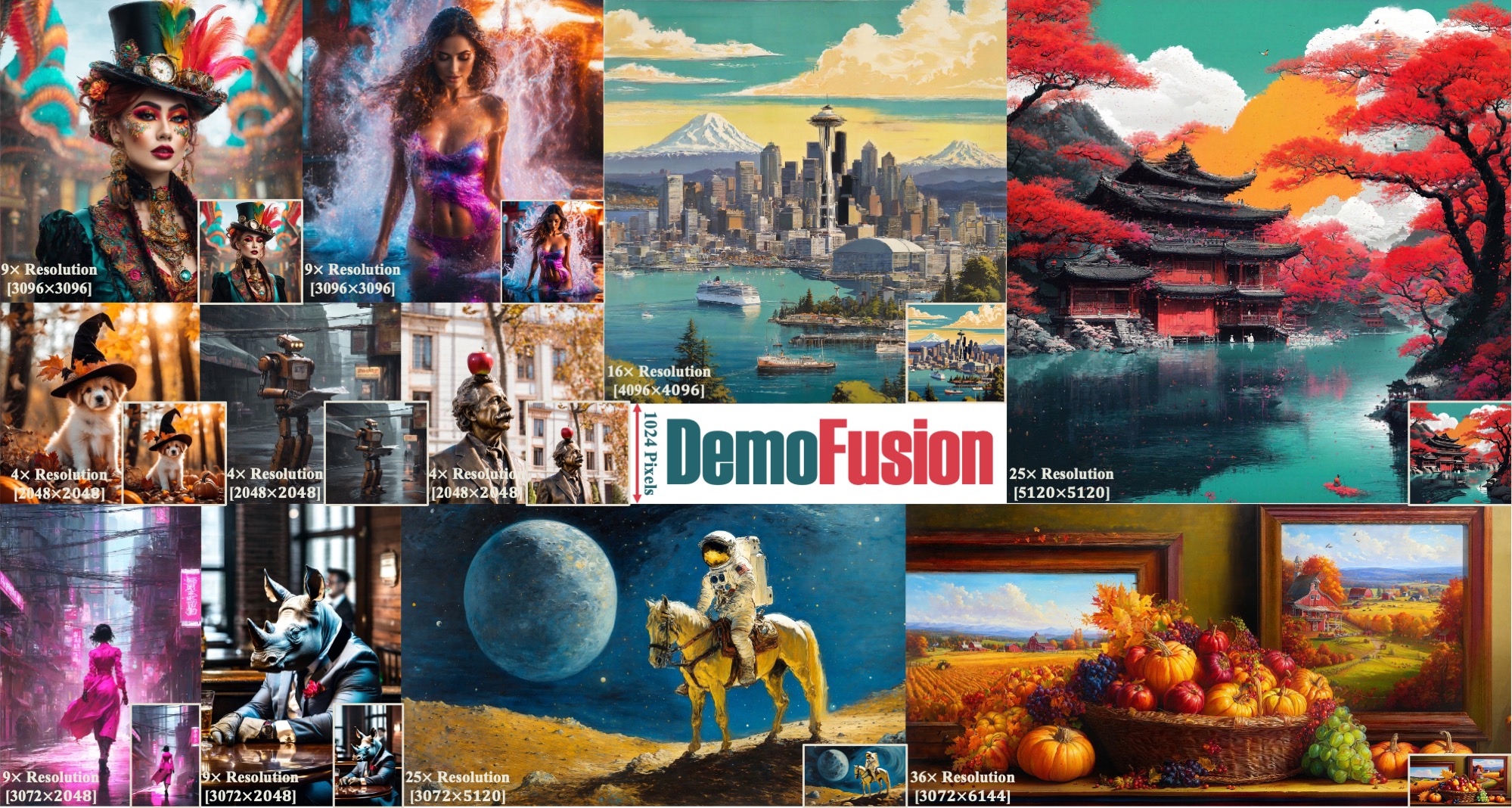
Abstract: High-resolution image generation with Generative Artificial Intelligence (GenAI) has immense potential but, due to the enormous capital investment required for training, it is increasingly centralised to a few large corporations, and hidden behind paywalls. This paper aims to democratise high-resolution GenAI by advancing the frontier of high-resolution generation while remaining accessible to a broad audience. We demonstrate that existing Latent Diffusion Models (LDMs) possess untapped potential for higher-resolution image generation. Our novel DemoFusion framework seamlessly extends open-source GenAI models, employing Progressive Upscaling, Skip Residual, and Dilated Sampling mechanisms to achieve higher-resolution image generation. The progressive nature of DemoFusion requires more passes, but the intermediate results can serve as "previews", facilitating rapid prompt iteration.
News
- 2024.02.27: 🔥 DemoFusion has been accepted to CVPR'24!
- 2023.12.15: 🚀 A ComfyUI Demofusion Custom Node is available! Thank Andre for the implementation!
- 2023.12.12: ✨ DemoFusion with ControNet is availabe now! Check it out at
pipeline_demofusion_sdxl_controlnet! The local Gradio Demo is also available. - 2023.12.10: ✨ Image2Image is supported by
pipeline_demofusion_sdxlnow! The local Gradio Demo is also available. - 2023.12.08: 🚀 A HuggingFace Demo for Img2Img is now available!
 for the support!
 - 2023.12.07: 🚀 Add Colab demo . Check it out! Thank camenduru for the implementation!
- 2023.12.06: ✨ The local Gradio Demo is now available! Better interaction and presentation!
- 2023.12.04: ✨ A low-vram version of DemoFusion is available! Thank klimaleksus for the implementation!
- 2023.12.01: 🚀 Integrated to Replicate. Check out the online demo:
- 2023.11.29: 💰
pipeline_demofusion_sdxlis released.
Usage
A quick try with integrated demos
- HuggingFace Space: Try Text2Image generation at
and Image2Image enhancement at
- Colab: Try Text2Image generation at and Image2Image enhancement at .
- Replicate: Try Text2Image generation at
Starting with our code
Hyper-parameters
view_batch_size(int, defaults to 16): The batch size for multiple denoising paths. Typically, a larger batch size can result in higher efficiency but comes with increased GPU memory requirements.stride(int, defaults to 64): The stride of moving local patches. A smaller stride is better for alleviating seam issues, but it also introduces additional computational overhead and inference time.cosine_scale_1(float, defaults to 3): Control the decreasing rate of skip-residual. A smaller value results in better consistency with low-resolution results, but it may lead to more pronounced upsampling noise. Please refer to Appendix C in the DemoFusion paper.cosine_scale_2(float, defaults to 1): Control the decreasing rate of dilated sampling. A smaller value can better address the repetition issue, but it may lead to grainy images. For specific impacts, please refer to Appendix C in the DemoFusion paper.cosine_scale_3(float, defaults to 1): Control the decrease rate of the Gaussian filter. A smaller value results in less grainy images, but it may lead to over-smoothing images. Please refer to Appendix C in the DemoFusion paper.sigma(float, defaults to 1): The standard value of the Gaussian filter. A larger sigma promotes the global guidance of dilated sampling, but it has the potential of over-smoothing.multi_decoder(bool, defaults to True): Determine whether to use a tiled decoder. Generally, a tiled decoder becomes necessary when the resolution exceeds 3072*3072 on an RTX 3090 GPU.show_image(bool, defaults to False): Determine whether to show intermediate results during generation.
Text2Image (will take about 17 GB of VRAM)
- Set up the dependencies as:
conda create -n demofusion python=3.9
conda activate demofusion
pip install -r requirements.txt
- Download
pipeline_demofusion_sdxl.pyand run it as follows. A use case can be found indemo.ipynb.
from pipeline_demofusion_sdxl import DemoFusionSDXLPipeline
import torch

model_ckpt = "stabilityai/stable-diffusion-xl-base-1.0"
pipe = DemoFusionSDXLPipeline.from_pretrained(model_ckpt, torch_dtype=torch.float16)
pipe = pipe.to("cuda")

prompt = "Envision a portrait of an elderly woman, her face a canvas of time, framed by a headscarf with muted tones of rust and cream. Her eyes, blue like faded denim. Her attire, simple yet dignified."
negative_prompt = "blurry, ugly, duplicate, poorly drawn, deformed, mosaic"

images = pipe(prompt, negative_prompt=negative_prompt,
              height=3072, width=3072, view_batch_size=16, stride=64,
              num_inference_steps=50, guidance_scale=7.5,
              cosine_scale_1=3, cosine_scale_2=1, cosine_scale_3=1, sigma=0.8,
              multi_decoder=True, show_image=True
             )

for i, image in enumerate(images):
    image.save('image_' + str(i) + '.png')
- ⚠️ When you have enough VRAM (e.g., generating 2048*2048 images on hardware with more than 18GB RAM), you can set
multi_decoder=False, which can make the decoding process faster. - Please feel free to try different prompts and resolutions.
- Default hyper-parameters are recommended, but they may not be optimal for all cases. For specific impacts of each hyper-parameter, please refer to Appendix C in the DemoFusion paper.
- The code was cleaned before the release. If you encounter any issues, please contact us.
Text2Image on Windows with 8 GB of VRAM
- Set up the environment as:
cmd
git clone "https://github.com/PRIS-CV/DemoFusion"
cd DemoFusion
python -m venv venv
venv\Scripts\activate
pip install -U "xformers==0.0.22.post7+cu118" --index-url https://download.pytorch.org/whl/cu118
pip install "diffusers==0.21.4" "matplotlib==3.8.2" "transformers==4.35.2" "accelerate==0.25.0"
- Launch DemoFusion as follows. The use case can be found in
demo_lowvram.py.
python
from pipeline_demofusion_sdxl import DemoFusionSDXLPipeline

import torch
from diffusers.models import AutoencoderKL
vae = AutoencoderKL.from_pretrained("madebyollin/sdxl-vae-fp16-fix", torch_dtype=torch.float16)

model_ckpt = "stabilityai/stable-diffusion-xl-base-1.0"
pipe = DemoFusionSDXLPipeline.from_pretrained(model_ckpt, torch_dtype=torch.float16, vae=vae)
pipe = pipe.to("cuda")

prompt = "Envision a portrait of an elderly woman, her face a canvas of time, framed by a headscarf with muted tones of rust and cream. Her eyes, blue like faded denim. Her attire, simple yet dignified."
negative_prompt = "blurry, ugly, duplicate, poorly drawn, deformed, mosaic"

images = pipe(prompt, negative_prompt=negative_prompt,
              height=2048, width=2048, view_batch_size=4, stride=64,
              num_inference_steps=40, guidance_scale=7.5,
              cosine_scale_1=3, cosine_scale_2=1, cosine_scale_3=1, sigma=0.8,
              multi_decoder=True, show_image=False, lowvram=True
             )

for i, image in enumerate(images):
    image.save('image_' + str(i) + '.png')
Text2Image with local Gradio demo
- Make sure you have installed
gradioandgradio_imageslider. - Launch DemoFusion via Gradio demo now -- try
python gradio_demo.py! Better Interaction and Presentation!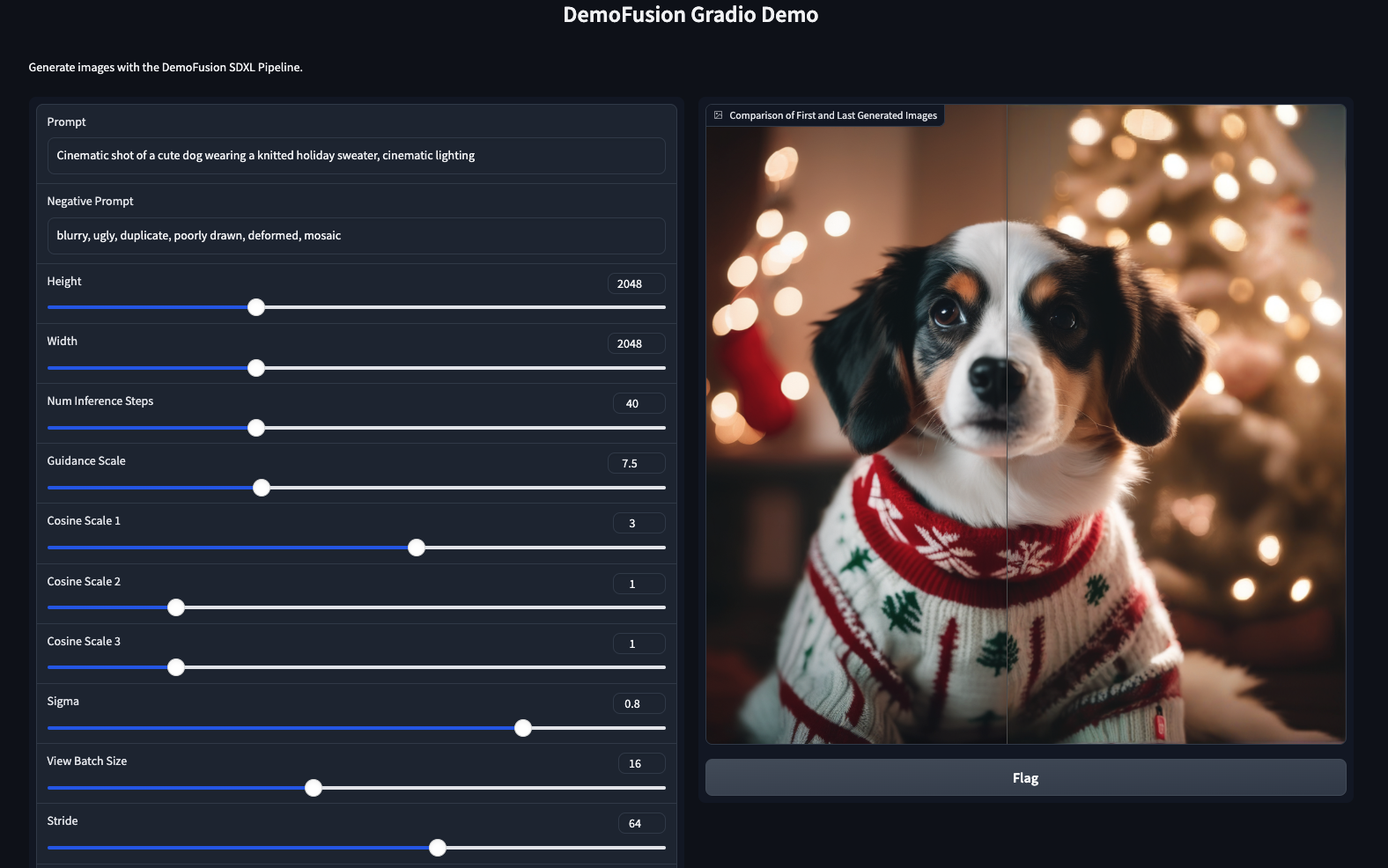
Image2Image with local Gradio demo
- Make sure you have installed
gradioandgradio_imageslider. - Launch DemoFusion Image2Image by
python gradio_demo_img2img.py.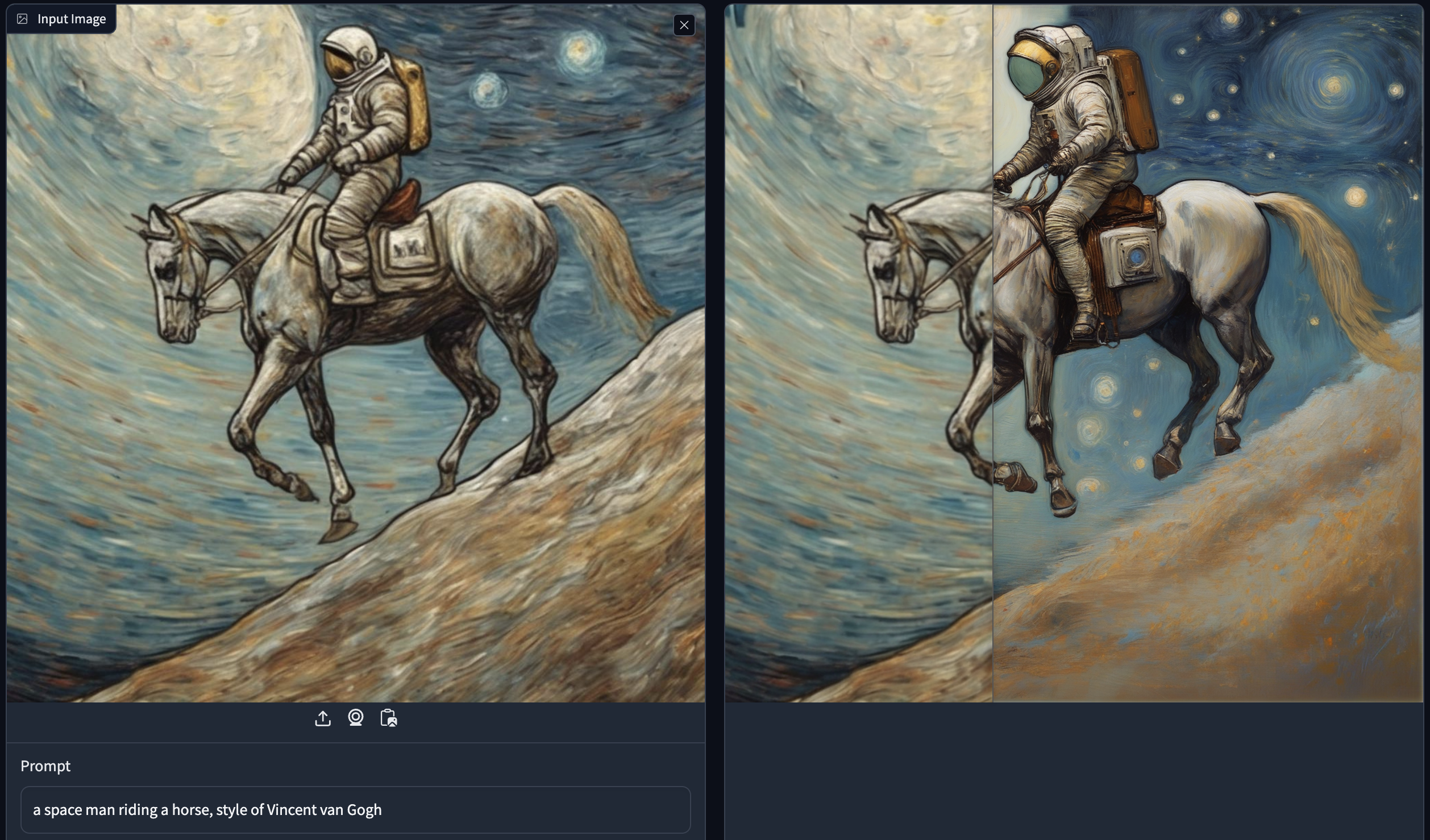
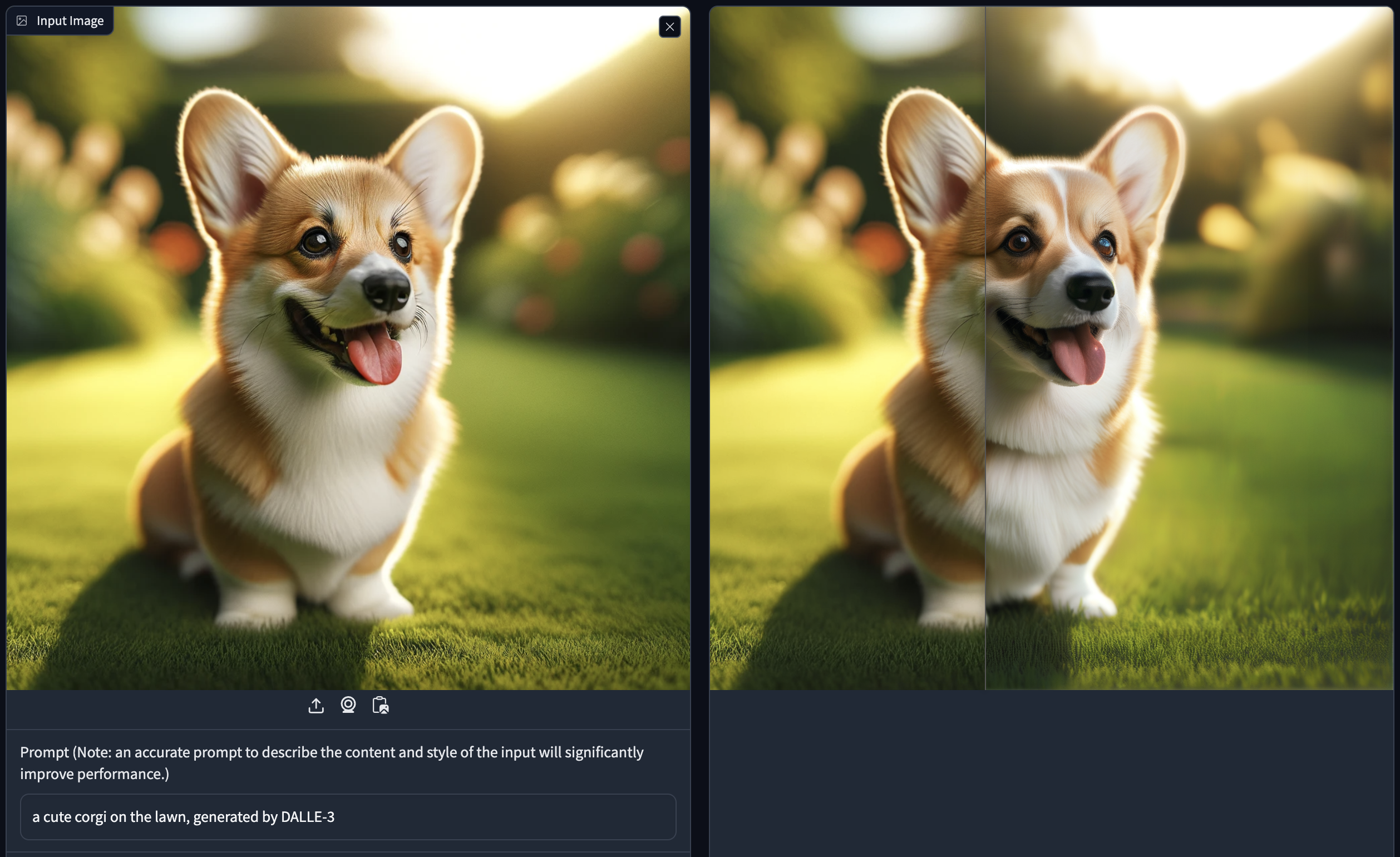
- ⚠️ Please note that, as a tuning-free framework, DemoFusion's Image2Image capability is strongly correlated with the SDXL's training data distribution and will show a significant bias. An accurate prompt to describe the content and style of the input also significantly improves performance. Have fun and regard it as a side application of text+image based generation.
DemoFusion+ControlNet with local Gradio demo
- Make sure you have installed
gradioandgradio_imageslider. - Launch DemoFusion+ControNet Text2Image by
python gradio_demo.py. -
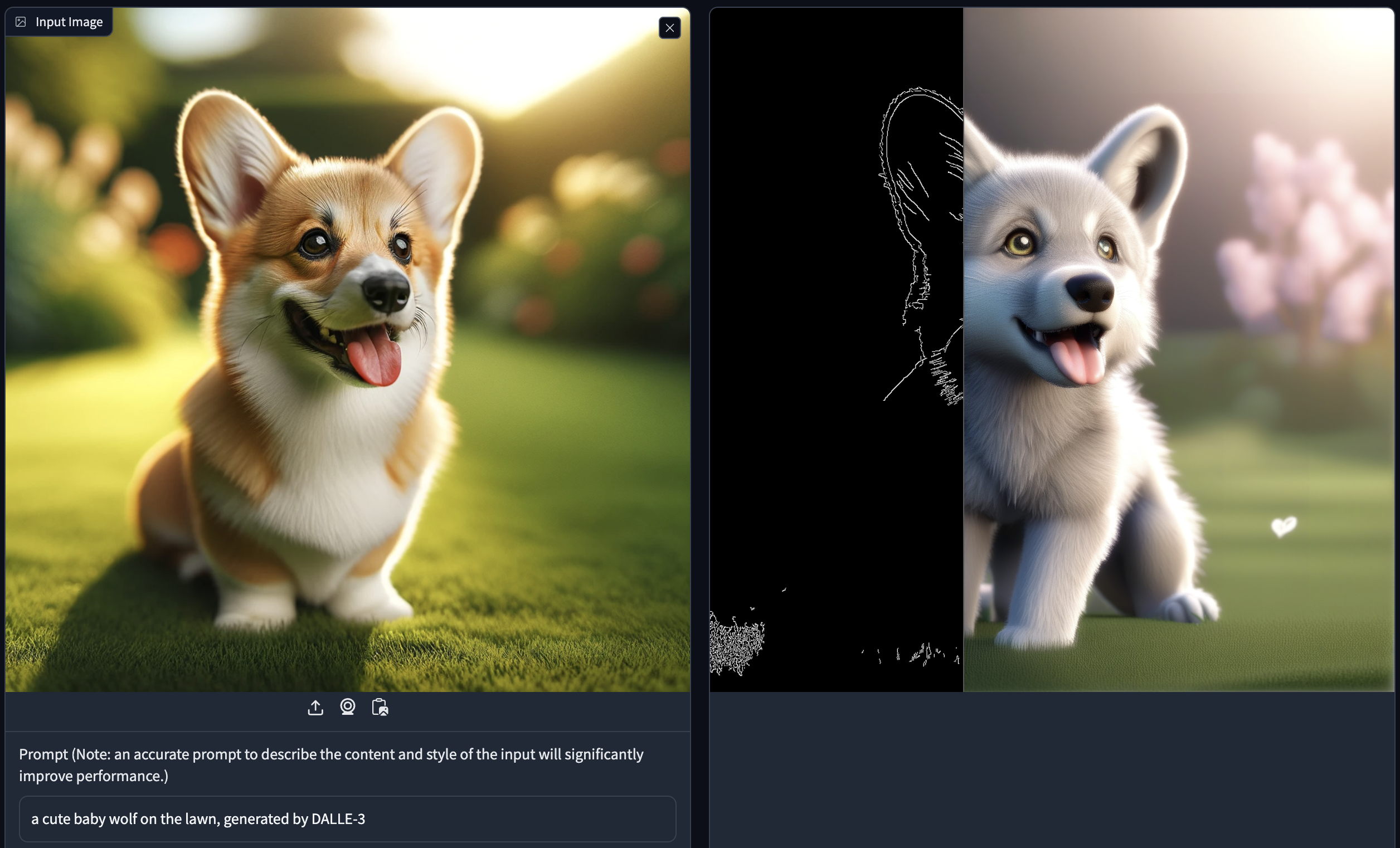
- Launch DemoFusion+ControNet Image2Image by
python gradio_demo_img2img.py. -
Citation
If you find this paper useful in your research, please consider citing:
@inproceedings{du2024demofusion,
  title={DemoFusion: Democratising High-Resolution Image Generation With No \$\$\$},
  author={Du, Ruoyi and Chang, Dongliang and Hospedales, Timothy and Song, Yi-Zhe and Ma, Zhanyu},
  booktitle={CVPR},
  year={2024}
}