
Designing Cloud Native Microservices on AWS (via DDD/EventStormingWorkshop)
 Picture license-free from Pexels
Building software is hard. Understanding the business needs of the software is even harder. In almost every software development project, there will always be some form of gap between the requirements of the business users and the actual implementation.
As a developer, knowing how to narrow this gap can help you go a long way to building applications that are relevant for the users. Using a Domain Driven Design approach, delivered via Event Storming, it can help to reduce the time it takes for everyone in the project team to understand a business domain model.
Theory and Practice: Learning in the Real world cases
Go through all of the learning journey, develop-->build-->deploy artifacts on AWS
🏗️ Modern Cloud-Native Architecture on Amazon EKS
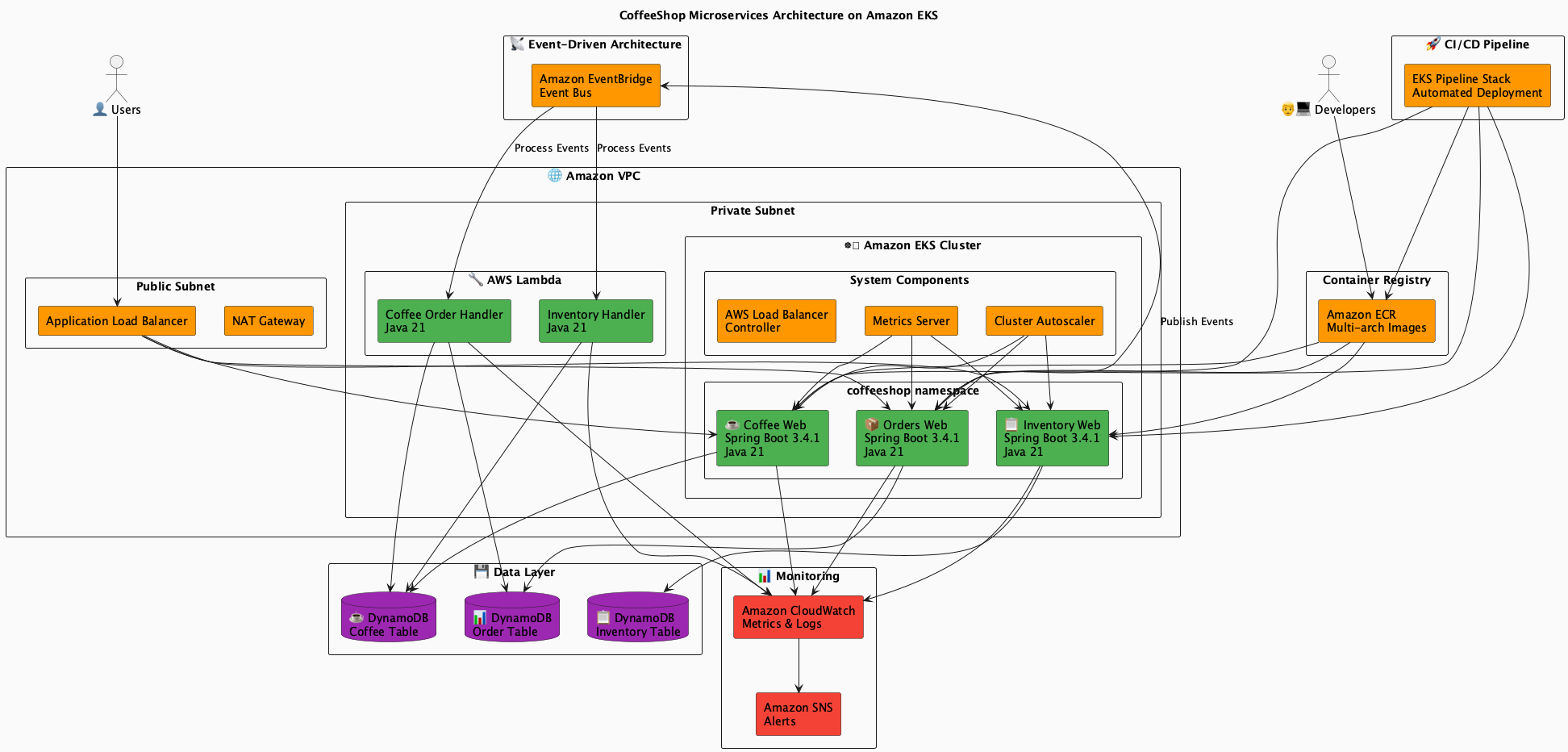
AWS cloud-native microservices architecture using EKS + Lambda hybrid computing model with event-driven service communication via EventBridge
📋 Click to view Mermaid source code
graph TB
%% External Users and Systems
User[👤 Users] --> ALB[Application Load Balancer]
Developer[👨💻 Developers] --> ECR[Amazon ECR<br/>Container Registry]
%% Network Layer
subgraph VPC["🌐 Amazon VPC (10.0.0.0/16)"]
subgraph PublicSubnet["Public Subnet"]
ALB
NAT[NAT Gateway]
end
subgraph PrivateSubnet["Private Subnet"]
%% EKS Cluster
subgraph EKS["☸️ Amazon EKS Cluster"]
subgraph Namespace["coffeeshop namespace"]
OrdersPod[📦 Orders Web<br/>Spring Boot 3.4.1<br/>Java 21]
CoffeePod[☕ Coffee Web<br/>Spring Boot 3.4.1<br/>Java 21]
InventoryPod[📋 Inventory Web<br/>Spring Boot 3.4.1<br/>Java 21]
end
subgraph SystemPods["System Components"]
ALBController[AWS Load Balancer Controller]
ClusterAutoscaler[Cluster Autoscaler]
MetricsServer[Metrics Server]
EBSCSIDriver[EBS CSI Driver]
end
end
%% Lambda Functions
subgraph Lambda["🔧 AWS Lambda"]
CoffeeOrderHandler[Coffee Order Handler<br/>Java 21]
InventoryHandler[Inventory Handler<br/>Java 21]
end
end
end
%% Data Layer
subgraph DataLayer["💾 Data Layer"]
DynamoOrder[(📊 DynamoDB<br/>Order Table)]
DynamoCoffee[(☕ DynamoDB<br/>Coffee Table)]
DynamoInventory[(📋 DynamoDB<br/>Inventory Table)]
end
%% Event-Driven Architecture
subgraph EventDriven["📡 Event-Driven Architecture"]
EventBridge[Amazon EventBridge<br/>Event Bus]
end
%% API Gateway
subgraph APILayer["🌐 API Layer"]
APIGateway[Amazon API Gateway<br/>REST API]
end
%% Monitoring and Observability
subgraph Monitoring["📊 Monitoring & Observability"]
CloudWatch[Amazon CloudWatch<br/>Metrics & Logs]
Dashboard[CloudWatch Dashboard]
SNS[Amazon SNS<br/>Alarm Notifications]
end
%% CI/CD Pipeline
subgraph CICD["🚀 CI/CD Pipeline"]
Pipeline[EKS Pipeline Stack<br/>Automated Deployment]
end
%% Connections
ALB --> OrdersPod
ALB --> CoffeePod
ALB --> InventoryPod
%% Microservices to Data
OrdersPod --> DynamoOrder
OrdersPod --> EventBridge
CoffeePod --> DynamoCoffee
InventoryPod --> DynamoInventory
%% Lambda connections
APIGateway --> CoffeeOrderHandler
APIGateway --> InventoryHandler
CoffeeOrderHandler --> DynamoOrder
CoffeeOrderHandler --> DynamoCoffee
InventoryHandler --> DynamoCoffee
%% Event-driven flow
EventBridge --> CoffeeOrderHandler
OrdersPod -.->|Send Events| EventBridge
%% ECR to EKS
ECR --> OrdersPod
ECR --> CoffeePod
ECR --> InventoryPod
%% Monitoring connections
OrdersPod --> CloudWatch
CoffeePod --> CloudWatch
InventoryPod --> CloudWatch
CoffeeOrderHandler --> CloudWatch
InventoryHandler --> CloudWatch
EKS --> CloudWatch
CloudWatch --> Dashboard
CloudWatch --> SNS
%% CI/CD
Pipeline --> ECR
Pipeline --> EKS
%% Auto-scaling
MetricsServer --> OrdersPod
MetricsServer --> CoffeePod
MetricsServer --> InventoryPod
ClusterAutoscaler --> EKS
%% Styling
classDef userClass fill:#e1f5fe,stroke:#01579b,stroke-width:2px
classDef awsService fill:#ff9800,stroke:#e65100,stroke-width:2px,color:#fff
classDef microservice fill:#4caf50,stroke:#1b5e20,stroke-width:2px,color:#fff
classDef database fill:#9c27b0,stroke:#4a148c,stroke-width:2px,color:#fff
classDef monitoring fill:#f44336,stroke:#b71c1c,stroke-width:2px,color:#fff
class User,Developer userClass
class ALB,ECR,EKS,Lambda,EventBridge,APIGateway,CloudWatch,SNS,Pipeline awsService
class OrdersPod,CoffeePod,InventoryPod,CoffeeOrderHandler,InventoryHandler microservice
class DynamoOrder,DynamoCoffee,DynamoInventory database
class Dashboard,SNS monitoring
🎯 Architecture Highlights
Container Orchestration (Amazon EKS)
- Kubernetes Cluster: Managed EKS with ARM64 Graviton3 nodes for cost optimization
- Microservices: Orders, Coffee, and Inventory services running as containers
- Auto-scaling: Horizontal Pod Autoscaler (HPA) for dynamic scaling
- Load Balancing: Application Load Balancer (ALB) for traffic distribution
Event-Driven Architecture
- Amazon EventBridge: Central event bus for asynchronous service communication
- Domain Events: OrderCreated, CoffeeRequested, InventoryUpdated events
- Loose Coupling: Services communicate via events, not direct API calls
- Event Sourcing: Complete audit trail of all business events
Modern Technology Stack
- Runtime: Java 21 LTS with enhanced performance features
- Framework: Spring Boot 3.4.1 with cloud-native optimizations
- Architecture: Hexagonal Architecture with Domain-Driven Design (DDD)
- Data Storage: Amazon DynamoDB with pay-per-request billing
Cloud-Native Benefits
- Scalability: Independent scaling of each microservice
- Resilience: Fault isolation and automatic recovery
- Cost Optimization: ARM64 Graviton3 instances reduce compute costs by up to 20%
- Developer Experience: Modern Java features and Spring Boot productivity
Table of Contents
- 00 - Event Storming
- 01 - Hands-on: Events exploring
- 02 - Cafe business scenario
- 03 - Roles, Commands, and Events Mapping
- 04 - Modeling and Development
- 05 - Deploy Applications on Amazon EKS
- Showcase Website
Event Storming
What is Event Storming?
Event Storming is a rapid, lightweight, and often under-appreciated group modeling technique invented by Alberto Brandolini, that is intense, fun, and useful to accelerate project teams. It is typically offered as an interactive workshop and it is a synthesis of facilitated group learning practices from Gamestorming, leveraging on the principles of Domain Driven Design (DDD).
You can apply it practically on any technical or business domain, especially those that are large, complex, or both.
Whom is it for?
Event Storming isn't limited to just for the software development team. In fact, it is recommend to invite all the stakeholders, such as developers, domain experts, business decision makers etc to join the Event Storming workshop to collect viewpoints from each participants.
Event Storming Terms
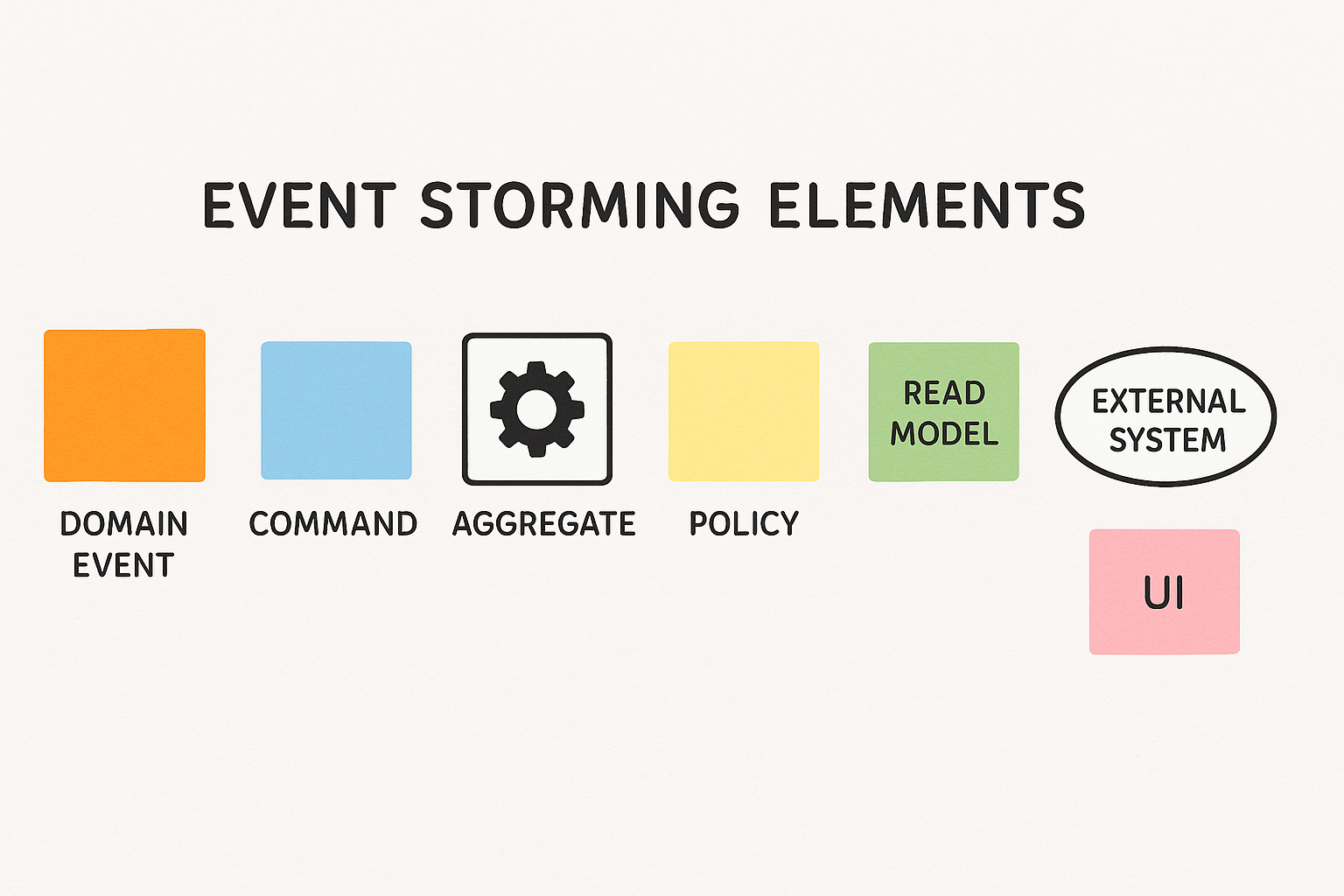 Take a look on this diagram, there are a few colored sticky notes with different intention:
- Domain Events (Orange sticky note) - Describes what happened. Represent facts that happened in a specific business context, written in past tense
- Actions aka Command (Blue sticky note) - Describes an action that caused the domain event. It is a request or intention, raised by a role or time or external system
- Information (Green sticky note) - Describes the supporting information required to help make a decision to raise a command
- Consistent Business Rules aka Aggregate (Yellow sticky note)
- Groups of Events or Actions that represent a specific business capability
- Has the responsibility to accept or fulfill the intention of command
- Should be in small scope
- And communicated by eventual consistency
- Eventual Consistent Business rules aka Policy (Lilac sticky note)
- Represents a process or business rules. Can come from external regulation and restrictions e.g. account login success/fail process logic.
Event Storming Benefits
Business requirements can be very complex. It is often hard to find a fluent way to help the Product Owner and Development teams to collaborate effectively. Event storming is designed to be efficient and fun. By bringing key stakeholder into the same room, the process becomes:
-
Efficient: Everyone coming together in the same room can make decisions and sort out differences quickly. To create a comprehensive business domain model, what used to take many weeks of email, phone call or meeting exchanges can be reduced to a single workshop.
-
Simple: Event Storming encourages the use of "Ubiquitous language" that both the technical and non-technical stakeholders can understand.
-
Fun: Domain modeling is fun! Stakeholders get hands-on experience to domain modeling which everyone can participate and interact with each other. It also provides more opportunities to exchange ideas and improve mindsharing, from various perspective across multiple roles.
-
Effective: Stakeholders are encouraged not to think about the data model, but about the business domain. This puts customers first and working backwards from there, achieves an outcome that is more relevant.
-
Insightful: Event Storming generate conversations. This helps stakeholders to understand the entire business process better and help to have a more holistic view from various perspective.
Event Storming Applications
There are many useful applications of Event Storming. The most obvious time to use event storming is at a project's inception, so the team can start with a common understanding of the domain model. Some other reasons include:
- Discovering complexity early on, finding missing concepts, understanding the business process;
- Modelling or solving a specific problem in detail;
- Learning how to model and think about modelling.
Event Storming can also help to identify key views for your user interface, which can jump start Site Mapping or Wireframing.
Let's get started with a quick example to demonstrate how to run a simple Event Storming.
Next: 01 Hands-on Events Exploring >
Showcase Website
An interactive single-page showcase website is included under the website/ directory. It demonstrates the three Bounded Contexts (Orders, Coffee, Inventory) with a live DDD architecture diagram, an order form, a coffee menu, and an inventory dashboard.
Tech stack: HTML + Tailwind CSS CDN + Vanilla JS (no build step required)
Quick start:
cd website
python3 -m http.server 8888
# Open http://localhost:8888
The website connects to the three Spring Boot microservices (ports 8081/8082/8083). When the backend is offline, it gracefully falls back to static data so the UI remains fully functional for demo purposes.
License
This library is licensed under the MIT-0 License. See the LICENSE file.