
Feature Flags Service
Self-hosted, high-performance feature flag evaluation built on .NET 10. 50k RPS · <5ms p99 · 100% success rate · Client SDK · Real-time Blazor demo using SignalR · 79 tests passing
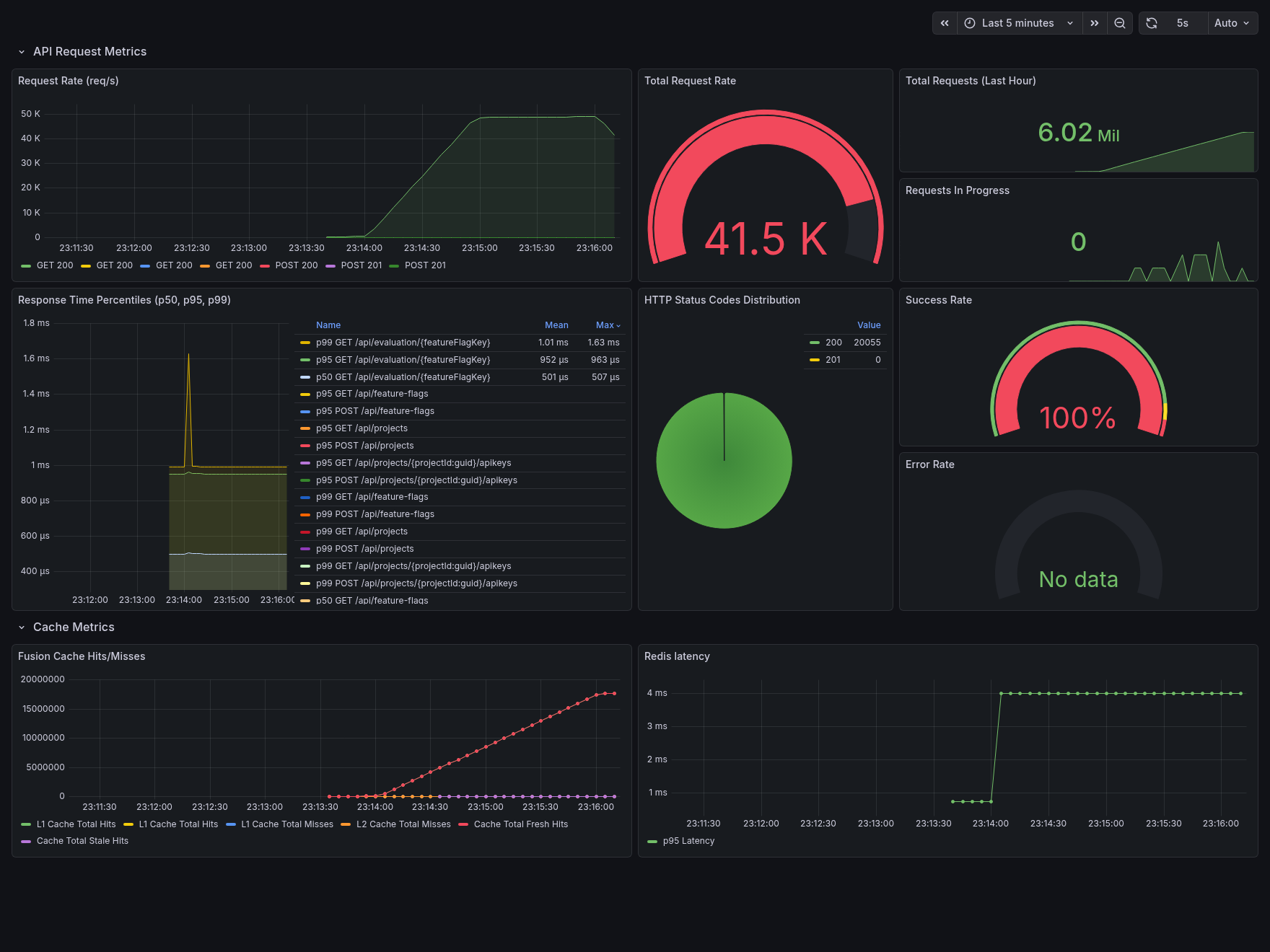
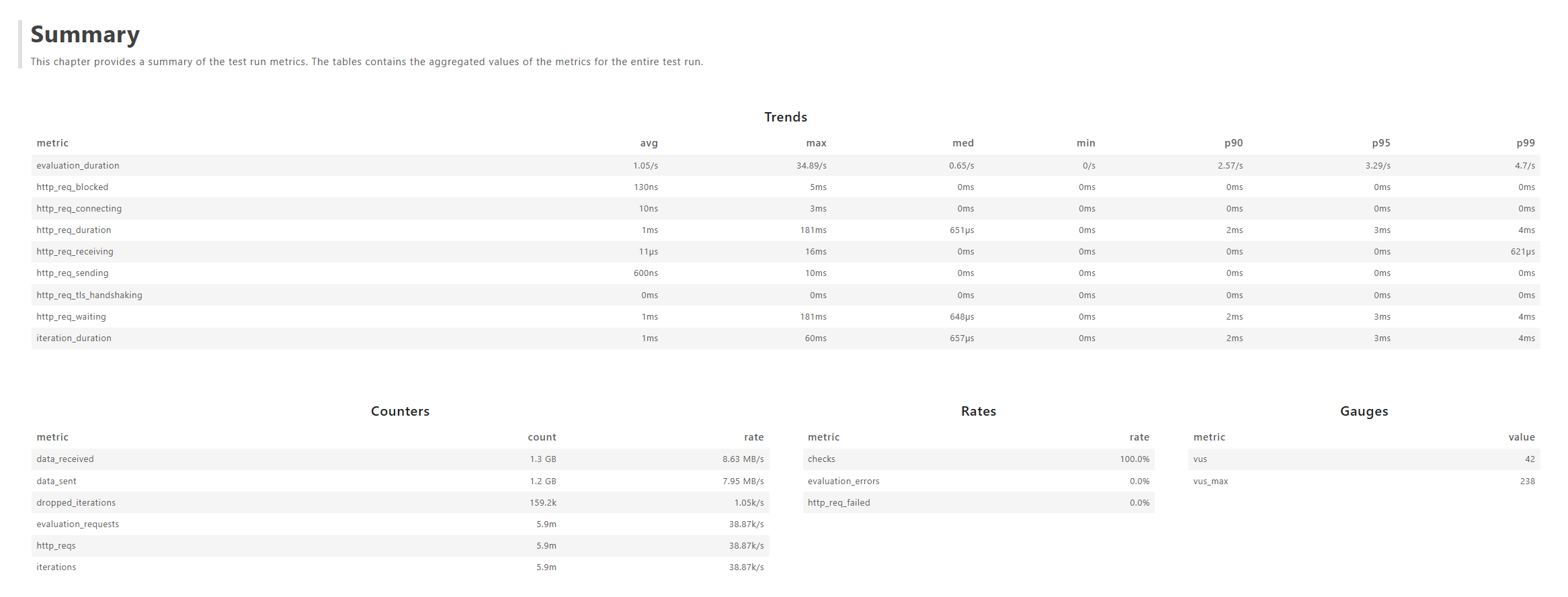
This README is documentation of a feature flags service that focuses on scalability and performance. This is a Proof of Concept.
Why this project?
Current feature flag services can cost upwards of £100+ per month at scale. This is a self-hostable alternative built to demonstrate how .NET 10 can be used to build a high-performance feature flag service.
Built as a portfolio project to learn and explore:
- Zero-allocation hot paths using Span<T>, stackalloc and more efficient hashing methods
- Hybrid L1/L2 caching with eventual consistency guarantees using FusionCache
- Distributed systems patterns at high throughput
- SDK creation and usage - focusing on Developer Experience (DX)
Performance
| Scenario | RPS | p99 Latency | Cache Hit Rate |
|---|---|---|---|
| Warm cache | 20,000 | 1.0ms | 99.79% |
| Warm cache | 50,000 | 4.7ms | 99.79% |
These benchmarks reflect warm cache scenarios. See LocalHostBenchmarks.md for full methodology, environment details, results and analysis.
SDK & Demo
Client SDK (NuGet: FeatureFlags.Client and FeatureFlags.Client.DependencyInjection)
- Typed .NET client for flag evaluation and management of the entire service
- Built-in optional caching + retry logic
- See Client SDK Usage for Client SDK documentation
- See Client SDK DI Usage for Client SDK DI documentation
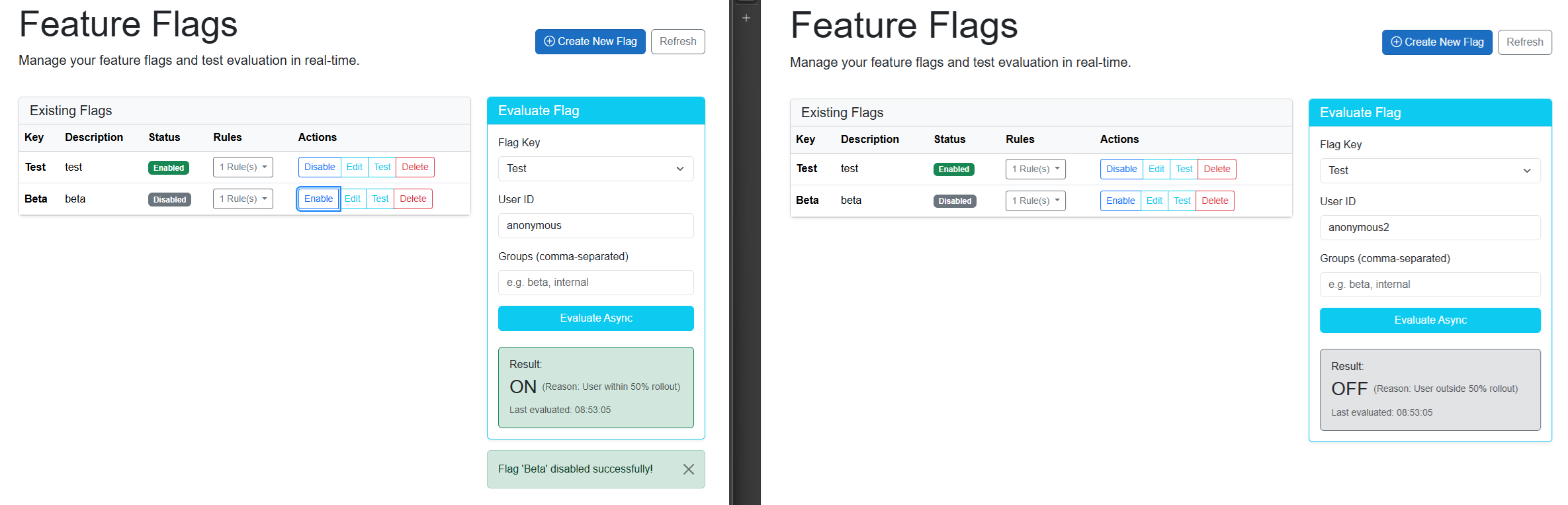
Blazor Demo App
- Real-time flag updates via SignalR
- Changes propagate to UI in <100ms
- See Blazor Sample for more details
Architecture
The coding architecture will be based on the Clean Architecture principles, which separates the code into different layers, such as the API layer, application layer, domain layer, and infrastructure layer. This will help with maintainability and scalability of the codebase.
flowchart TB
    client["CLIENT (SDK)
    API Key: ffsk_live_xxx"] --> web["WEB API LAYER"]

    subgraph web["WEB API LAYER"]
        auth["Authentication Middleware
        • Checks X-Api-Key header
        • Validates API key (hash, expiration, revocation)
        • Extracts projectId → adds to Claims"]
        endpoints["Endpoints
        • Extract projectId from user.GetProjectId()
        • Pass projectId to services"]
        auth --> endpoints
    end

    web --> app["APPLICATION LAYER"]

    subgraph app["APPLICATION LAYER"]
        services["Services (Business Logic)
        • IFeatureFlagsService
        • IEvaluationService
        • IProjectService
        • IApiKeyService"]
    end

    app --> infra["INFRASTRUCTURE LAYER"]

    subgraph infra["INFRASTRUCTURE LAYER"]
        repos["Repositories
        • Filter by projectId in queries
        • ProjectRepository, ApiKeyRepository
        • FeatureFlagsRepository"]
    end

    infra --> domain["DOMAIN LAYER"]

    subgraph domain["DOMAIN LAYER"]
        entities["Entities
        • Project (id, name, description)
        • ApiKey (projectId, keyHash, scopes, expires)
        • FeatureFlag"]
    end

    domain --> db["DATABASE / CACHE LAYER"]
Tech stack:
- API: .NET 10 Minimal APIs
- Cache: FusionCache (L1 memory + L2 Redis) with Redis backplane
- Database: PostgreSQL
- Observability: Prometheus + Grafana
- Load testing: k6
See ARCHITECTURE.md and INFRASTRUCTURE.md for more details on clean architecture breakdown and design decisions.
Key Engineering Decisions
Hashing
Profiling using PerfView and Speedscope revealed that SHA256 hashing was a significant bottleneck in the evaluation hot path. At one point, load testing at 2k RPS/core showed 450% CPU usage in my API container, replacing it with XxHash32 and XxHash64 in places not needing cryptographic security immediately reduced that usage to 110% in the same scenario.
Zero-Allocation Hot Paths
Evaluation logic allocates zero bytes per request:
ReadOnlySpan<char>parsing instead ofstring.Split()for determing user groupsstackallocfor cache key generation under 256 bytes, used in user bucketing as well- ZString for zero-allocation string concatenation
Caching
Feature flags and their rules are cached in L1 memory, as well as evaluation results. The Redis backplane is used to synchronize cache updates across multiple API instances. There are different cache configurations across each entity used in the service, these are defined in each repository.
Quick Start:
# Option 1: Infrastructure only (for local development)
docker-compose -f infrastructure/compose.localhost.yaml up -d
dotnet run --project src/Web.Api

# Option 2: Performance Baseline (Local API + Docker Infra)
# Use this to target <5ms p99 by avoiding Docker network overhead
docker-compose -f infrastructure/compose.localhost.yaml up -d
$env:ASPNETCORE_ENVIRONMENT="Production"
dotnet run --project src/Web.Api -c Release

# Option 3: Fully containerized (including API and Docker network load testing)
docker-compose -f infrastructure/compose.local.yaml --profile with-api --profile with-load-test up --build

# View monitoring
# Prometheus: http://localhost:9090
# Grafana: http://localhost:3000 (admin/admin)
# Metrics endpoint: http://localhost:5000/metrics

# Run load test
cd infrastructure
k6 run --out json=summary.json infrastructure/k6.evaluation.steady.js
or
k6 run --out json=summary.json infrastructure/k6.key-stress-test.js
Refer to QUICKSTART.md for more details.
Features
Main features:
- Feature flag CRUD operations with project-based multi-tenancy
- Real-time evaluation logic with user targeting and percentage rollout rules using bucketing
- Audit logs for all CRUD operations that happen in the background
- Cursor-based pagination
- Client SDK with DI support and optional in-memory caching for feature flag evaluations
Reliability:
- Fail-safe caching, it will serve stale data when Redis/Postgres are down
- Chaos testing using Chaos Monkey is verified (Redis and Postgres containers are killed randomly)
- ETag support for optimistic concurrency control
Observability:
- Grafana dashboard that shows cache (L1, L2) hit rate, evaluation latency, request rates, error rates and more
- Prometheus metrics endpoint
- OpenTelemetry tracing
Project Status
The project is currently a production-ready PoC. All core features are implemented, and the service is designed to be self-hosted in production environments.
Known Issues
- Evaluation caching: Currently caches full evaluation results - the user + flag. This trades consistency for throughput. Rule-only caching will be implemented instead.
- Eventual consistency window needs to go up, a more bulletproof caching strategy needs to be implemented.
- Rate limiting needs to be implemented.
- Limited distributed load testing, more load testing scenarios and more load testing infrastructure are needed. Podman and kind will be used for local Kubernetes cluster testing.
Testing
79 tests across the full solution including the API and Client SDK, all successful.
Documentation
| Doc | What It Covers |
|---|---|
| ARCHITECTURE.md | Clean architecture, layer responsibilities |
| INFRASTRUCTURE.md | Infrastructure choices, explanations and reasoning |
| LocalHostBenchmarks.md | Full benchmark methodology + results |
| ETAG.md | ETag implementation, optimistic concurrency |
| PAGINATION.md | Cursor-based pagination design |
Author
Adiv Asif · Software Engineer
LinkedIn
License
This project is licensed under the MIT License - see the LICENSE file for details.