
flowview




Visual data pipeline debugger for Polars. Stop print-debugging your pipelines.
Install
pip install flowview
or with uv:
uv add flowview
Quick Start
Add @fv.trace to any function that transforms a Polars DataFrame. flowview traces every method call and renders a visual flow in your terminal.
import polars as pl
import flowview as fv

@fv.trace
def process(df: pl.DataFrame) -> pl.DataFrame:
    return (
        df.filter(pl.col("status") == "active")
          .with_columns((pl.col("price") * pl.col("quantity")).alias("revenue"))
          .group_by("category")
          .agg(pl.col("revenue").sum().alias("total_revenue"))
          .sort("total_revenue", descending=True)
    )

df = pl.DataFrame({
    "status": ["active", "inactive", "active"],
    "category": ["Books", "Books", "Electronics"],
    "price": [14.99, 599.99, 299.99],
    "quantity": [5, 1, 2],
})

result = process(df)
.pipe() chains work too:
@fv.trace
def process(df: pl.DataFrame) -> pl.DataFrame:
    return df.pipe(clean).pipe(filter_active).pipe(add_revenue)
What You See
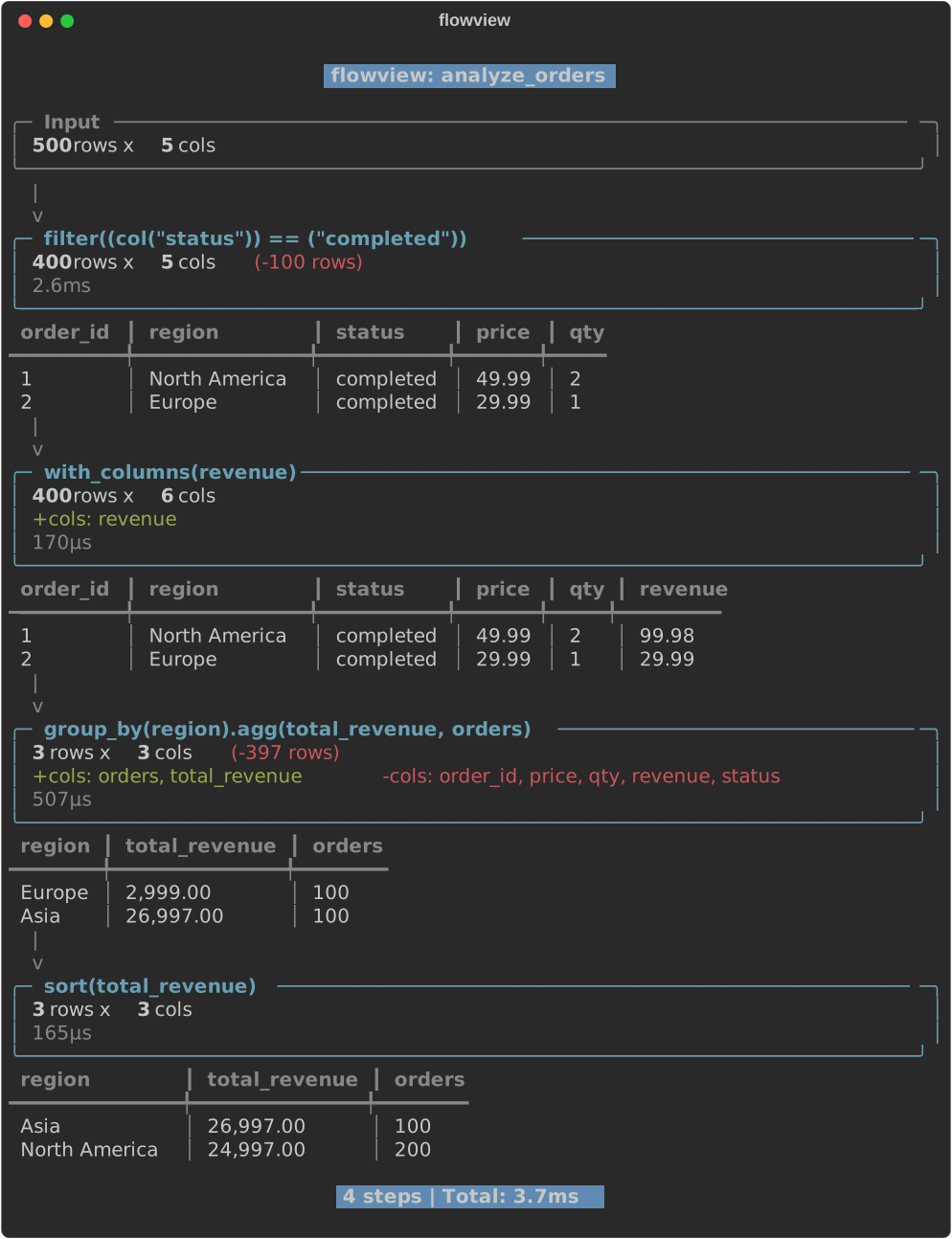
Each step in your pipeline is displayed as a box showing:
- Row count with diff from the previous step (e.g.,
700 rows x 4 cols (-300 rows)) - Schema changes — columns added or removed (e.g.,
+cols: revenue -cols: status) - Sample data — first N rows at each transformation
- Execution time per step
Steps are connected with arrows to show the flow. A summary footer shows the total step count and wall-clock time.
Supported Operations
flowview traces any DataFrame method that returns a new DataFrame. These methods get human-readable step names:
| Method | Step name example |
|---|---|
filter(expr) |
filter((col("status")) == ("active")) |
with_columns(exprs) |
with_columns(revenue, tax) |
select(cols) |
select(status, price) |
drop(cols) |
drop(status, category) |
rename(mapping) |
rename(price->unit_price) |
sort(cols) |
sort(price, quantity) |
head(n) / tail(n) |
head(10) / tail(5) |
unique(subset) |
unique(id) |
join(other, ...) |
join(on=id, how=left) |
group_by(cols).agg(exprs) |
group_by(category).agg(total_revenue) |
pipe(fn) |
uses the function name, e.g. clean_data |
Other methods (e.g., explode, melt, unpivot) are traced with a fallback name like explode('tags').
Options
@fv.trace(sample_rows=3, show_sample=True, show_schema=True)
def process(df):
    ...
| Option | Type | Default | Description |
|---|---|---|---|
sample_rows |
int |
5 |
Number of sample rows to capture at each step |
show_sample |
bool |
True |
Display sample data tables in the output |
show_schema |
bool |
False |
Display the full schema at each step |
How It Works
The @fv.trace decorator wraps the first DataFrame argument in a lightweight proxy before calling your function. The proxy intercepts every method call, captures a snapshot of the result (row count, schema, sample rows, timing), and delegates to the real Polars DataFrame underneath. When your function returns, the proxy is unwrapped and you get back a regular pl.DataFrame.
There is no monkey-patching and no global state. Each decorated call is fully isolated.
Limitations
- LazyFrame is not supported —
df.lazy()exits the proxy. Only eager DataFrames are traced. - Pipe internals are not individually traced —
df.pipe(fn)produces a single step named afterfn, not one step per operation insidefn. - IDE autocomplete may not show DataFrame methods inside the decorated function body.
type(df)returnsTracedDataFrameinside the decorated function.isinstance(df, pl.DataFrame)works correctly.- Only the first DataFrame argument is wrapped when a function takes multiple DataFrames.