
🚀 Boosting Latent Diffusion with Flow Matching
Johannes Schusterbauer * · Ming Gui* · Pingchuan Ma* · Nick Stracke · Stefan A. Baumann · Vincent Tao Hu · Björn Ommer
CompVis Group @ LMU Munich
* equal contribution
ECCV 2024 Oral


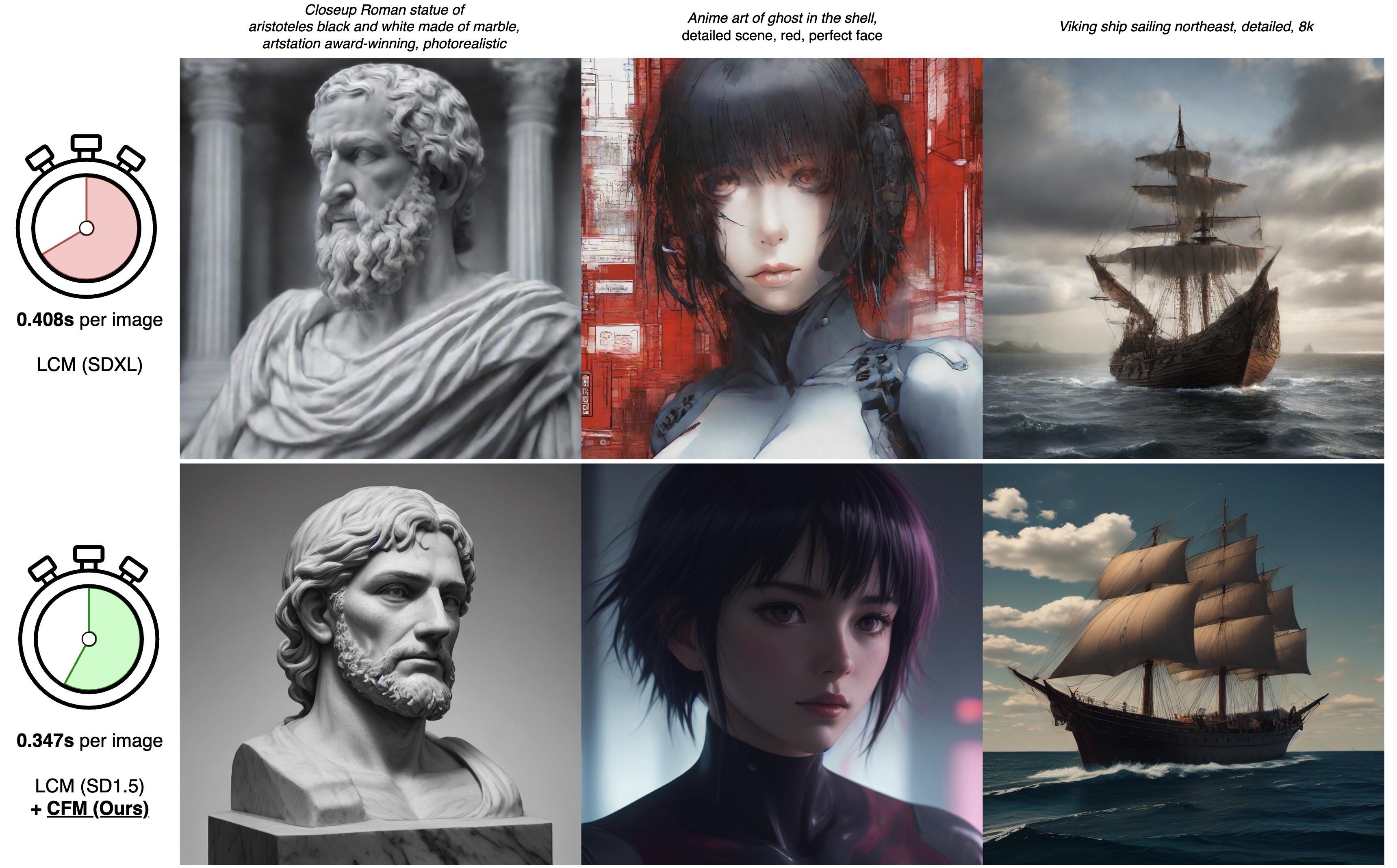
Samples synthesized in $1024^2$ px. We elevate DMs and similar architectures to a higher-resolution domain, achieving exceptionally rapid processing speeds. We leverage the Latent Consistency Models (LCM), distilled from SD1.5 and SDXL, respectively. To achieve the same resolution as LCM (SDXL), we boost LCM-SD1.5 with our general Coupling Flow Matching (CFM) model. This yields a further speedup in the synthesis process and enables the generation of high-resolution images of high fidelity in an average $0.347$ seconds. The LCM-SDXL model fails to produce competitive results within this shortened timeframe, highlighting the effectiveness of our approach in achieving both speed and quality in image synthesis.
📝 Overview
In this work, we leverage the complementary strengths of Diffusion Models (DMs), Flow Matching models (FMs), and Variational AutoEncoders (VAEs): the diversity of stochastic DMs, the speed of FMs in training and inference stages, and the efficiency of a convolutional decoder to map latents into pixel space. This synergy results in a small diffusion model that excels in generating diverse samples at a low resolution. Flow Matching then takes a direct path from this lower-resolution representation to a higher-resolution latent, which is subsequently translated into a high-resolution image by a convolutional decoder. We achieve competitive high-resolution image synthesis at $1024^2$ and $2048^2$ pixels with minimal computational cost.
🚀 Pipeline
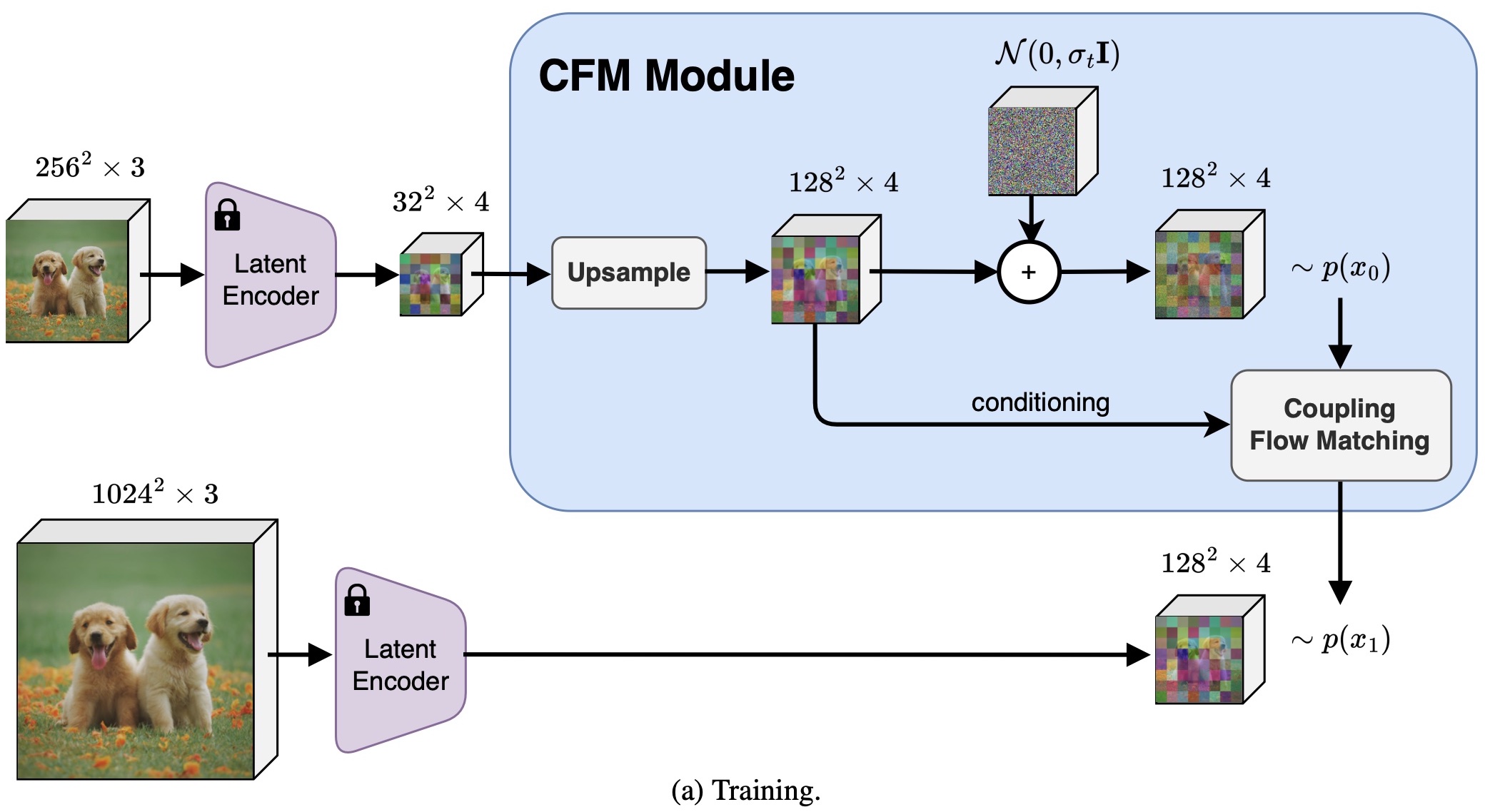
During training we feed both a low- and a high-res image through the pre-trained encoder to obtain a low- and a high-res latent code. Our model is trained to regress a vector field which forms a probability path from the low- to the high-res latent within $t \in [0, 1]$.
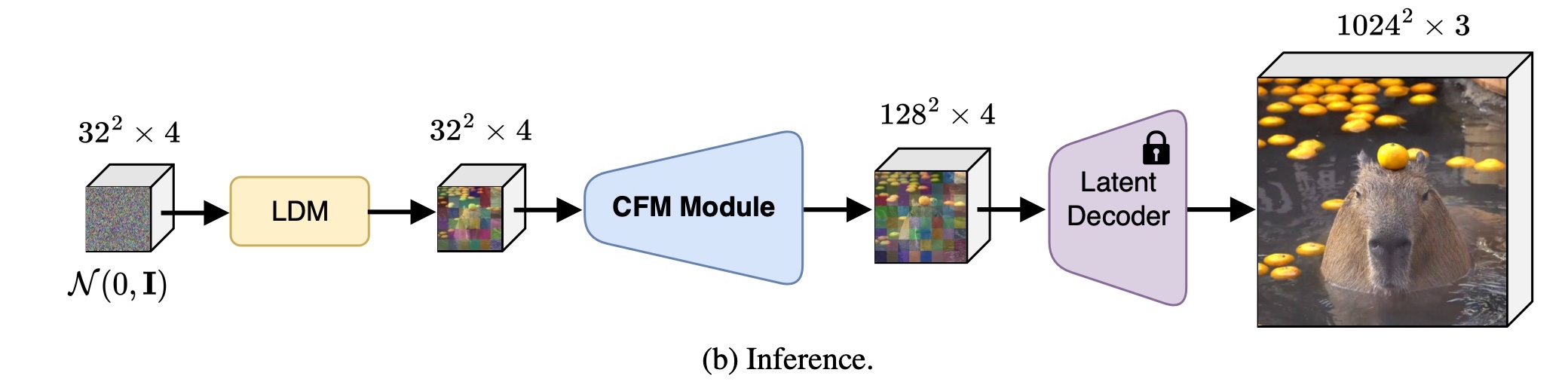
At inference we can take any diffusion model, generate the low-res latent, and then use our Coupling Flow Matching model to synthesize the higher dimensional latent code. Finally, the pre-trained decoder projects the latent code back to pixel space, resulting in $1024^2$ or $2048^2$ images.
📈 Results
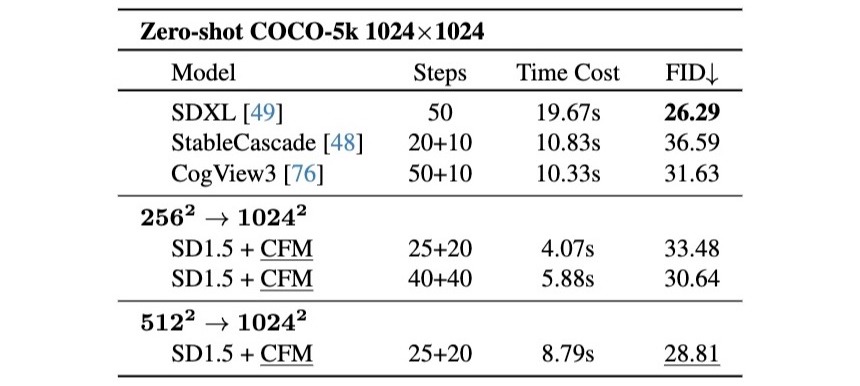
We show zero-shot quantitative comparison of our method against other state-of-the-art methods on the COCO dataset. Our method achieves a good trade-off between performance and computational cost.
We can cascade our models to increase the resolution of a $128^2$ px LDM 1.5 generation to a $2048^2$ px output.
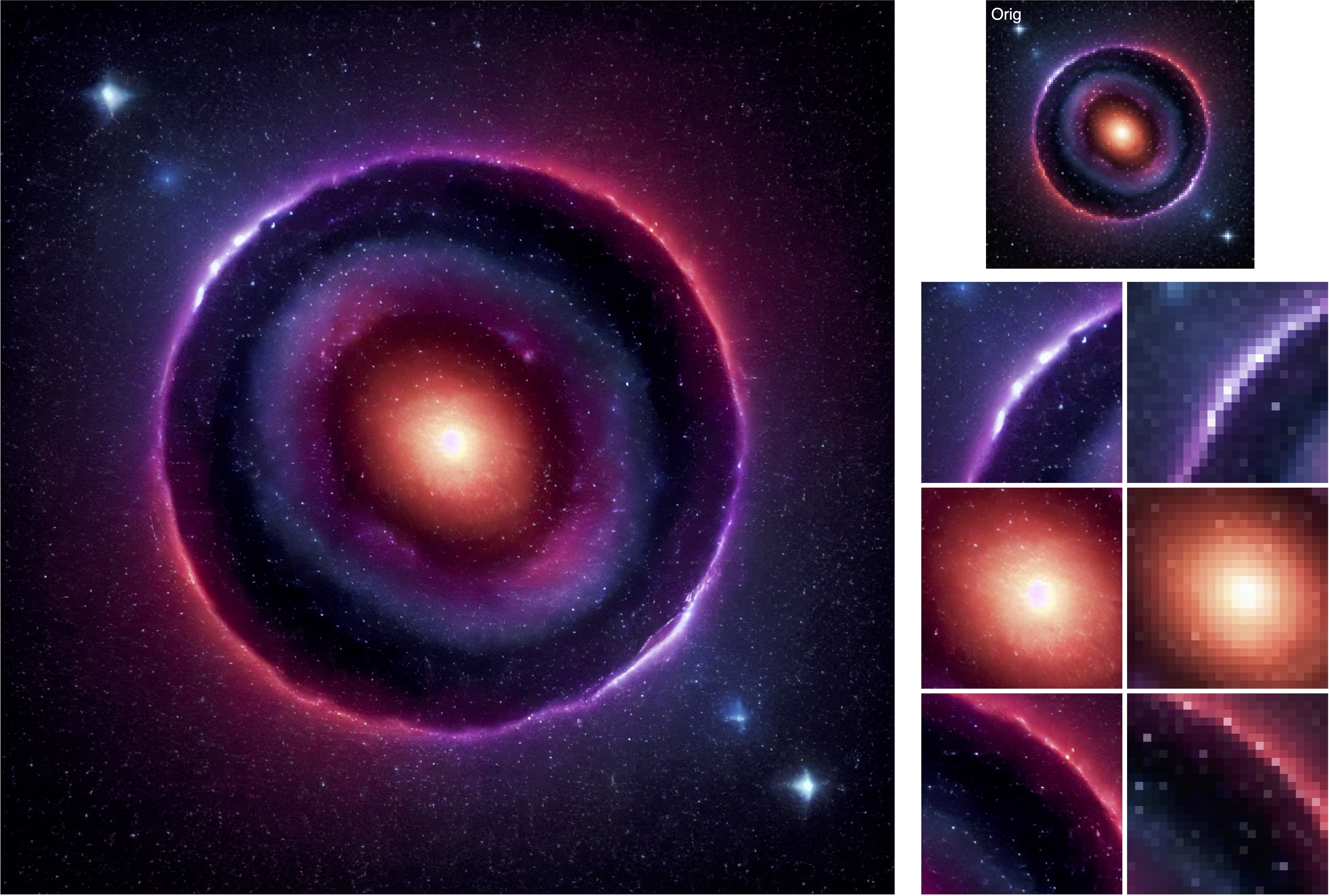
You can find more qualitative results on our project page.
🔥 Usage
Please execute the following command to download the first stage autoencoder checkpoint:
mkdir checkpoints
wget -O checkpoints/sd_ae.ckpt https://www.dropbox.com/scl/fi/lvfvy7qou05kxfbqz5d42/sd_ae.ckpt?rlkey=fvtu2o48namouu9x3w08olv3o&st=vahu44z5&dl=0
Data
For training the model, you have to provide a config file. An example config can be found in configs/flow400_64-128/unet-base_psu.yaml. Please customize the data part to your use case.
In order to speed up the training process, we pre-computed the latents. Your dataloader should return a batch with the following keys, i.e. image, latent, and latent_lowres. Please notice that we use pixel space upsampling (PSU in the paper), therefore the latent and latent_lowres should have the same spatial resolution (refer to L228 extract_from_batch() in fmboost/trainer.py).
Training
Afterwards, you can start the training with
python3 train.py --config configs/flow400_64-128/unet-base_psu.yaml --name your-name --use_wandb
the flag --use_wandb enables logging to WandB. By default, it only logs metrics to a CSV file and tensorboard. All logs are stored in the logs folder. You can also define a folder structure for your experiment name, e.g. logs/exp_name.
Resume checkpoint
If you want to resume from a checkpoint, just add the additional parameter
... --resume_checkpoint path_to_your_checkpoint.ckpt
This resumes all states from the checkpoint (i.e. optimizer states). If you want to just load weights in a non-strict manner from some checkpoint, use the --load_weights argument.
Inference
We will release a pretrained checkpoint and the corresponding inference jupyter notebook soon. Stay tuned!
🎓 Citation
Please cite our paper:
@InProceedings{schusterbauer2024boosting,
      title={Boosting Latent Diffusion with Flow Matching},
      author={Johannes Schusterbauer and Ming Gui and Pingchuan Ma and Nick Stracke and Stefan A. Baumann and Vincent Tao Hu and Björn Ommer},
      booktitle = {ECCV},
      year={2024}
}