



kind-cluster — Local Kubernetes Lab on KinD
Local Kubernetes lab on Docker via KinD — Traefik ingress (with opt-in Gateway API), a LoadBalancer (cloud-provider-kind, or MetalLB), Headlamp UI, RWX NFS storage, a local image registry, and Prometheus wired up out of the box. Run on your host, or inside a throwaway Multipass VM.
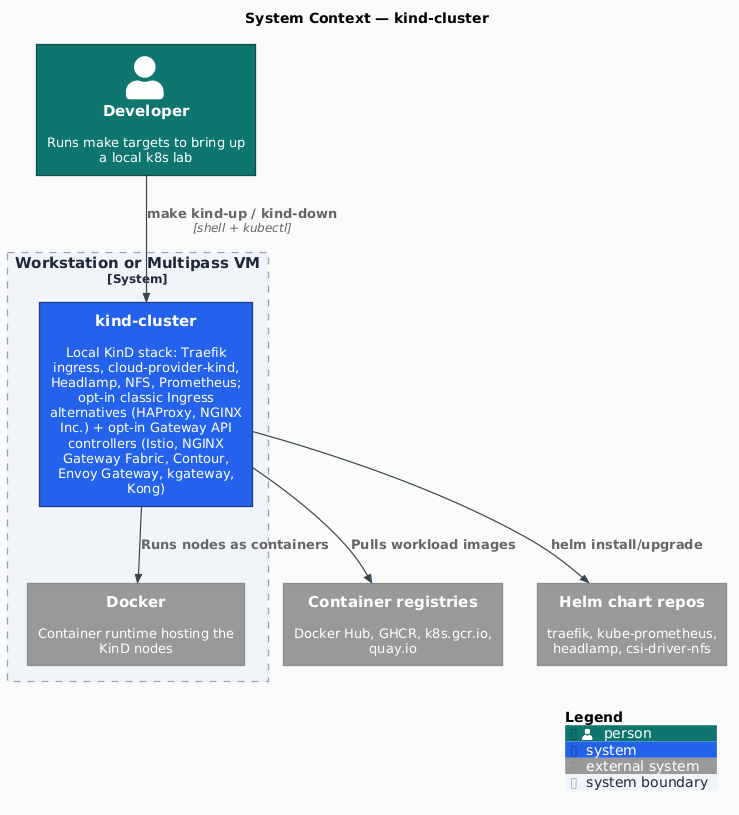
| Component | Technology | Rationale |
|---|---|---|
| Cluster | KinD v0.32.0 on Docker | Fastest local k8s — single binary, multi-node config, no VM overhead |
| Ingress | Traefik v3 (chart 40.x) | Replaces the retired ingress-nginx; supports networking.k8s.io/v1 Ingress + Gateway API on one binary |
| Load Balancer (default) | cloud-provider-kind v0.10.0 | One host container watches Service: LoadBalancer and hands out IPs from the kind docker bridge — routable from your laptop with zero extra setup. Kind-team maintained. |
| Load Balancer (alternative) | MetalLB v0.16.0 | In-cluster install (controller + speaker DaemonSet + CRDs). Pick it when you need L2/BGP announcement parity with prod. Enable with LB=metallb make install-all — see Which LoadBalancer?. |
| Storage (RWX) | csi-driver-nfs v4.13.2 | Same driver backs both in-cluster and host-NFS modes — only the StorageClass differs |
| Observability | kube-prometheus-stack | One-shot Prometheus + Grafana + Alertmanager + node-exporter for HPA / dashboards |
| Web UI | Headlamp 0.42.x | SIG-UI-endorsed Kubernetes UI (successor to the archived kubernetes/dashboard); single-pod ClusterIP with token-based login |
| CI | GitHub Actions | make deps + make kind-create — same Makefile path users hit locally; CI verifies install scripts on every push |
Quick Start
make deps        # auto-bootstraps mise + installs pinned tools from .mise.toml
make kind-up     # create cluster + Traefik ingress + cloud-provider-kind + demo workloads
kubectl cluster-info --context kind-kind
echo "127.0.0.1 demo.localdev.me" | sudo tee -a /etc/hosts   # one-time
# Open http://demo.localdev.me/
make kind-down   # tear down
kind-up is a docker-compose-style alias for install-all. For the cluster and add-ons without the demo apps, run make install-all-no-demo-workloads.
Once the stack is up, see Access services for discovering LoadBalancer IPs and opening service URLs — the same section covers both bare-host (make kind-up) and VM (make vm-install-all) paths.
Prerequisites
User provides (host-level):
| Tool | Version | Purpose |
|---|---|---|
| GNU Make | 3.81+ | Task orchestration |
| Git | latest | Version control |
| Docker | latest | Container runtime for KinD nodes |
| helm | v3+ | Chart-based installs (Headlamp, Prometheus, NFS) |
| curl | latest | Download helpers used by scripts |
| base64 | latest | Token decoding for Headlamp access |
Pinned in .mise.toml, auto-installed by make deps via mise (mise itself is bootstrapped into ~/.local/bin on first run):
| Tool | Pinned version |
|---|---|
| kind | 0.32.0 |
| kubectl | 1.36.2 |
| jq | 1.8.1 |
| shellcheck | 0.11.0 |
| actionlint | 1.7.12 |
| gitleaks | 8.30.1 |
| trivy | 0.71.0 |
| hadolint | 2.14.0 |
| act | 0.2.89 |
| bats | 1.13.0 |
Renovate's native mise manager keeps .mise.toml up to date (platform automerge enabled).
Architecture
Container View
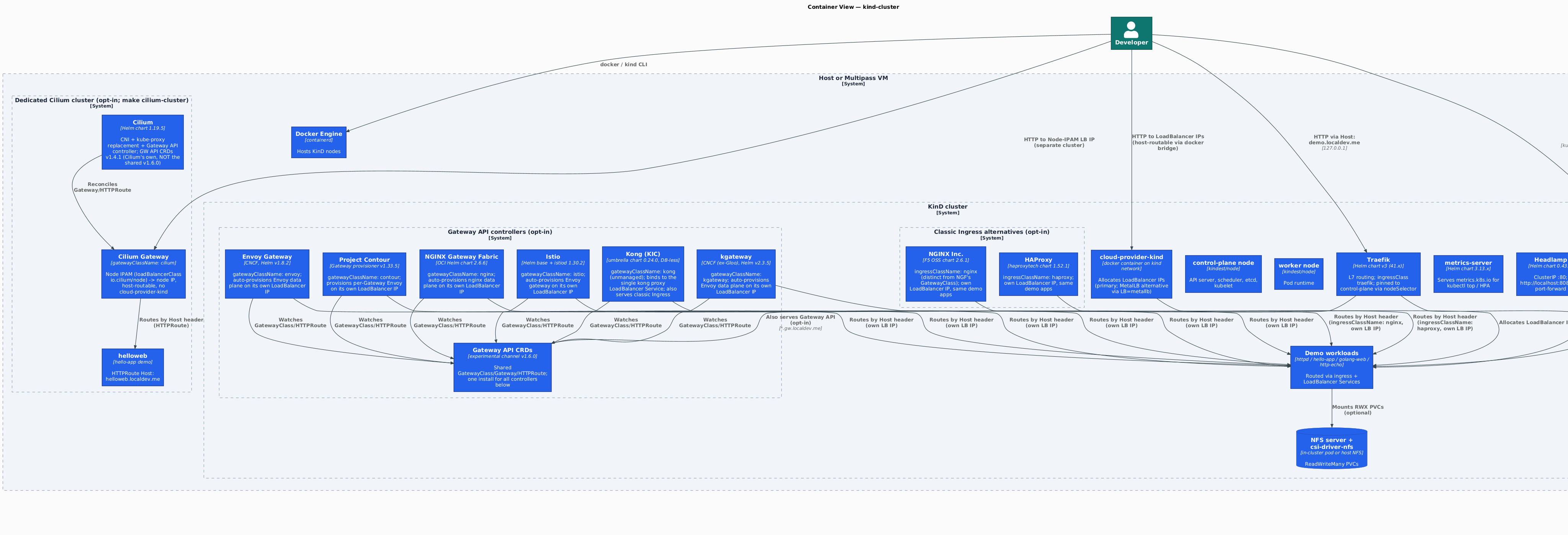
Source: docs/diagrams/c4-container.puml. Render with make diagrams (uses pinned plantuml/plantuml Docker image).
The cluster runs entirely on the local Docker bridge. The LoadBalancer provider (cloud-provider-kind by default) hands out Service: LoadBalancer IPs from the bridge's IPv4 subnet, so demo apps are reachable directly via curl <LB_IP>:<port> from the host.
Ingress is pinned to the control-plane node (via the ingress-ready nodeSelector label). kind-config.yaml maps host ports 80/443 to that node, so http://demo.localdev.me/ resolves through the host port — independent of which LoadBalancer provider is active.
Headlamp listens on port 80 inside the cluster — reach it via the headlamp-forward target (forwards to http://localhost:8081).
Deployment View
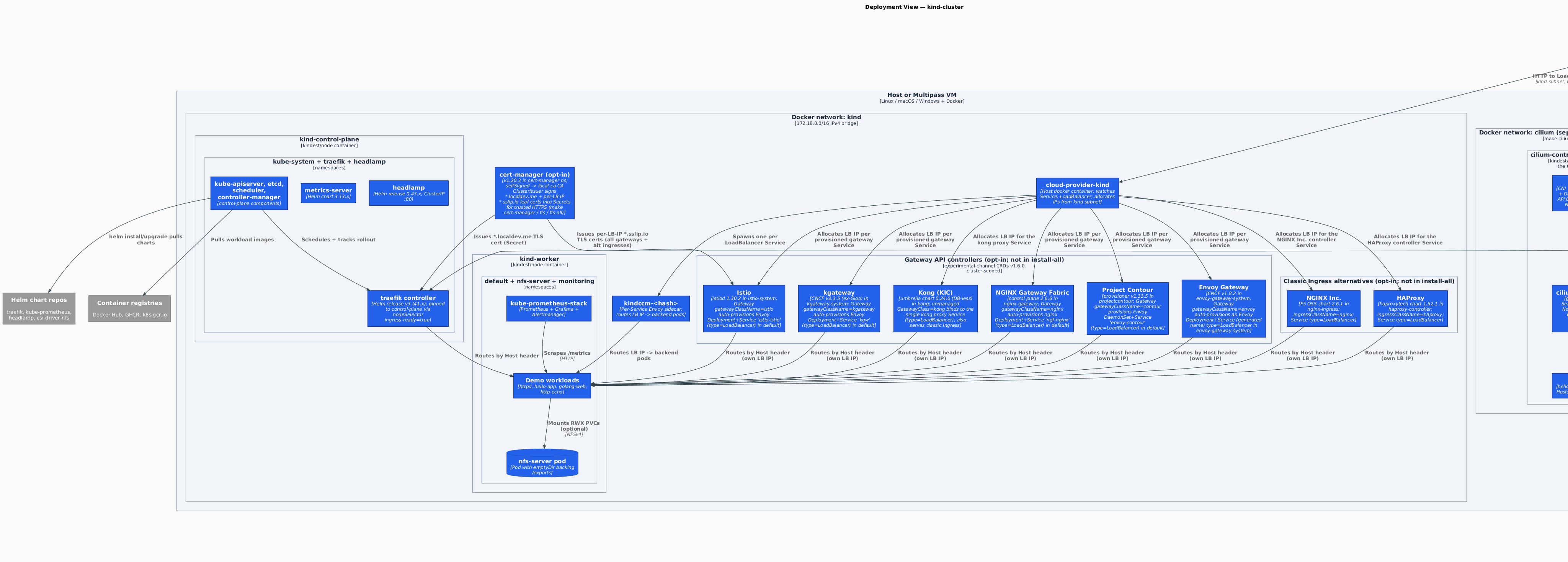
Source: docs/diagrams/c4-deployment.puml.
kind-control-planenode — kindest/node container running kube-apiserver/etcd/scheduler plus Traefik (pinned here via theingress-ready=truenodeSelector + control-plane toleration), with Headlamp and metrics-server scheduled cluster-wide.kind-workernode — runs application workloads (demo apps, in-cluster NFS server pod, kube-prometheus-stack).cloud-provider-kind— host docker container watchingService: LoadBalanceron the kind docker network; allocates LB IPs from the kind subnet (172.18.0.0/16 by default).kindccm-<hash>— per-Service Envoy sidecars spawned by cloud-provider-kind that route LB-IP traffic to backend pods. Cleaned up bymake kind-destroy(failing to clean these up was the cause of the K1.5 "connection reset on first curl" flake — seescripts/kind-delete.sh).- Developer access — host port 80/443 forwards to Traefik via
kind-config.yamlextraPortMappings (and Traefik's chart hostPort overrides), sohttp://*.localdev.me/resolves through the kind host port without needing the LB IP. The LB IP route is also host-routable for direct-IP access.
Which LoadBalancer?
The default is cloud-provider-kind (CPK). Simpler setup, kind-team maintained. Stick with it unless you have a specific reason to pick MetalLB.
| cloud-provider-kind (default) | MetalLB | |
|---|---|---|
| Install form | host docker run on the kind network |
in-cluster Deployment + DaemonSet + CRDs |
| IP allocation | automatic from the kind Docker subnet |
you declare an IPAddressPool range |
| Maintenance | kind-team, single binary | independent release cadence |
| When to pick | works for everything this repo deploys | you need BGP / L2Advertisement parity with prod, or want to reproduce a MetalLB-specific bug |
Two entry points to MetalLB:
LB=metallb make install-all    # fresh cluster with MetalLB as the LB provider
make lb-metallb                # already-running cluster, no LB yet — install MetalLB only
Switching providers on a live cluster requires tearing down the first one — each script hard-refuses if the other is present. Run make kind-down && LB=<provider> make kind-up for a clean reset.
Ingress vs Gateway API
The default routing path is classic Ingress (networking.k8s.io/v1, ingressClassName: traefik) — the simplest thing that works. The Kubernetes Gateway API is its GA successor (the Ingress API is frozen; ingress-nginx is retiring — the reason this project moved to Traefik). Traefik, Istio, NGINX Gateway Fabric, and Contour are all conformant Gateway API controllers and can be enabled here opt-in, each routing the same demo apps:
make gateway-traefik   # enable Traefik's Gateway API provider (same pod also keeps classic Ingress)
make gateway-istio     # add Istio as a 2nd Gateway API controller, its own LB IP, same backends
make gateway-nginx     # add NGINX Gateway Fabric (the Gateway-API successor to ingress-nginx), its own LB IP, same backends
make gateway-contour   # add Project Contour (Gateway provisioner), its own LB IP, same backends
They coexist because each GatewayClass has a distinct controllerName and cloud-provider-kind gives each gateway its own LoadBalancer IP. Antrea is not in this comparison — it's a CNI, not a Gateway API controller (its "gateway" is the antrea-gw0 dataplane interface); the real CNI-integrated gateways are Cilium / Calico.
📖 Full comparison (Traefik vs Istio vs Cilium/Calico), coexistence mechanics, and "is it advisable to run all of them?" — see docs/gateway-api-ingress.md.
Headlamp install
Pinned to Helm chart headlamp 0.42.0. Headlamp is the SIG-UI-endorsed successor to the archived kubernetes/dashboard project — a single Pod fronted by a ClusterIP Service on port 80 (HTTP), with token-based login.
flowchart LR
    B[Browser<br/>http://localhost:8081] -->|kubectl port-forward| S[Service<br/>headlamp:80]
    S --> P[Pod<br/>headlamp]
make headlamp-install   # helm upgrade --install + apply admin ServiceAccount + write token to headlamp-admin-token.txt
make headlamp-forward   # kubectl port-forward svc/headlamp 8081:80 + xdg-open
make headlamp-token     # print the admin-user token
At the login screen, paste the token printed by make headlamp-token. See Access services · Headlamp for the bare-host vs VM port-forward/tunnel recipes.
Uninstall: helm delete headlamp --namespace headlamp.
NFS & RWX storage
Kubernetes default storage classes only support ReadWriteOnce (a PV can be mounted by a single node). To run workloads that need ReadWriteMany (multiple pods writing to the same volume) — e.g., CI shared caches, content-processing pipelines, WordPress clusters — you need an NFS-backed StorageClass.
Two approaches are provided. Pick one.
Option 1 — in-cluster NFS (recommended for local dev)
An NFS server runs as a pod inside the cluster. csi-driver-nfs provisions PVs backed by that pod. No host config, no sudo, no /etc/exports. Tears down cleanly with the cluster; data does not survive make kind-down.
flowchart LR
    subgraph cluster[kind cluster]
        A[app pod] -->|RWX PVC<br/>storageClassName: nfs-csi| SC[StorageClass<br/>nfs-csi]
        SC --> CSI[csi-driver-nfs<br/>kube-system]
        CSI -->|NFSv4.1| NS[nfs-server pod<br/>namespace: nfs-server]
        NS --> ED[(emptyDir<br/>ephemeral)]
    end
make nfs-incluster
kubectl apply -f ./k8s/nfs/pvc-incluster.yaml   # sample RWX PVC
Pinned versions: csi-driver-nfs v4.13.2. Source: scripts/kind-add-nfs-incluster.sh.
Option 2 — host-side NFS (persistent across cluster recreates)
The host machine (your laptop) runs nfs-kernel-server as a system service; the same csi-driver-nfs used by Option 1 is installed into the cluster but configured to mount exports from the host instead of from an in-cluster pod. Data lives on your host disk — it survives make kind-down. Requires sudo and works only on Linux.
Both commands run from your laptop shell (no SSH, no VM login). The split is what each command modifies:
make nfs-host-setupmodifies your laptop OS —apt install nfs-kernel-server, edits/etc/exports, opens the firewall, starts the systemd service. Interactive sudo.make nfs-host-provisionerreaches the cluster via kubectl —helm install csi-driver-nfs+ aStorageClasspointing at your laptop's IP.
flowchart LR
    subgraph cluster[kind cluster]
        A[app pod] -->|RWX PVC<br/>storageClassName: nfs-host| SC[StorageClass<br/>nfs-host]
        SC --> CSI[csi-driver-nfs<br/>kube-system]
    end
    subgraph host[Your laptop — host OS, sudo-managed]
        NFS[nfs-kernel-server<br/>systemd]
        DISK[("/srv/k8s_nfs_storage")]
    end
    CSI -.NFSv4 over TCP.-> NFS
    NFS --> DISK
# Step 1 — laptop: install nfs-kernel-server, create export, open firewall (interactive sudo)
make nfs-host-setup

# Step 2 — cluster (via kubectl from the same laptop shell):
#          install csi-driver-nfs + StorageClass, point it at your laptop's IP
make nfs-host-provisioner NFS_SERVER=192.168.1.27
kubectl apply -f ./k8s/nfs/pvc.yaml             # sample RWX PVC; binds via the nfs-host StorageClass
Option 1 and Option 2 differ only in backend: csi-driver-nfs is installed once, and you pick a StorageClass (nfs-csi for in-cluster, nfs-host for host-backed). Sources: scripts/kind-add-nfs-host-setup.sh, scripts/kind-add-nfs-host-provisioner.sh.
References: NFS Server on Ubuntu · Dynamic NFS Provisioning in k8s · RWX in KinD with NFS.
Run in a VM (Multipass)
For full reproducibility — and to keep Docker, kind, and the host NFS server off your main machine — the whole stack can run inside a throwaway Ubuntu VM. Multipass ships the image, and a cloud-init YAML does the bootstrap.
flowchart LR
    DEV[Developer<br/>laptop shell]
    subgraph vm[Multipass VM: kind-host]
        subgraph cluster[kind cluster]
            ING[Traefik]
            HL[Headlamp]
            APPS[demo apps]
        end
        LB[cloud-provider-kind<br/>host container on kind docker net]
        NFS[nfs-kernel-server<br/>optional — NFS Option 2]
        LB -.allocates LB IP.-> ING
        cluster -.NFSv4.-> NFS
    end
    DEV -->|multipass CLI / make vm-ssh| vm
    DEV -.->|SSH tunnel / static route<br/>see Access services Path B| ING
1. Install Multipass
| Platform | Install command | Notes |
|---|---|---|
| Ubuntu / Debian / other Linux with snap | sudo snap install multipass |
Uses snap confinement; nested virtualization works on KVM-capable hosts |
| macOS (Apple Silicon / Intel) | brew install --cask multipass |
Uses hypervisor.framework on M1/M2/M3 |
| Windows 10/11 | winget install Canonical.Multipass or direct download |
Requires Hyper-V (Pro/Enterprise) or VirtualBox |
Verify: multipass version should print a version string and the daemon should be reachable (multipass list returns a table, even if empty).
Other install methods and troubleshooting: multipass.run/install.
2. Launch the VM
make vm-up                                # defaults: 4 CPU / 8 GB RAM / 40 GB disk
# or override:
make vm-up CPUS=6 MEMORY=12G DISK=60G NAME=my-kind
First boot takes ~3–5 min (Ubuntu cloud image download, apt-get install, docker pull, kind/kubectl/helm fetch). Subsequent vm-up on the same NAME is a no-op — the command prints VM already exists and shows multipass info.
The cloud-init playbook (vm/cloud-init.yaml) runs once at first boot:
- Installs Docker CE, KinD v0.32.0, kubectl v1.36.1, helm v4.2.0
- Installs
nfs-kernel-server, exports/srv/k8s_nfs_storage - Clones this repo to
/home/ubuntu/kind-cluster - Writes
/var/lib/kind-cluster-bootstrappedas the finished sentinel —vm-up.shpolls this file.
3. Run the stack
# Option A: interactive — SSH in, then run inside
make vm-ssh
cd ~/kind-cluster && make install-all

# Option B: remote one-shot (git pulls latest + runs install-all)
make vm-install-all
4. Tear down
make vm-down
Runs multipass stop && multipass delete && multipass purge — no stale VMs left behind.
Override NAME to target a specific VM: make vm-down NAME=my-kind.
Access services
This section applies to both install paths — make kind-up (cluster runs in host Docker) and make vm-install-all (cluster runs inside a Multipass VM). Pick your path below; the rest of the section uses shell variables that are populated by commands you can copy-paste, so no <LB_IP>-style hand-editing.
Access patterns
Three patterns map to three needs — the stack uses each where it fits:
| Pattern | What | Used by |
|---|---|---|
| Ingress | one L7 gateway (Traefik) fronts every HTTP demo, routed by Host header | demo.localdev.me, helloweb.localdev.me, golang.localdev.me, foo.localdev.me |
| LoadBalancer | the LB provider (cloud-provider-kind or MetalLB) allocates ONE external IP — for the ingress controller — plus a distinct IP for Grafana (persistent admin UI) | traefik, Grafana |
| Port-forward | kubectl port-forward from your terminal to an in-cluster Service; ephemeral, admin-only |
Headlamp, Prometheus, Alertmanager |
All HTTP demo apps use ingress. Step 2–4 below set up one LB IP plus one /etc/hosts entry that covers every demo app.
Step 1 — point kubectl at the cluster
Define a kube shell function that both paths use identically. A function (rather than a variable holding a multi-word command) works in both bash and zsh — zsh doesn't word-split unquoted $VAR references, so KUBECTL="multipass exec … -- kubectl"; $KUBECTL get svc fails there.
# Path A — bare host (you ran `make kind-up` on your laptop)
kube() { kubectl "$@"; }

# Path B — Multipass VM (you ran `make vm-install-all`)
NAME=${NAME:-kind-host}
VM_IP=$(multipass info "$NAME" --format json | jq -r '.info | to_entries[0].value.ipv4[0]')
kube() { multipass exec "$NAME" -- kubectl "$@"; }
echo "NAME=$NAME  VM_IP=$VM_IP"
From here on, every kubectl command is written as kube … so both paths run the same snippets.
Step 2 — discover the ingress IP
Only Traefik gets a LoadBalancer IP now (demo apps are ClusterIP services behind ingress). Grab it once:
INGRESS_IP=$(kube get svc -n traefik traefik -o jsonpath='{.status.loadBalancer.ingress[0].ip}')
echo "INGRESS_IP=$INGRESS_IP"
Step 3 — add the demo hostnames to /etc/hosts
All four demo apps are reached by hostname under demo.localdev.me, helloweb.localdev.me, golang.localdev.me, foo.localdev.me. Pick the target based on install path:
Path A (bare host) and Path B · Option 1 — point them at 127.0.0.1. kind-config.yaml's extraPortMappings already wires 127.0.0.1:80 to the kind control-plane node (where Traefik is pinned via ingress-ready), so host-side ingress traffic works without touching any LB IP:
# Idempotent — replace any existing *.localdev.me entries
sudo sed -i.bak '/\.localdev\.me/d' /etc/hosts
echo "127.0.0.1 demo.localdev.me helloweb.localdev.me golang.localdev.me foo.localdev.me" | sudo tee -a /etc/hosts
Path A: skip to Step 4.
Path B · Option 1 — SSH tunnel to the VM's ingress port. One tunnel for all four hostnames (they all resolve to the ingress):
# One-time: authorize your host key in the VM (multipass launch does not inject it)
PUBKEY=$(cat ~/.ssh/id_ed25519.pub)
multipass exec "$NAME" -- bash -c "mkdir -p /home/ubuntu/.ssh && grep -qxF '$PUBKEY' /home/ubuntu/.ssh/authorized_keys 2>/dev/null || echo '$PUBKEY' >> /home/ubuntu/.ssh/authorized_keys && chown -R ubuntu:ubuntu /home/ubuntu/.ssh && chmod 700 /home/ubuntu/.ssh && chmod 600 /home/ubuntu/.ssh/authorized_keys"

# Forward host port 80 → VM's kind hostPort 80 (needs sudo for <1024).
sudo ssh -fN -L 80:127.0.0.1:80 ubuntu@"$VM_IP"
If you don't want sudo, tunnel to a non-privileged port and append :8080 to every URL:
ssh -fN -L 8080:127.0.0.1:80 ubuntu@"$VM_IP"
# Then http://helloweb.localdev.me:8080/ , http://foo.localdev.me:8080/ , etc.
Kill tunnels with pkill -f "ssh.*-L.*$VM_IP".
Path B · Option 2 — Static route to the kind subnet (Linux/macOS, sudo once, no port suffix).
Route to the VM's kind docker subnet + allow DOCKER-USER forwards, then point /etc/hosts at $INGRESS_IP instead of 127.0.0.1:
# [HOST] — discover the kind IPv4 subnet (modern Docker lists IPv6 first when dual-stack)
KIND_NET=$(multipass exec "$NAME" -- bash -lc "docker network inspect kind | jq -r '.[0].IPAM.Config[] | select(.Subnet | test(\"^[0-9]+\\\\.\")) | .Subnet' | head -1")

# [VM] — Docker installs a default `FORWARD DROP` policy; allow the kind subnet.
multipass exec "$NAME" -- sudo iptables -I DOCKER-USER -s "$KIND_NET" -j ACCEPT
multipass exec "$NAME" -- sudo iptables -I DOCKER-USER -d "$KIND_NET" -j ACCEPT

# [HOST] — static route
sudo ip route add "$KIND_NET" via "$VM_IP"                             # Linux
# sudo route -n add -net "$KIND_NET" "$VM_IP"                          # macOS

# [HOST] — repoint /etc/hosts from 127.0.0.1 to $INGRESS_IP
sudo sed -i.bak '/\.localdev\.me/d' /etc/hosts
echo "$INGRESS_IP demo.localdev.me helloweb.localdev.me golang.localdev.me foo.localdev.me" | sudo tee -a /etc/hosts
Cleanup when you're done:
sudo ip route del "$KIND_NET"                                          # Linux
# sudo route -n delete -net "$KIND_NET"                                # macOS
sudo sed -i.bak '/\.localdev\.me/d' /etc/hosts
# DOCKER-USER rules go away with the VM.
Caveat: routes are kernel-wide and collide if another tool on your host already uses 172.18.0.0/16 (e.g., local Docker Desktop). If so, recreate the VM with a different docker bridge subnet or stick with Option 1.
Step 4 — hit the URLs
All four demo apps go through ingress. Same URLs on all paths (Path B · Option 1 adds :8080 if you chose the no-sudo tunnel):
curl http://demo.localdev.me/              # "It works!"  (httpd)
curl http://helloweb.localdev.me/          # "Hello, world!"  (Google hello-app)
curl http://golang.localdev.me/myhello/    # golang-web
curl http://golang.localdev.me/healthz     # golang-web health
curl http://foo.localdev.me/               # "foo" or "bar"  (http-echo; Service load-balances)
| Service | URL |
|---|---|
| ingress demo (httpd) | http://demo.localdev.me/ |
| helloweb | http://helloweb.localdev.me/ |
| golang-hello-world-web | http://golang.localdev.me/myhello/ · /healthz |
| foo-bar-service | http://foo.localdev.me/ |
Headlamp
Headlamp listens on port 80 inside the cluster (HTTP). Same flow on both paths: a kubectl port-forward. Path B adds an outer SSH tunnel to reach the VM.
# Path A — port-forward directly from your host (foreground; Ctrl+C to stop)
make headlamp-forward

# Path B — port-forward runs inside the VM (terminal 1), outer tunnel from host (terminal 2)
# terminal 1:  make vm-ssh   →   make headlamp-forward
# terminal 2:
ssh -fN -L 8081:localhost:8081 ubuntu@"$VM_IP"

# Both paths — grab the admin token for the login screen (reuses the `kube` function from Step 1)
kube -n headlamp create token admin-user
Browser: http://localhost:8081
Observability
kube-prometheus-stack (Prometheus + Grafana + Alertmanager)
Installs the community kube-prometheus-stack Helm chart into the monitoring namespace. Grafana is exposed via the LoadBalancer provider (whichever you picked); Prometheus and Alertmanager stay ClusterIP — reach them via kubectl port-forward.
The credential-discovery snippets reuse the kube function from Access services · Step 1. Paths labelled [HOST] run on your laptop; [VM] run inside the Multipass VM.
Path A — bare host (make kind-up)
port-forward from your laptop binds host-local ports — directly reachable in your browser.
# [HOST]
make kube-prometheus-stack

GRAFANA_IP=$(kube get svc -n monitoring kube-prometheus-stack-grafana -o jsonpath='{.status.loadBalancer.ingress[0].ip}')
GRAFANA_PASSWORD=$(kube get secret -n monitoring kube-prometheus-stack-grafana -o jsonpath='{.data.admin-password}' | base64 -d)
echo "Grafana:       http://$GRAFANA_IP/   (admin / $GRAFANA_PASSWORD)"

kube port-forward -n monitoring svc/kube-prometheus-stack-prometheus    9090:9090 >/dev/null 2>&1 &
kube port-forward -n monitoring svc/kube-prometheus-stack-alertmanager  9093:9093 >/dev/null 2>&1 &
echo "Prometheus:    http://localhost:9090/   (targets: /targets)"
echo "Alertmanager:  http://localhost:9093/"
Path B — Multipass VM (make vm-install-all)
Install runs inside the VM. kube port-forward would bind the VM's localhost (not your host's) — so the port-forward stays in the VM and you add an outer SSH tunnel from the host. Grafana goes through the LoadBalancer provider so the access mode depends on which Option from §Access services Step 3 you picked.
# [VM] — install + start in-VM port-forwards
multipass exec "$NAME" -- bash -lc 'cd ~/kind-cluster && make kube-prometheus-stack'
multipass exec "$NAME" -- bash -lc 'nohup kubectl port-forward -n monitoring svc/kube-prometheus-stack-prometheus    9090:9090 >/dev/null 2>&1 & disown'
multipass exec "$NAME" -- bash -lc 'nohup kubectl port-forward -n monitoring svc/kube-prometheus-stack-alertmanager  9093:9093 >/dev/null 2>&1 & disown'

# [HOST] — discover credentials
GRAFANA_IP=$(kube get svc -n monitoring kube-prometheus-stack-grafana -o jsonpath='{.status.loadBalancer.ingress[0].ip}')
GRAFANA_PASSWORD=$(kube get secret -n monitoring kube-prometheus-stack-grafana -o jsonpath='{.data.admin-password}' | base64 -d)

# [HOST] — outer SSH tunnels for Prometheus + Alertmanager (always needed for Path B)
ssh -fN -L 9090:localhost:9090 ubuntu@"$VM_IP"
ssh -fN -L 9093:localhost:9093 ubuntu@"$VM_IP"

# [HOST] — Grafana access depends on which §Access services Option you picked:
#   Path B · Option 1 (SSH tunnel):  add another tunnel on a free local port
ssh -fN -L 3000:"$GRAFANA_IP":80 ubuntu@"$VM_IP"
echo "Grafana (Option 1):  http://localhost:3000/  (admin / $GRAFANA_PASSWORD)"
#   Path B · Option 2 (static route): the LB IP is already routable from host
echo "Grafana (Option 2):  http://$GRAFANA_IP/      (admin / $GRAFANA_PASSWORD)"

echo "Prometheus:    http://localhost:9090/   (targets: /targets)"
echo "Alertmanager:  http://localhost:9093/"
Summary — pick the column matching your install path:
| Component | Path A (http://…) |
Path B · Option 1 | Path B · Option 2 |
|---|---|---|---|
| Grafana | http://$GRAFANA_IP/ |
http://localhost:3000/ |
http://$GRAFANA_IP/ |
| Prometheus | http://localhost:9090/ |
http://localhost:9090/ |
http://localhost:9090/ |
| Alertmanager | http://localhost:9093/ |
http://localhost:9093/ |
http://localhost:9093/ |
| Login (Grafana) | admin / $GRAFANA_PASSWORD |
same | same |
If you're running inside a Multipass VM, prefix with multipass exec $NAME -- or run the port-forward inside the VM and add a host-side SSH tunnel exactly like the Headlamp flow in §4 above (replace 8081 with 9090 / 9093).
metrics-server
Required for kubectl top and HorizontalPodAutoscalers. On KinD, it's installed via the metrics-server Helm chart with --set args={--kubelet-insecure-tls} (the KinD kubelet serving cert isn't signed by the cluster CA).
make metrics-server
Local Docker Registry
For pushing locally-built images without going through Docker Hub/GHCR, make registry creates a fresh KinD cluster wired to a Docker registry at localhost:5001 — containerd on the kind nodes mirrors that registry, so pods can pull localhost:5001/<image>:<tag> directly.
make registry         # create cluster + registry container
make registry-test    # pull hello-app, retag to localhost:5001, push, deploy, curl
This is an alternative to the default make install-all flow — the registry cluster doesn't include ingress, a LoadBalancer provider, or the demo workloads. Useful for iterating on an image you're building locally. Tear down with KIND_CLUSTER_NAME=kind-registry make kind-destroy and remove the registry container with docker rm -f kind-registry.
Available Make Targets
make help is the authoritative list. The table below groups targets by purpose for scanning.
| Category | Target | Description |
|---|---|---|
| Cluster | make kind-up |
docker-compose-style alias for install-all (bring the whole stack up) |
| Cluster | make kind-down |
docker-compose-style alias for kind-destroy (tear the whole stack down) |
| Cluster | make install-all |
cluster + Traefik ingress + LoadBalancer (CPK default, or LB=metallb) + demo workloads |
| Cluster | make install-all-no-demo-workloads |
same minus demo apps |
| Cluster | make kind-create |
Create KinD cluster only (alias: make create-cluster) |
| Cluster | make kind-destroy |
Delete KinD cluster + clean up cloud-provider-kind sidecars (alias: make delete-cluster) |
| Cluster | make export-cert |
Export k8s client keys and CA certificates |
| Cluster | make e2e |
Bring up the full stack and run smoke tests (chains install-all + e2e-smoke) |
| Cluster | make e2e-smoke |
Smoke-test an already-running cluster (no install) |
| Cluster | make clean |
Tear down cluster + remove generated scratch artifacts (certs, tokens) |
| Add-ons | make headlamp-install |
Headlamp UI (Helm chart 0.42.0) + admin ServiceAccount — successor to the archived kubernetes/dashboard |
| Add-ons | make headlamp-forward |
Port-forward Headlamp to http://localhost:8081 and open browser |
| Add-ons | make headlamp-token |
Print the admin-user token |
| Add-ons | make ingress-traefik |
Install Traefik ingress controller (replaces retired ingress-nginx) |
| Add-ons | make lb-cpk |
Install cloud-provider-kind (default LoadBalancer) |
| Add-ons | make lb-metallb |
Install MetalLB (alternative; also: LB=metallb make install-all) |
| Add-ons | make metrics-server |
metrics-server (for kubectl top / HPA) |
| Add-ons | make kube-prometheus-stack |
Prometheus + Grafana + Alertmanager |
| NFS | make nfs-incluster |
Option 1 — in-cluster NFS server + csi-driver-nfs (no host config) |
| NFS | make nfs-host-setup |
Option 2, step 1 — configure host as NFS server (sudo; Ubuntu/Debian) |
| NFS | make nfs-host-provisioner NFS_SERVER=<ip> |
Option 2, step 2 — install csi-driver-nfs pointing at the host export |
| Demo apps | make deploy-app-ingress-localhost |
httpd behind ingress at http://demo.localdev.me/ |
| Demo apps | make deploy-app-helloweb |
helloweb sample |
| Demo apps | make deploy-app-golang-hello-world-web |
golang-hello-world-web sample |
| Demo apps | make deploy-app-foo-bar-service |
foo-bar-service (two backends behind one Service) |
| Multipass VM | make vm-up |
launch Ubuntu 22.04 VM + cloud-init provisioning |
| Multipass VM | make vm-ssh |
open a shell inside the VM |
| Multipass VM | make vm-install-all |
run make install-all inside the VM |
| Multipass VM | make vm-down |
stop, delete, purge the VM |
| Registry | make registry |
KinD cluster wired to local Docker registry at localhost:5001 |
| Registry | make registry-test |
push hello-app:2.0 to the local registry and deploy it |
| Utilities | make deps |
bootstrap mise + install pinned tools from .mise.toml; verify docker/helm/curl/base64 on PATH |
| Utilities | make image-build |
build kubectl-test Docker image |
| Utilities | make image-test |
build + runtime-verify the kubectl-test image (the docker CI job) |
| Utilities | make renovate-validate |
validate renovate.json |
| Quality | make lint |
shellcheck + actionlint + hadolint + scripts-exec-bit check |
| Quality | make test |
bats unit tests for the scripts/lib.sh helpers |
| Quality | make secrets |
gitleaks (suppressions: .gitleaks.toml) |
| Quality | make trivy-fs |
Trivy fs scan (vulns, secrets, misconfigs; CRITICAL/HIGH) |
| Quality | make vulncheck |
Alias for trivy-fs (portfolio-standard target name) |
| Quality | make trivy-config |
Trivy scan of k8s/ manifests |
| Quality | make mermaid-lint |
validate mermaid blocks in tracked *.md files |
| Quality | make diagrams |
render PlantUML C4 diagrams (via pinned plantuml/plantuml image) |
| Quality | make diagrams-check |
verify committed PNGs match current .puml source |
| Quality | make diagrams-clean |
remove rendered PNGs under docs/diagrams/out/ and .drawio exports under docs/diagrams/drawio/ |
| Quality | make diagrams-drawio |
convert .puml sources to editable .drawio XML via pinned ghcr.io/andriykalashnykov/puml2drawio; output under docs/diagrams/drawio/ (gitignored — on-demand, for local editing) |
| Quality | make static-check |
composite: lint + test + secrets + trivy-fs + trivy-config + mermaid-lint + diagrams-check |
| Quality | make ci |
full local pipeline: static-check + renovate-validate |
| Quality | make ci-run |
run the GitHub Actions workflow locally via act |
Suppressions (intentional, justified inline):
.gitleaks.toml— allowlist for the localheadlamp-admin-token.txt..trivyignore.yaml— demo workloads use default securityContext, the in-cluster NFS pod needs privileged mode..hadolint.yaml—kubectl-testis a throwaway debug image; alpine-package pinning is overkill.
CI/CD
ci.yml runs on every push to main, tags v*, and pull requests. Three sibling workflows run on weekly crons (plus workflow_dispatch and targeted paths: triggers): e2e-metallb.yml, monitoring-test.yml, registry-test.yml. The CI workflow short-circuits on doc-only changes via the changes paths-filter detector job — heavy jobs only run when source code or workflow YAML changed.
ci.yml
| Job | Needs | Steps |
|---|---|---|
| changes | — | dorny/paths-filter outputs code=true if anything outside docs/markdown/images changed; downstream jobs gate on it |
| static-check | changes | make static-check (lint + test + secrets + trivy-fs + trivy-config + mermaid-lint + diagrams-check) |
| docker | changes, static-check | make image-test — build and runtime-verify the kubectl-test image |
| e2e | changes, static-check | jdx/mise-action + make deps + make kind-create, install ingress + cloud-provider-kind + Headlamp, deploy all demo workloads, K1.5 route-readiness poll, run make e2e-smoke for body-asserting smoke tests via docker exec (~4 min end-to-end) |
| ci-pass | changes, static-check, docker, e2e | Aggregate gate — fails if any upstream job failed or was cancelled |
Sibling workflows
| Workflow | Schedule | Triggers also on push to | What it covers |
|---|---|---|---|
e2e-metallb.yml |
Sun 04:00 UTC | scripts/kind-add-metallb.sh, scripts/migrate-from-metallb.sh, scripts/e2e-migrate-smoke.sh, the workflow itself |
Mirrors ci.yml's e2e job but installs MetalLB instead of cloud-provider-kind. Final step runs scripts/e2e-migrate-smoke.sh to exercise the MetalLB → cloud-provider-kind migration path. |
monitoring-test.yml |
Sun 05:00 UTC | scripts/kind-add-kube-prometheus-stack.sh, the workflow itself |
Brings up the full stack via the granular install scripts, installs kube-prometheus-stack, then runs TEST_MONITORING=yes make e2e-smoke to assert Grafana gets a LoadBalancer IP and the admin secret is mintable. |
registry-test.yml |
Sun 06:00 UTC | scripts/kind-with-registry.sh, scripts/test-registry.sh, k8s/helloweb-deployment-local.yaml, the workflow itself |
Exercises the alternative make registry cluster (containerd-mirrored local registry at localhost:5001) via make registry-test — pull → retag → push → deploy → curl. |
cleanup-runs.yml |
Sun 00:00 UTC | n/a | Prunes old workflow runs (keeps latest 5) and caches from closed PR branches. |
No repo secrets or variables are required by any workflow — only the default GITHUB_TOKEN.
Renovate keeps action digests, container images, .mise.toml pins (via the native mise manager), and Makefile / scripts/*.sh constants (via # renovate: inline comments) up to date with platform automerge enabled.
Contributing
Contributions welcome — open a PR. Run make ci locally before submitting.
License
MIT — see LICENSE.