
LightCL
1 Introduction
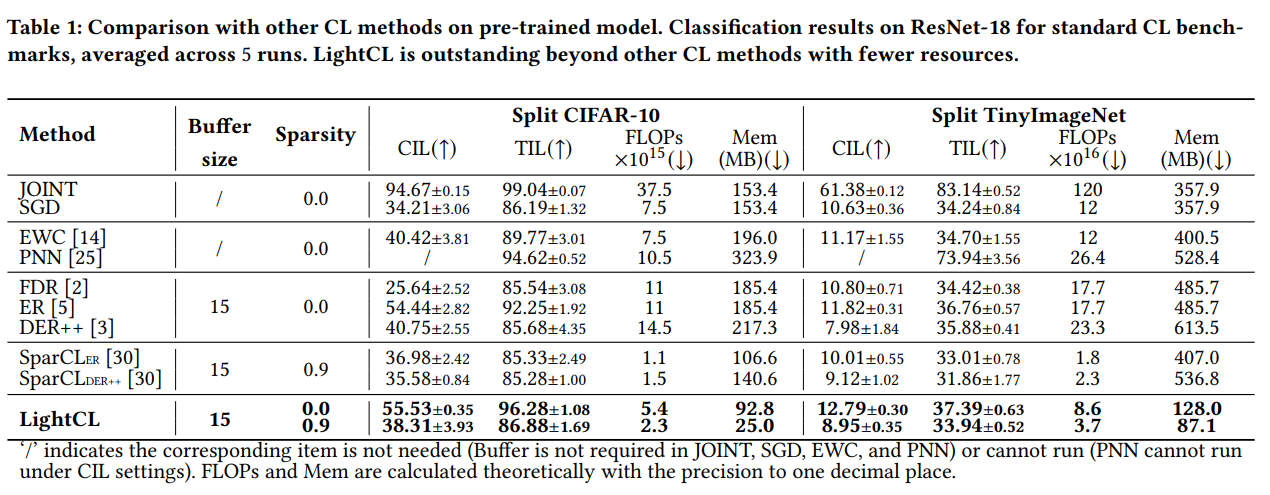
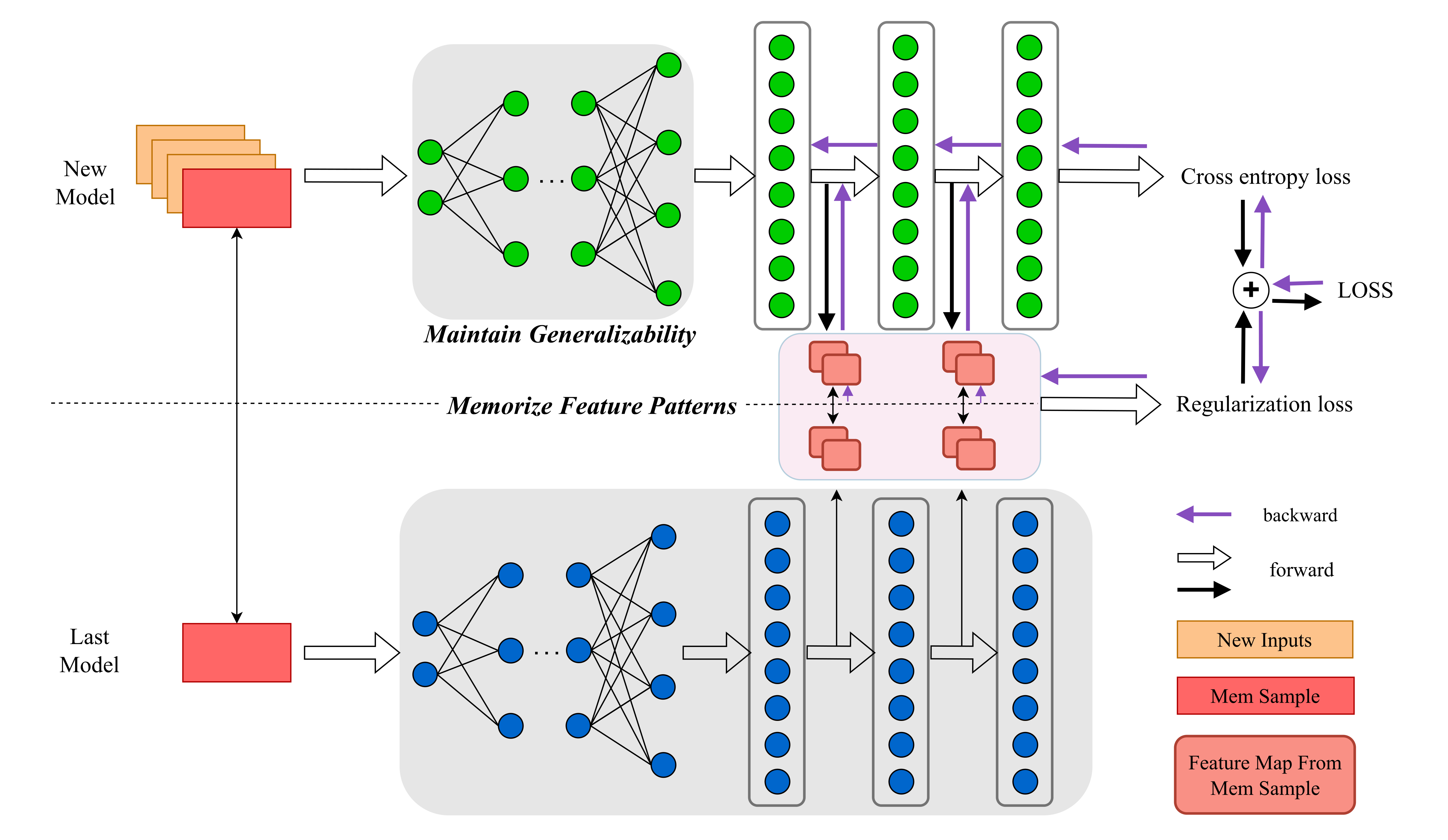 LightCL is a compact algorithm for continual learning. Specifically, we consider two factors of generalizability, learning plasticity and memory stability, and design metrics of both to quantitatively assess generalizability of neural networks during CL. This evaluation shows that generalizability of different layers in a neural network exhibits a significant variation. Thus, as shown in the following figure, we Maintain Generalizability by freezing generalized parts without the resource-intensive training process and Memorize Feature Patterns by stabilizing feature extracting of previous tasks to enhance generalizability for less-generalized parts with a little extra memory, which is far less than the reduction by freezing. The following Experiment illustrate that LightCL outperforms other state-of-the-art methods and reduces at most 6.16× memory footprint. We also verify the effectiveness of LightCL on the edge device.
2 Implementation
Requirements
- Python==3.11.4
- numpy==1.24.3
- torch==2.1.2
- torchvision==0.16.2
- tqdm==4.65.0, etc(which can be easily installed with pip)
Usage
Run LightCL.py with the commands like below:
- Default
python LightCL.py
- With sparse
python LightCL.py --Sparse
Here the major parameters are:
lr: learning rate (default=0.01)Beta: hyperparameter for regulation loss (default=0.0002)BufferNum: number of Memory Buffer (default=15)Ratio: selecting vital feature map withRatio(default=0.15)Seed: the random seed (default=0)pretrain: whether use the pre-trained model (default=True)Dataset: dataset (default: CIFAR10; Other: TinyImageNet)Sparse: whether sparse (default=False)
Note that we already have the pre-trained model (ResNet18_for_LightCL.pth) in the directory. If you want to pre-train the model yourself, you can download dataset ImageNet32x32 under data/ and run code get_parameter.py.
3 Cite
@inproceedings{wang2025lightCL,
author = {Wang, Zeqing and Cheng, Fei and Ji, Kangye and Huang, Bohu},
title = {LightCL: Compact Continual Learning with Low Memory Footprint For Edge Device},
booktitle = {Proceedings of the 30th Asia and South Pacific Design Automation Conference},
year = {2025},
}