
LinearRAG: Linear Graph Retrieval-Augmented Generation on Large-scale Corpora
A relation-free graph construction method for efficient GraphRAG. It eliminates LLM token costs during graph construction, making GraphRAG faster and more efficient than ever.



🎉 News
- [2026-04-07] Our ProbeRAG for RAG faithfulness is accepted by ACL'26.
- [2026-04-07] Our BAPO for reliable agentic search is accepted by ACL'26.
- [2026-04-07] Our LegalGraphRAG for reliable legal reasoning is accepted by ACL'26.
- [2026-04-07] Our LogicPoison, a GraphRAG attack model, is accepted by ACL'26.
- [2026-01-26] Our LinearRAG for efficient GraphRAG is accepted by ICLR’26.
- [2026-01-26] Our GraphRAG Benchmark is accepted by ICLR’26.
- [2025-10-27] We release LinearRAG, a relation-free graph construction method for efficient GraphRAG.
- [2025-06-06] We release the GraphRAG Benchmark for evaluating GraphRAG models.
- [2025-01-21] We release the GraphRAG survey.
🚀 Highlights
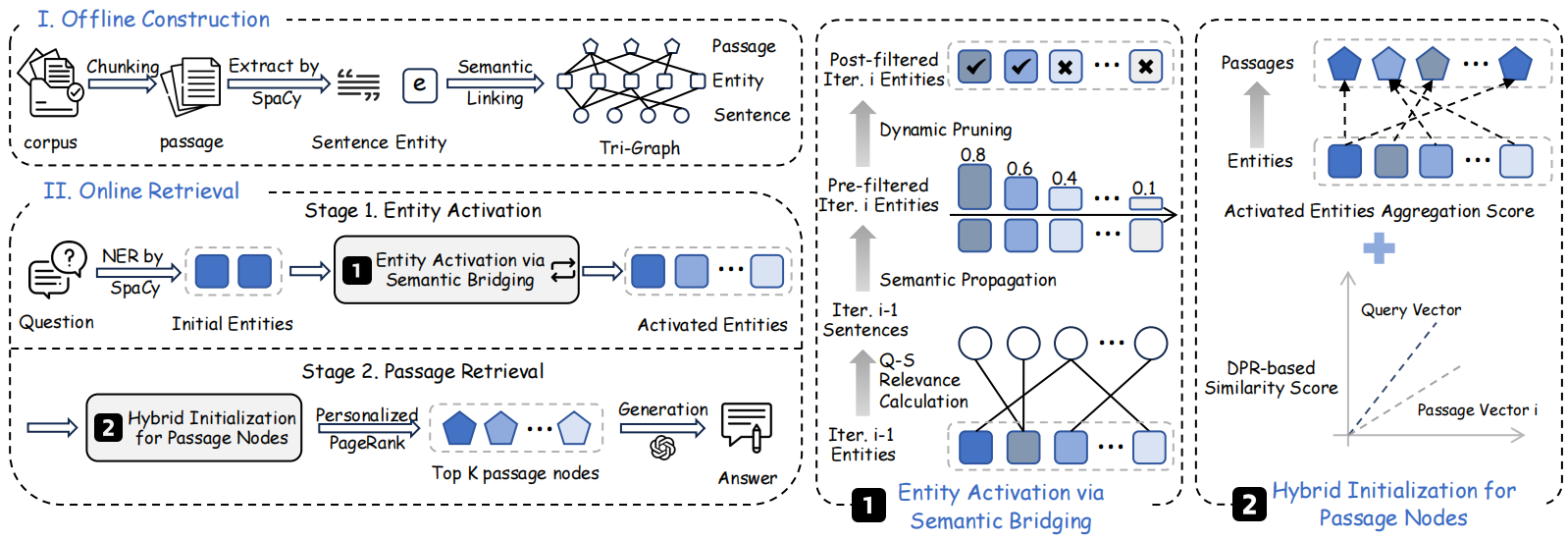
- ✅ Context-Preserving: Relation-free graph construction, relying on lightweight entity recognition and semantic linking to achieve comprehensive contextual comprehension.
- ✅ Complex Reasoning: Enables deep retrieval via semantic bridging, achieving multi-hop reasoning in a single retrieval pass without requiring explicit relational graphs.
- ✅ High Scalability: Zero LLM token consumption, faster processing speed, and linear time/space complexity.
🛠️ Usage
1️⃣ Install Dependencies
Step 1: Install Python packages
pip install -r requirements.txt
(Use Python 3.9 preferably)
Step 2: Download Spacy language model
python -m spacy download en_core_web_trf
Note: For the
medicaldataset, you need to install the scientific/biomedical Spacy model:
pip install https://s3-us-west-2.amazonaws.com/ai2-s2-scispacy/releases/v0.5.3/en_core_sci_scibert-0.5.3.tar.gz
Step 3: Set up your OpenAI API key
export OPENAI_API_KEY="your-api-key-here"
export OPENAI_BASE_URL="your-base-url-here"
Step 4: Download Datasets
Download the datasets from HuggingFace and place them in the dataset/ folder:
git clone https://huggingface.co/datasets/Zly0523/linear-rag
cp -r linear-rag/* dataset/
Step 5: Prepare Embedding Model
Make sure the embedding model is available at:
model/all-mpnet-base-v2/
2️⃣ Quick Start Example
SPACY_MODEL="en_core_web_trf"
EMBEDDING_MODEL="model/all-mpnet-base-v2"
DATASET_NAME="2wikimultihop"
LLM_MODEL="gpt-4o-mini"
MAX_WORKERS=16

python run.py \
    --spacy_model ${SPACY_MODEL} \
    --embedding_model ${EMBEDDING_MODEL} \
    --dataset_name ${DATASET_NAME} \
    --llm_model ${LLM_MODEL} \
    --max_workers ${MAX_WORKERS}
    # --use_vectorized_retrieval # optional, use vectorized matrix-based retrieval for GPU acceleration if Strong GPU is available, otherwise use BFS iteration.
🎯 Performance
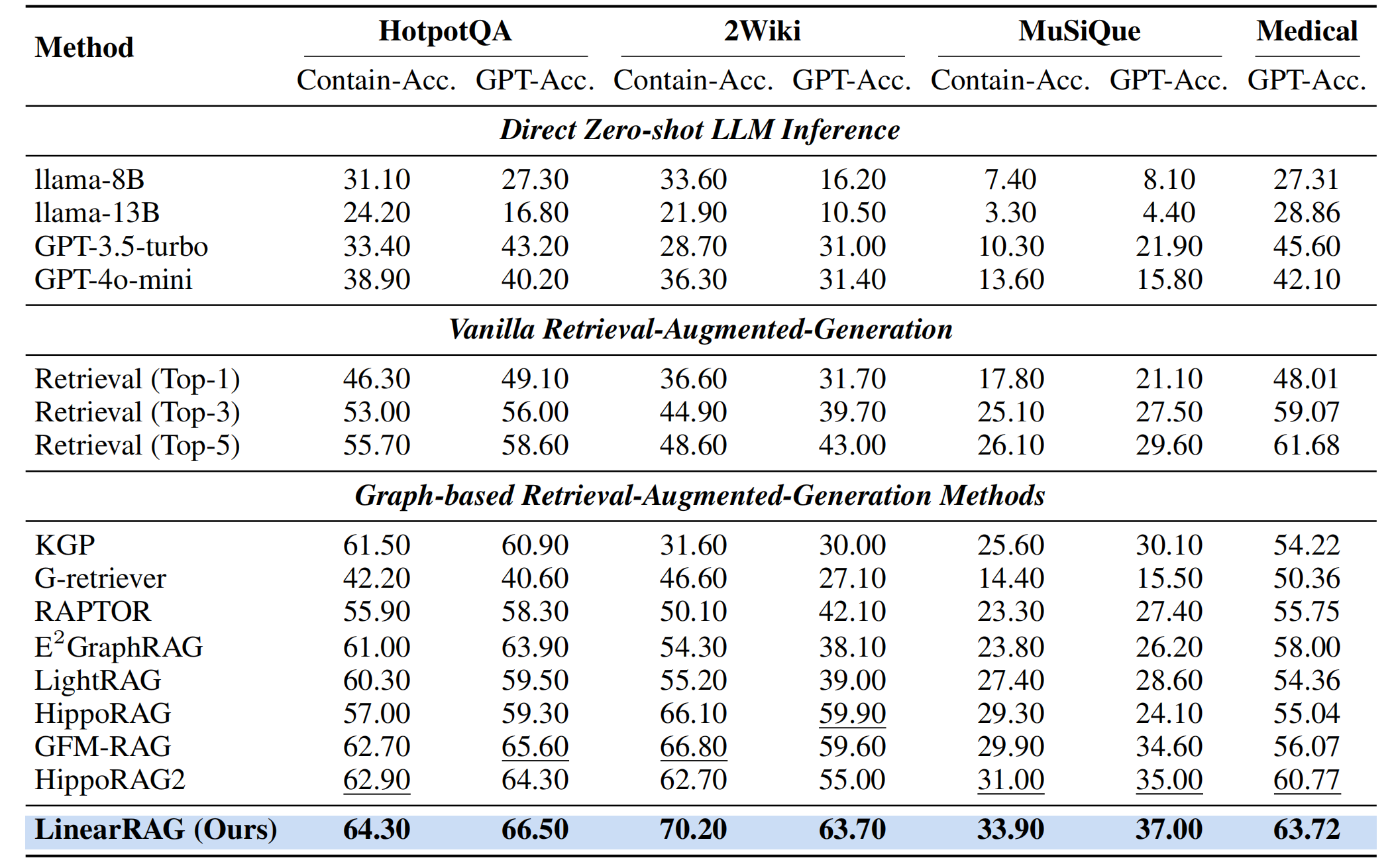
Main results of end-to-end performance
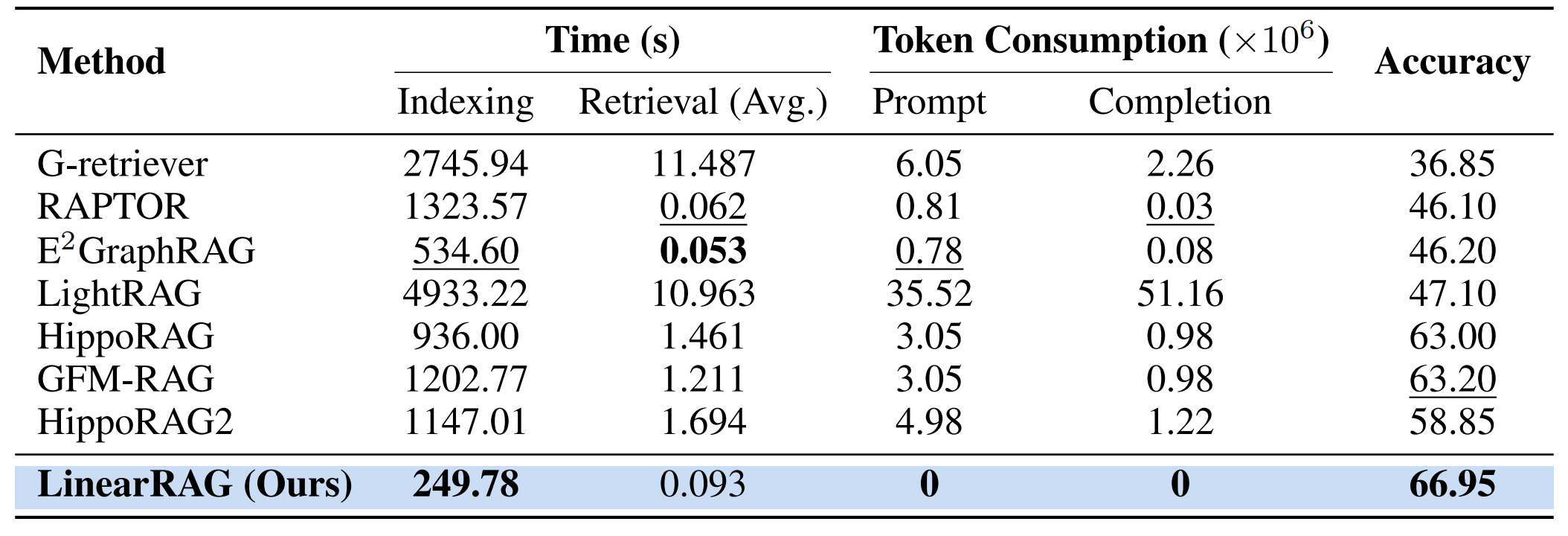
Efficiency and performance comparison.
📬 Citation
If you find this work helpful, please consider citing us:
@article{zhuang2025linearrag,
  title={LinearRAG: Linear Graph Retrieval Augmented Generation on Large-scale Corpora},
  author={Zhuang, Luyao and Chen, Shengyuan and Xiao, Yilin and Zhou, Huachi and Zhang, Yujing and Chen, Hao and Zhang, Qinggang and Huang, Xiao},
  journal={arXiv preprint arXiv:2510.10114},
  year={2025}
}