
LLMCompiler: An LLM Compiler for Parallel Function Calling [Paper]
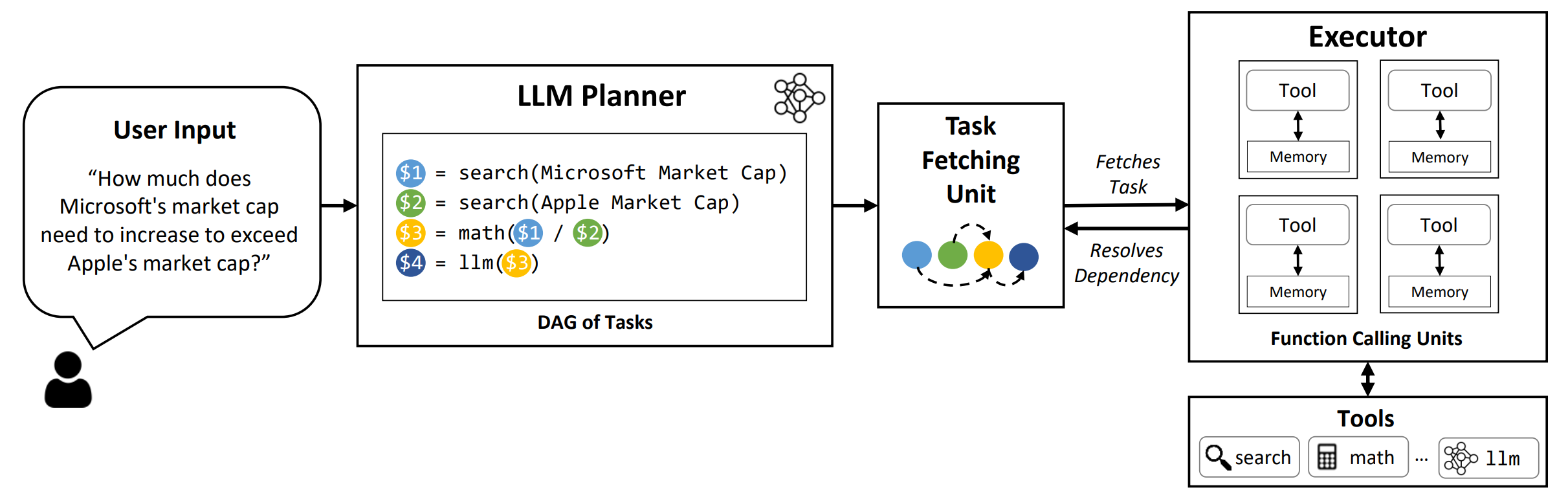
LLMCompiler is a framework that enables an efficient and effective orchestration of parallel function calling with LLMs, including both open-source and close-source models, by automatically identifying which tasks can be performed in parallel and which ones are interdependent.
TL;DR: The reasoning capabilities of LLMs enable them to execute multiple function calls, using user-provided functions to overcome their inherent limitations (e.g. knowledge cutoffs, poor arithmetic skills, or lack of access to private data). While multi-function calling allows them to tackle more complex problems, current methods often require sequential reasoning and acting for each function which can result in high latency, cost, and sometimes inaccurate behavior. LLMCompiler addresses this by decomposing problems into multiple tasks that can be executed in parallel, thereby efficiently orchestrating multi-function calling. With LLMCompiler, the user specifies the tools along with optional in-context examples, and LLMCompiler automatically computes an optimized orchestration for the function calls. LLMCompiler can be used with open-source models such as LLaMA, as well as OpenAI’s GPT models. Across a range of tasks that exhibit different patterns of parallel function calling, LLMCompiler consistently demonstrated latency speedup, cost saving, and accuracy improvement. For more details, please check out our paper.
News
- 📌 [7/9] Friendli endpoints are supported for popular open-source models.
- 🦜 [2/13] LLMCompiler is available within the LangGraph framework of LangChain.
- 📌 [1/17] Running custom models using vLLM supported
- 🦙 [12/29] LLMCompiler is available on LlamaIndex
Installation
- Create a conda environment and install the dependencies
conda create --name llmcompiler python=3.10 -y
conda activate llmcompiler
- Clone and install the dependencies
git clone https://github.com/SqueezeAILab/LLMCompiler
cd LLMCompiler
pip install -r requirements.txt
Basic Runs
To reproduce the evaluation results in the paper, run the following command.
You need to first register your OpenAI API key to the environment: export OPENAI_API_KEY="sk-xxx"
python run_llm_compiler.py --benchmark {benchmark-name} --store {store-path} [--logging] [--stream]
To run a custom models served using the vLLM framework, run the following command. Detailed instructions for serving custom models with the vLLM framework can be found in the vLLM documentation. Note that the pre-defined prompts in the default configuration files are tailored for (non-chat) LLaMA-2 70B and might need adjustments for different models.
python run_llm_compiler.py --model_type vllm --benchmark {benchmark-name} --store {store-path} --model_name {vllm-model-name} --vllm_port {vllm-port} [--logging]
--benchmark: Benchmark name. Usehotpotqa,movie, andparallelqato evaluate LLMCompiler on the HotpotQA, Movie Recommendation, and ParallelQA benchmarks, respectively.--store: Path to save the result. Question, true label, prediction, and latency per example will be stored in a JSON format.--logging: (Optional) Enables logging. Not yet supported for vLLM.--do_benchmark: (Optional) Do additional benchmarking on detailed run-time statistics.--stream: (Optional, Recommended) Enables streaming. It improves latency by streaming out tasks from the Planner to the Task Fetching Unit and Executor immediately after their generation, rather than blocking the Executor until all the tasks are generated from the Planner.--react: (Optional) Use ReAct instead of LLMCompiler for baseline evaluation.
Azure Endpoint
You can optionally use your Azure endpoint instead of OpenAI endpoint with --model_type azure. In this case, you need to provide the associated Azure configuration as the following fields in your environment: AZURE_ENDPOINT, AZURE_OPENAI_API_VERSION, AZURE_DEPLOYMENT_NAME, and AZURE_OPENAI_API_KEY.
Friendli Endpoint
You can use Friendli endpoint with --model_type friendli. In this case, you need to provide Friendli API key in your environment: FRIENDLI_TOKEN. Additionally, you need to install Friendli Client:
pip install friendli-client
After the run is over, you can get the summary of the results by running the following command:
python evaluate_results.py --file {store-path}
Adding Your Custom Benchmark
To use LLMCompiler on your custom benchmarks or use cases,
you only need to provide the functions and their descriptions, as well as example prompts.
Please refer to configs/hotpotqa, configs/movie, and configs/parallelqa as examples.
gpt_prompts.py: Defines in-context example promptstools.py: Defines functions (i.e. tools) to use, and their descriptions (i.e. instructions and arguments)
Roadmap
We are planning to update the following features soon:
- Tree-of-Thoughts evaluation we used in the paper
Citation
LLMCompiler has been developed as part of the following paper. We appreciate it if you would please cite the following paper if you found the library useful for your work:
@article{kim2023llmcompiler,
  title={An LLM Compiler for Parallel Function Calling},
  author={Kim, Sehoon and Moon, Suhong and Tabrizi, Ryan and Lee, Nicholas and Mahoney, Michael and Keutzer, Kurt and Gholami, Amir},
  journal={arXiv},
  year={2023}
}