
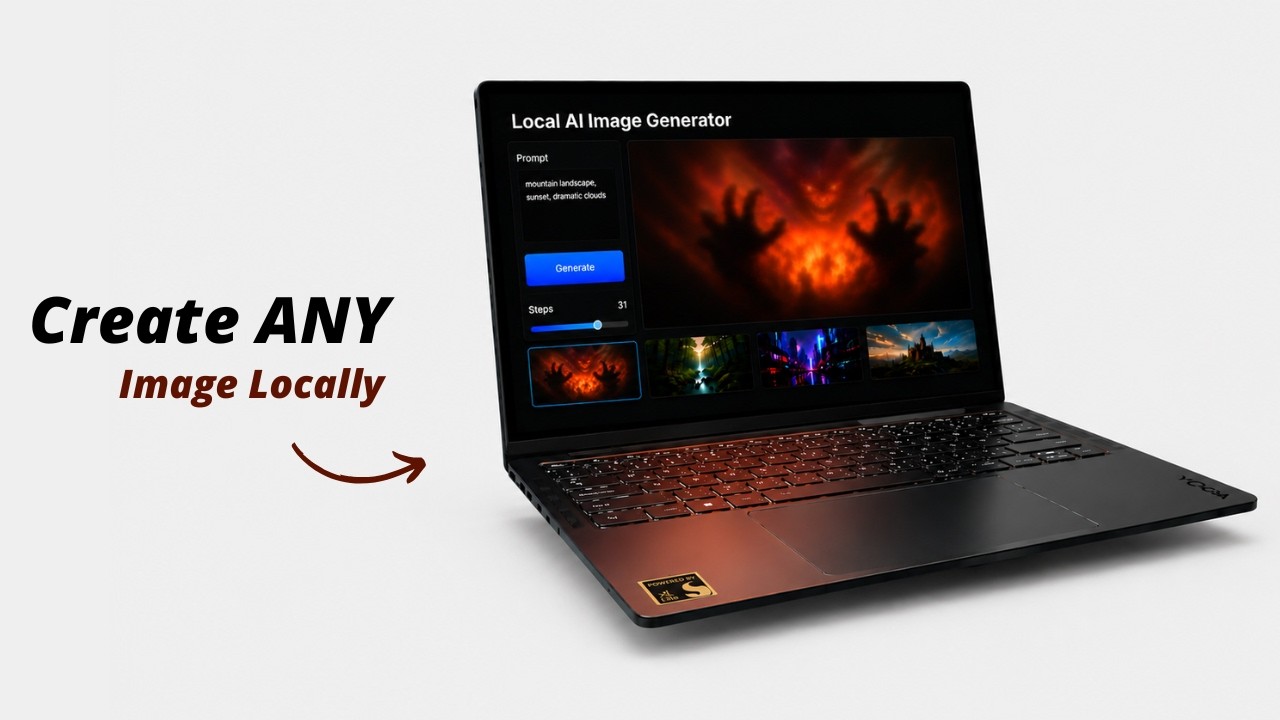
🖼️ Local AI Image Generator
An easy, zero-setup Stable Diffusion GUI for Windows. Run GGUF & Safetensors models offline without Python configuration.
| Generation Workspace | Model Library | Image Constraints |
|---|---|---|
 |
 |
 |
🎥 Watch the Setup & Demo Video: https://youtu.be/ESELhY-G_9w
📖 Overview
Local AI Image Generator is a zero-configuration, portable desktop environment for running Stable Diffusion (Safetensors/GGUF/CKPT) offline on Windows. Double-clicking start.bat automatically handles dependency setup, GPU backend matching (CUDA/Vulkan), and launches a high-performance local web workspace.
⚡ Quick Start
- Launch: Double-click
start.bat(downloads portable Node.js and pre-compiled GPU backend binaries on first run). - Add Models: Drop
.safetensors,.gguf, or.ckptweights intoapp/models/(or download them via the Model Manager tab in the UI). - Generate: Open
http://localhost:1420in your browser, select your model, and write a prompt.
✨ Features
- 100% Offline & Private: Inference runs completely locally on your hardware.
- Auto-Detected GPU Acceleration: Configures CUDA for Nvidia cards, and Vulkan for AMD or Intel Arc GPUs.
- Zero System Footprint: Node.js is sandboxed inside the folder. No global environment paths are altered.
- Integrated Model Manager: Paste a Hugging Face URL to download weights directly, or drag-and-drop local weight files to import them.
- Real-time Telemetry: Monitor RAM, VRAM, CPU, and GPU load directly in the UI.
- Local Gallery: Saves generated PNGs alongside prompt metadata JSONs to
app/outputs/.
📁 Repository Structure
local-ai-image-generator/
├── start.bat                  # Main double-click entrypoint
├── LICENSE                    # MIT Open Source license
├── .gitignore
├── README.md
├── scripts/
│   ├── setup.ps1              # Automated GPU-detect and environment installer
│   ├── reset.ps1              # Cleans runtime environments (keeps models & outputs)
│   └── serve.cjs              # UI web server and backend lifecycle manager
└── app/
    ├── frontend/              # UI source code (Vite + React)
    ├── models/                # Place weights here (.safetensors, .gguf, .ckpt)
    └── outputs/               # Saved images and parameters metadata
🖥️ GPU Compatibility Matrix
| GPU Vendor | Tech | Status | Notes |
|---|---|---|---|
| Nvidia | CUDA | ✅ Native | Maps sd-cuda.exe with Nvidia SDK 12 optimizations. |
| AMD Radeon | Vulkan | ✅ Native | Maps sd-vulkan.exe with Vulkan API acceleration. |
| Intel Arc | Vulkan | ✅ Native | Maps sd-vulkan.exe for Intel hardware. |
| Integrated / None | CPU | ⚠️ Fallback | Runs on logical CPU threads (slow). |
⏱️ Performance Benchmarks
Typical generation times for an image with 20 steps (e.g. 512x512 resolution; actual times can vary depending on specific hardware specifications, clock speeds, and system load):
- CUDA GPU (Nvidia RTX): ~10 seconds.
- Vulkan GPU (AMD / Intel Arc): ~89 seconds.
- GTX Vulkan Fallback (Nvidia GTX): ~30 seconds (Vulkan runs significantly faster on legacy GTX series cards since they lack Tensor Cores).
- CPU (Fallback): ~150 - 300+ seconds (highly dependent on processor core count, speed, and AVX instruction sets).
🛠️ Troubleshooting
- Reset Environment: If a build fails or you want to clear dependencies, run
scripts/reset.ps1. (This preserves your models and generated images). - Port Conflicts: The frontend uses
1420by default. The backend tries8080first, then automatically falls back to a free port if8080is already busy.
📝 License
This project is licensed under the MIT License - see the LICENSE file. Bundles stable-diffusion.cpp (MIT License). Model weights are subject to their respective creators' licenses.