
Modular Context | Obsidian LLM Knowledge Base for Strategy, Ops & Comms
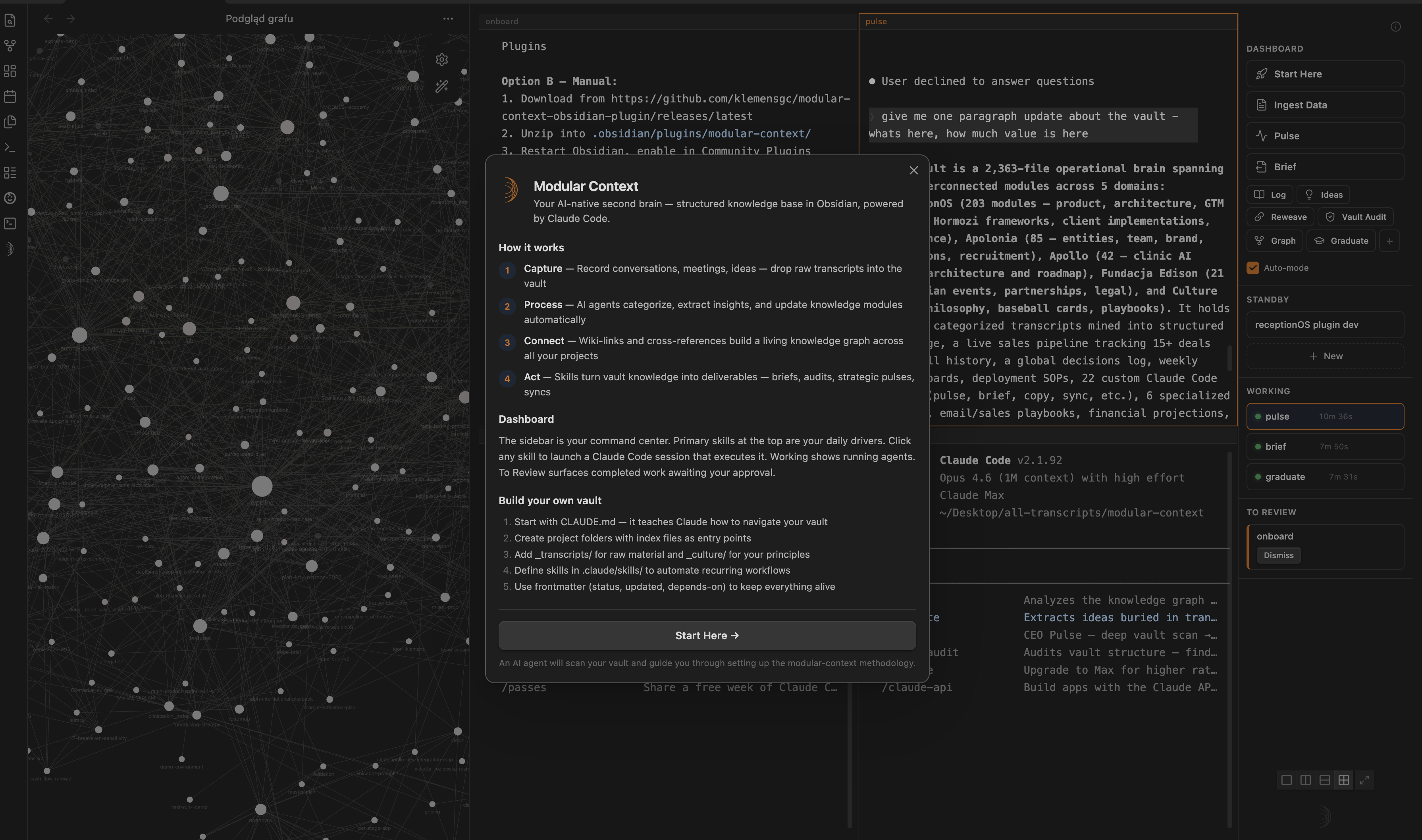
Your Obsidian vault as LLM-native knowledge base + multi-account Google Workspace (Gmail, Calendar, Drive, Docs, Sheets, Slides) exposed as 25 MCP tools for Claude Code. Local-first, encrypted, no telemetry.




What is this?
Two things in one plugin:
-
LLM Knowledge Base — Your Obsidian vault structured as Sources → Wiki → Schema (Karpathy-aligned framing). Multi-terminal Claude Code + Codex with skills sidebar, agent tracking, session glyphs. Your second brain seen by LLMs as a first-class context.
-
G-Suite MCP Server — Multi-account Google Workspace (Gmail, Calendar, Drive, Docs, Sheets, Slides) exposed as 25 native tools for Claude Code (
gmail_search,drive_list_files,docs_create_doc,sheets_append_row,slides_read_presentation, …). OAuth 2.0 + PKCE desktop flow, tokens encrypted via ElectronsafeStorage(OS keychain), no telemetry, no cloud.
One install, one onboarding, two productivity frontiers.
🏢 The AI Company Stack
The plugin isn't just a terminal + an MCP server — paired with the skills library it's a whole AI company stack running on one workflow: your vault is the brain, Claude Code is the operator, and each layer plugs into the next.
| Layer | What it does | Skills |
|---|---|---|
| 🎙️ Notetaker | Turn raw transcripts, calls and tweets into structured, tagged knowledge | process-transcripts, xdaily, graduate |
| 🧠 Self-healing Knowledge Base | The vault keeps itself current — reweaves stale modules, fixes links, audits structure, syncs sibling vaults | reweave, vault-audit, graph, sync, pulse |
| 📡 Communication layer | One read across mail, WhatsApp and Google Workspace — what's happening and what belongs to you | comms-review, whatsapp-digest, gsuite-analysis |
| 📊 CRM / ops | Ready skills that connect to ClickUp — review your sales funnel and pull your weekly plan straight from the workspace | clickup-review, review-core, tasklist |
Each layer is independently useful; together they run a one-person company on autopilot. Skills install from the in-app library (dependencies auto-resolve).
Architecture
   ┌──────────────────────────────────────────────────────────────────┐
   │  YOUR VAULT — your full context, structured so an LLM works on      │
   │  YOUR reality: projects · people · decisions · history              │
   │                                                                     │
   │  Sources  →  Wiki  →  Schema                                        │
   │  raw input   linked notes   structured & typed (LLM-navigable)      │
   └──────────────────────▲────────────────────────▲───────────────────┘
                    reads  │                        │  writes back
   ╔═══════════════════════╧════════════════════════╧═══════════════════╗
   ║              🦀  CLAUDE CODE  (the operator)  🦀                    ║
   ║                                                                     ║
   ║   ── works on your notes ──        ── works with the world ──       ║
   ║   🦀 Capture     🦀 Keep current    🦀 Communicate  🦀 Operate       ║
   ║   calls & files  fix outdated       read & send      review &       ║
   ║   → notes        notes + links      email·WhatsApp    act (CRM)      ║
   ╚══════════════════════════════════════════╦═════════════════╦═══════╝
                                              ▼                 ▼
   COMMUNICATIONS  (read + send)
   ├─ Gmail       ← search          → send / draft / labels
   └─ WhatsApp    ← read messages     (read-only · macOS)

   OPERATIONS  (read + write)
   └─ ClickUp     ← sales funnel · your tasks · weekly plan  → update · batch actions

   WORKSPACE  (Google · multi-account)
   ├─ Calendar  ← list           → create / update / delete
   ├─ Drive     ← list / search  → download / upload
   ├─ Docs      ← read           → create / update
   ├─ Sheets    ← read           → write / append
   └─ Slides    ← read           → create / add slide

   ── set up by ──▶  Modular Context Plugin  (installs skills · handles Google login)
Architecture decisions (full ADRs in docs/adrs/):
- ADR-001 — Hybrid OAuth: Quick Connect (shared client) + BYO (user-provided client)
- ADR-002 — Electron
safeStoragetoken storage (OS keychain) - ADR-003 + addendum — MCP server stdio lifecycle + plaintext credentials sidecar
- ADR-005 — Multi-account storage model (per-account folder + index)
Features
LLM Knowledge Base
- Multi-terminal split layouts — single, side-by-side, stacked, 2×2, 2×3, 2×4. Up to 8 sessions.
- Claude Code + Codex — toggle AI provider in settings; auto-launch on new terminal.
- Skills sidebar — 3 primary skills (full-width), rest in secondary grid. One-click launches.
- Agent tracker — Working / To Review / Standby states per session.
- Session glyphs — unique geometric shape per terminal. Skills inherit their icon.
- Compact mode — 48px icon-only sidebar, maximum terminal real estate.
- Fullscreen overlay — terminal fills Obsidian; sidebar docks right.
Escto exit. - Real PTY — zsh in a pseudo-terminal, not a basic runner.
- Wiki-link autocomplete —
[[inside terminal searches vault notes. - Drag-and-drop — Finder / Obsidian → terminal as shell-escaped paths.
- Session persistence — tab names, glyphs, layouts survive restarts.
- Smart Session Restore — on reopen, picker modal classifies saved sessions (Needs attention / Idle / Archive) instead of silent auto-resume. You choose what materializes — no accidental skill re-runs.
- Auto-onboarding — first install triggers a setup agent that scaffolds your vault.
G-Suite MCP Server (v2.1 — 25 tools)
- Multi-account — unlimited Google accounts in parallel (Testing mode: up to 100 test users per account)
- 25 tools for Claude Code across 6 Workspace products (Gmail ×4, Calendar ×6, Drive ×4, Docs ×3, Sheets ×5, Slides ×3 — see table below)
- Zero telemetry — no metrics, no crash reports, no external calls beyond OAuth + Google API
- Local-first — tokens encrypted via OS keychain (macOS Keychain / Windows DPAPI / Linux libsecret via
libsecret) - Auto-refresh — 50-minute timer per account, 5-minute expiry buffer
- Error taxonomy —
TOKEN_EXPIRED,ACCOUNT_NOT_FOUND,SCOPE_OUTDATED,RATE_LIMITED,PERMISSION_DENIED,QUOTA_EXCEEDED,NETWORK_ERROR - Hot reload — server re-reads credentials per tool call, zero-downtime refresh
3 primary skills (post-onboarding)
| Skill | Purpose | Uses |
|---|---|---|
| Synthesise Files | Turn raw files (transcripts, notes, backlog) into vault modules — categorize, tag, update, reweave neighbors | Your vault, optional _transcripts-backlog/ |
| WhatsApp Digest | Analyze WhatsApp groups for action items, blindspots, staleness vs vault | macOS WhatsApp.app |
| Gmail + G-Suite | Inbox sweep, stale follow-ups, calendar gap analysis, meeting prep, doc extraction, sheet logging, deck prep | MCP tools below |
All three write artifacts to _workspace/{YYYY-MM}/w{N}/. Secondary skills (Pulse, Brief, Log, Reweave, Graph, Graduate, Ideas, Vault-Audit) available in sidebar grid.
25 MCP tools
Gmail (4)
| Tool | Purpose |
|---|---|
gmail_search |
Query with Gmail syntax (is:unread, from:X, after:2026-04-01). Optional body extraction. |
gmail_draft |
Create draft — not sent. User opens webUrl in Gmail UI to send. |
gmail_send |
Send immediately. Skip draft for trusted, scripted sends. |
gmail_modify_labels |
Add/remove labels — system presets (INBOX, UNREAD, STARRED, IMPORTANT, SPAM, TRASH) + custom labels by name. |
Calendar (6)
| Tool | Purpose |
|---|---|
calendar_list_calendars |
Enumerate all calendars user has access to. |
calendar_list_events |
Events in time range. |
calendar_create_event |
Create event (sendUpdates: "none" default — no auto-invite spam). |
calendar_update_event |
Patch existing (only provided fields changed). |
calendar_delete_event |
Delete. |
calendar_freebusy |
Query busy windows across multiple calendars — ideal for "find time to meet". |
Drive (4)
| Tool | Purpose |
|---|---|
drive_list_files |
List with Drive query syntax filter, pagination, ordering. |
drive_search |
Full-text search across file content + names. Optional mimeType filter. Excludes trashed. |
drive_download_file |
Get file content. Google-native files auto-exported as text; binary returned as base64. |
drive_upload_file |
Create file with content + optional parentFolderId. Supports utf-8 / base64. |
Docs (3)
| Tool | Purpose |
|---|---|
docs_read_doc |
Plain-text extraction from doc body (walks paragraphs + tables). |
docs_create_doc |
New doc with title + optional initialContent. |
docs_update_doc |
mode: "append" (at document end) or mode: "replace" (wipe body + insert). |
Sheets (5)
| Tool | Purpose |
|---|---|
sheets_list_sheets |
Spreadsheet metadata + list of sheet tabs. |
sheets_read_range |
Read A1-notation range. Supports majorDimension + valueRenderOption. |
sheets_write_range |
Overwrite values at range. USER_ENTERED parses formulas + dates. |
sheets_append_row |
Append row(s) to data region end. |
sheets_create_spreadsheet |
New spreadsheet with optional initial sheet titles. |
Slides (3)
| Tool | Purpose |
|---|---|
slides_read_presentation |
Metadata + plain-text summary per slide. |
slides_create_presentation |
New presentation with title. |
slides_add_slide |
Insert slide with layout (BLANK / TITLE / TITLE_AND_BODY / SECTION_HEADER / TITLE_AND_TWO_COLUMNS / CAPTION_ONLY). |
Every tool accepts optional account param (email, case-insensitive). Omit → primary account. Unknown email → ACCOUNT_NOT_FOUND error.
OAuth scopes required (10 total): gmail.modify, calendar, drive.file, drive.metadata.readonly, documents, spreadsheets, presentations, plus OIDC openid email profile.
Google Cloud setup: Enable 6 APIs in your OAuth project — Gmail, Calendar, Drive, Docs, Sheets, Slides. Missing API returns PERMISSION_DENIED with direct enable link.
Install
Plugin
Requires Obsidian ≥ 0.15 and macOS (Linux + Windows may work; untested).
Via BRAT (Beta Reviewer plugin, recommended for now):
- Install BRAT from Community Plugins
Cmd+P→ "BRAT: Add a beta plugin" →klemensgc/modular-context-obsidian-plugin- Enable in Settings → Community plugins
Manual:
- Download
main.js,manifest.json,styles.css,mcp-server.jsfrom latest release - Copy to
<vault>/.obsidian/plugins/modular-context/ - Enable plugin in Settings → Community plugins → Modular Context
MCP server
Auto-installed on first Google Workspace: Connect. Plugin copies bundled binary to ~/.modular-context/mcp-google/dist/index.js (~100 MB one-time).
Repo structure
Monorepo with three packages:
modular-context-obsidian-plugin/
├── packages/
│   ├── plugin/        ← Obsidian plugin (main.ts, manifest, features + MCP client glue)
│   ├── mcp-google/    ← standalone MCP server (25 Google Workspace tools, Node)
│   ├── shared/        ← portable types + AgentTracker + PTY helper + UI primitives
│   └── app/           ← experimental standalone Electron app (WIP, not shipped)
├── README.md          ← you are here
├── banner.png
└── package.json       ← monorepo scripts (build:shared → build:mcp-google → build:plugin)
- packages/plugin/CHANGELOG.md — user-facing release notes (v1.0 → v2.0)
- packages/plugin/RELEASE-v2.0.0.md — v2.0 release highlights
- packages/mcp-google/README.md — MCP server docs (25 tools, accounts, env contract)
- packages/mcp-google/CHANGELOG.md — MCP server version history
- Skill library: separate repo klemensgc/modular-context-skills — plugin auto-syncs
Connect Google Workspace
Two paths:
- Quick Connect (no GCP setup) — use the shared OAuth client bundled with the pre-built release. Comment your email on #3 — Quick Connect: request test-user access to be added as a test user (usually within 24h). Then skip to step 5 below.
- BYO (your own GCP project) — full control, no test-user limit. Follow all 6 steps below.
6 steps (BYO path)
-
Create GCP OAuth Client
- Google Cloud Console → new project (e.g.
modular-context-gcp) - Enable APIs: Gmail API, Google Calendar API
- OAuth consent screen → External, Testing mode → add scopes:
gmail.modify,calendar, plusopenid,email,profile - Add yourself as test user
- Create credentials → OAuth 2.0 Client ID → Desktop app
- Copy Client ID + Client Secret
- Google Cloud Console → new project (e.g.
-
Fill
.env.localin the plugin's build folder:GOOGLE_OAUTH_CLIENT_ID=... GOOGLE_OAUTH_CLIENT_SECRET=... -
Rebuild (
npm run buildinpackages/plugin) if self-building. Pre-built release uses the shared Quick Connect client. -
Reload plugin —
Cmd+P→ "Reload app without saving" -
Connect —
Cmd+P→ "Google Workspace: Connect (or add account)" → browser OAuth → authorize → done -
Add more accounts — "Google Workspace: Add another account" any time
The plugin writes .mcp.json to your vault root + per-account sidecars to ~/.modular-context/mcp-google/accounts/{filename}/. Restart Claude Code session to pick up the MCP server.
Plugin commands
| Command | Purpose |
|---|---|
Google Workspace: Connect (or add account) |
Launch OAuth flow for new/additional account |
Google Workspace: Add another account |
Alias for above — clearer intent |
Google Workspace: Reconnect (upgrade scopes) |
Nuke tokens, re-auth all accounts with current scope set |
Google Workspace: Disconnect all accounts |
Remove all credentials + .mcp.json entry |
Google Workspace: Status |
List connected accounts, expiry times, scope status |
Google Workspace: Show MCP server logs |
Open ~/.modular-context/mcp-google/logs/server.log |
Plus 5+ non-Google commands for terminal / skill management. See Command Palette.
Security
- Tokens encrypted via Electron
safeStorage(OS keychain). Never leave disk in plaintext. - Credentials sidecar for MCP server: plaintext JSON at
0600perms in user-scope folder (comparable to~/.aws/credentials,~/.config/gcloud/). Plugin may re-encrypt in v2.1 (see ADR-003 addendum). - No telemetry. No crash reports. No metrics. Zero phone-home.
- Logs scrub tokens, emails, subjects via regex on every line.
- Multi-account isolation. Each account has separate credentials; MCP server honors
accountparam strictly.
Full threat model in docs/adrs/ADR-003-addendum-shared-state.md.
What's new in v2.0
- 3 primary skills reorganization —
Synthesise Files(was "Ingest Data"),WhatsApp Digest,Gmail + Calendar - New
gsuite-analysisskill — orchestrates 10 MCP tools with 4 playbook patterns - Graduated v1.5 / v1.6 / v1.7 beta milestones: OAuth + storage + MCP server + multi-account + full control
- OAuth scope upgrade:
gmail.modify+calendarfull (replacesgmail.readonly,gmail.send,calendar.events) mcp-google-workspace@ 1.1.0 stable (from 1.1.0-beta.1)- New tools:
gmail_send,gmail_modify_labels,calendar_list_calendars,calendar_update_event,calendar_delete_event,calendar_freebusy - Smart Session Restore Picker — replaces silent auto-resume on plugin reopen. Modal classifies saved sessions into Needs attention / Idle / Archive buckets; you pick what materializes. No accidental skill re-runs, no hidden respawns.
Full list in packages/plugin/CHANGELOG.md.
Troubleshooting
| Issue | Fix |
|---|---|
| Notice: "Reconnect required for {email}" | Google Workspace: Reconnect (upgrade scopes) — scopes changed |
TOKEN_EXPIRED from MCP tool |
User revoked access or refresh token rotated — Reconnect |
ACCOUNT_NOT_FOUND |
Account not connected — Add another account |
| MCP server not visible in Claude Code | Restart Claude Code session. .mcp.json loaded at session start. |
| Plugin reloaded but old behavior | Hard reload: Cmd+P → "Reload app without saving" (not just disable+enable) |
| Server logs empty | Normal — server only runs when Claude Code calls a tool. Not a daemon. |
Contributing
Plugin: modular-context-obsidian-plugin
Skills library: modular-context-skills (separate repo, auto-synced)
PRs welcome. Issues welcome. No support contract, but I read everything.
License
MIT © klemensgc / receptionOS