
OPC — One Person Company
A full team in a single Claude Code skill. You're the CEO — OPC is everyone else.
16 specialist agents (PM, Designer, Security, Devil's Advocate, and more) that build, review, and evaluate your code through a digraph-based pipeline with code-enforced quality gates.
How It Works
One principle: the agent that does the work never evaluates it.
Task → Flow Selection → Node Execution → Gate Verdict → Route Next
                              ↑                              ↓
                              └──────── ITERATE/FAIL ────────┘
-
Task inference — reads your request, picks a flow template (review, build-verify, full-stack, pre-release), and enters at the right node.
-
Typed nodes — each node has a type (discussion, build, review, execute, gate) with specific protocols. Build nodes produce commits. Review nodes dispatch parallel subagents. Gate nodes compute verdicts from code, not LLM judgment.
-
Mechanical gates — verdicts are computed by
opc-harness synthesize: any red = FAIL, any yellow = ITERATE, all green = PASS. No LLM gets to decide if a finding is "important enough." -
Cycle limits — max 3 loops per edge, 5 re-entries per node, 20-30 total steps depending on flow. Oscillation detection catches A↔B loops.
Quality Architecture
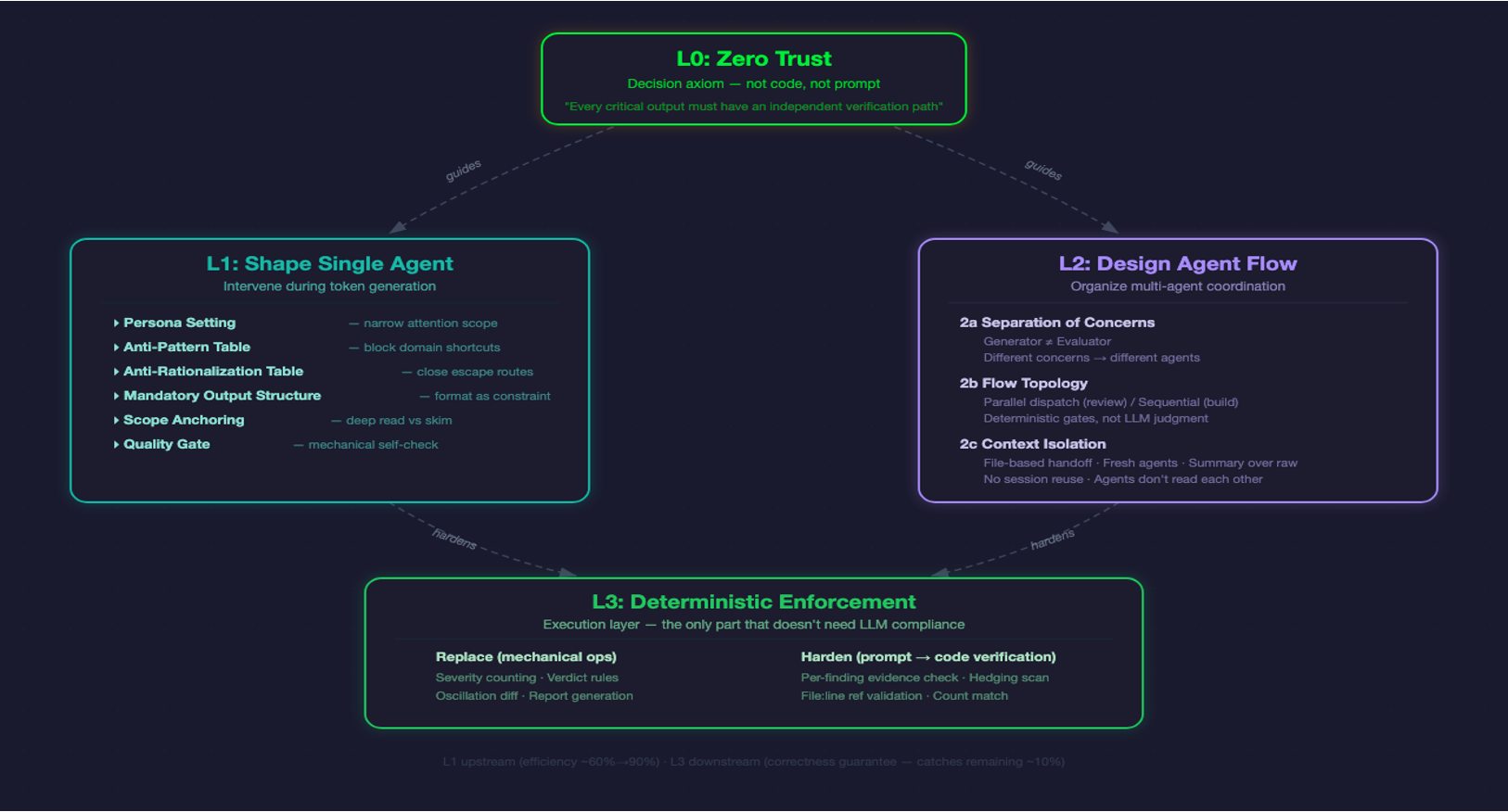
The system is built on a zero-trust axiom: every critical output must have an independent verification path. Four layers:
- L0 — Zero Trust: Decision axiom — not code, not prompt. Every critical output needs an independent verification path.
- L1 — Shape Single Agent: Intervene during token generation — persona setting, anti-pattern tables, mandatory output structure, scope anchoring, quality gates.
- L2 — Design Agent Flow: Multi-agent coordination — separation of concerns, flow topology (parallel review / sequential build), context isolation (file-based handoff, fresh agents, no session reuse).
- L3 — Deterministic Enforcement: The only layer that doesn't need LLM compliance — mechanical ops (severity counting, verdict rules, oscillation diff) and hardened verification (file-finding evidence checks, hedging scans, ref validation).
Quick Start
Install
npm install -g @touchskyer/opc
Skill files are automatically copied to ~/.claude/skills/opc/.
Manual install (no npm)
git clone https://github.com/iamtouchskyer/opc.git
cp -r opc ~/.claude/skills/opc
Use it
# Review — dispatches 2-5 role agents in parallel
/opc review the auth changes

# Build — implements + independent review + gate
/opc implement user authentication with email/password

# Autonomous loop — decomposes, schedules cron, runs unattended
/opc loop build features F1-F4 from PLAN.md

# Interactive mode — asks clarifying questions first
/opc -i redesign the onboarding flow

# Explicit roles
/opc security devil-advocate

# Flow control
/opc skip          # skip current node
/opc pass          # force-pass gate
/opc stop          # terminate, preserve state
/opc goto build    # jump to node
Autonomous Loop
/opc loop build the math tutoring app features F1-F4
What happens:
- Runbook lookup —
opc-harness runbook match "<task>"checks--dirflag →OPC_RUNBOOKS_DIR→~/.opc/runbooks/for a matching recipe. If one hits, itsunits/flow/tierbecome the plan; otherwise fall through to step 2. Disable per-invocation withOPC_DISABLE_RUNBOOKS=1. See docs/runbooks.md and examples/runbooks/add-feature.md. - Decompose (runbook miss only) — breaks task into atomic units (spec, implement, review, fix, e2e)
- Definition of done — establishes verify/eval criteria per unit before any work starts
- Schedule — durable cron (survives process restart) fires every 10 min
- Execute — each tick runs one unit through the appropriate OPC flow
- Guard —
opc-harnessenforces: git commit required, ≥2 independent reviewers, no plan tampering, no state forgery, artifact freshness, tick limits - Terminate — auto-stops when plan complete, tick limit hit, or wall-clock deadline reached
For well-scoped tasks, the system runs 10+ hours continuously without intervention.
Guardrails (code-enforced, not prompt-level)
| Guard | Enforcement |
|---|---|
| Write nonce | Random SHA256 at init; state written by harness only |
| Atomic writes | write → rename (POSIX atomic); no truncated JSON on crash |
| Plan integrity | SHA256 hash at init; verified every tick |
| Review independence | ≥2 eval files, identical content rejected, line overlap warned |
| Git commit required | HEAD must change for implement/fix units |
| Screenshot required | UI units must produce .png/.jpg artifact |
| Tick limits | maxTotalTicks (units×3) + 24h wall-clock deadline |
| Oscillation detection | A↔B pattern over 4-6 ticks = warning/hard stop |
| Concurrent tick mutex | in_progress status blocks overlapping cron fires |
| JSON crash recovery | try/catch on all JSON.parse; structured errors, not crashes |
| External validators | Pre-commit hooks, test suites detected at init and leveraged |
Flow Templates
| Template | Nodes | When |
|---|---|---|
| review | code-review → gate | PR review, audit, "find problems" |
| build-verify | build → code-review → test-design → test-execute → gate | "implement X", "fix bug Y" |
| full-stack | discuss → build → review → test → acceptance → audit → e2e → gates | Complex/vague requests |
| pre-release | acceptance → audit → e2e → gates | "verify before release" |
Extensions
OPC has a capability-routed extension surface. Extensions live in
~/.claude/skills/opc-extension/<name>/ — each with ext.json (capability
declarations) + hook.mjs exporting any of promptAppend / verdictAppend
/ executeRun / artifactEmit hooks. No fork, no rebuild. Hooks are
sandboxed via per-extension timeouts + circuit breakers, so a broken
third-party extension can't take down the harness.
The companion repo opc-extensions ships 4 extensions: design-intelligence (theme injection + design coverage + VLM visual eval), git-changeset-review, memex-recall, and session-logex.
Full authoring guide: docs/extension-authoring.md — zero-OPC-context
quickstart + reference, plus a starter template at examples/extensions/_starter/.
Built-in Roles
Product:     pm, designer
User Lens:   new-user, active-user, churned-user
Engineering: frontend, backend, devops, architect, engineer
Quality:     security, tester, compliance, a11y
Specialist:  planner, user-simulator, devil-advocate
Devil's Advocate (the 10th person) is auto-included when consensus is near-unanimous or decisions are irreversible. Comes with an automated verification script that checks its own findings.
Custom Roles
Add a .md file to roles/:
---
tags: [review, build]
---
# Role Name

## Identity
One sentence: who you are and what you care about.

## Expertise
- **Area** — what you know about it

## When to Include
- Condition that triggers this role
Available immediately, no configuration needed.
Testing
bash test/run-all.sh
100+ test files covering init-loop, complete-tick, next-tick, review independence, JSON crash recovery, compound defense, scope registry, criteria lint, pipeline E2E lint, D2 calibration, release packaging, and orchestrator-level E2E flow tests.
Requirements
- Claude Code (CLI, desktop app, or IDE extension)
- Node.js >= 18
- Core runtime has no npm dependencies, no MCP server, no build step
- Optional:
jqforopc install-hookscontext-compaction hooks
Works better with memex (optional)
OPC works standalone — pair it with memex for cross-session memory. Memex remembers which roles were useful, which findings were false positives, and your project-specific context.
npm install -g @touchskyer/memex
What's New
See CHANGELOG.md for version history.
Community
Using OPC? Share your setup in Discussions → Show and tell. Questions go in Q&A. Feature ideas in Ideas.
License
MIT