
  █▀▀█ █▀▀█ █▀▀█ █▀▀▄ ▀█▀ █▀▀▄ █▀▀█ █▀▀▀ █▀▀█ █▀▀▀
  █  █ █  █ █▀▀▀ █  █  █  █▀▀▄ █▀▀█ █    █▀▀▀ ▀▀▀█
  ▀▀▀▀ █▀▀▀ ▀▀▀▀ ▀  ▀  ▀  ▀  ▀ ▀  ▀ ▀▀▀▀ ▀▀▀▀ ▀▀▀▀
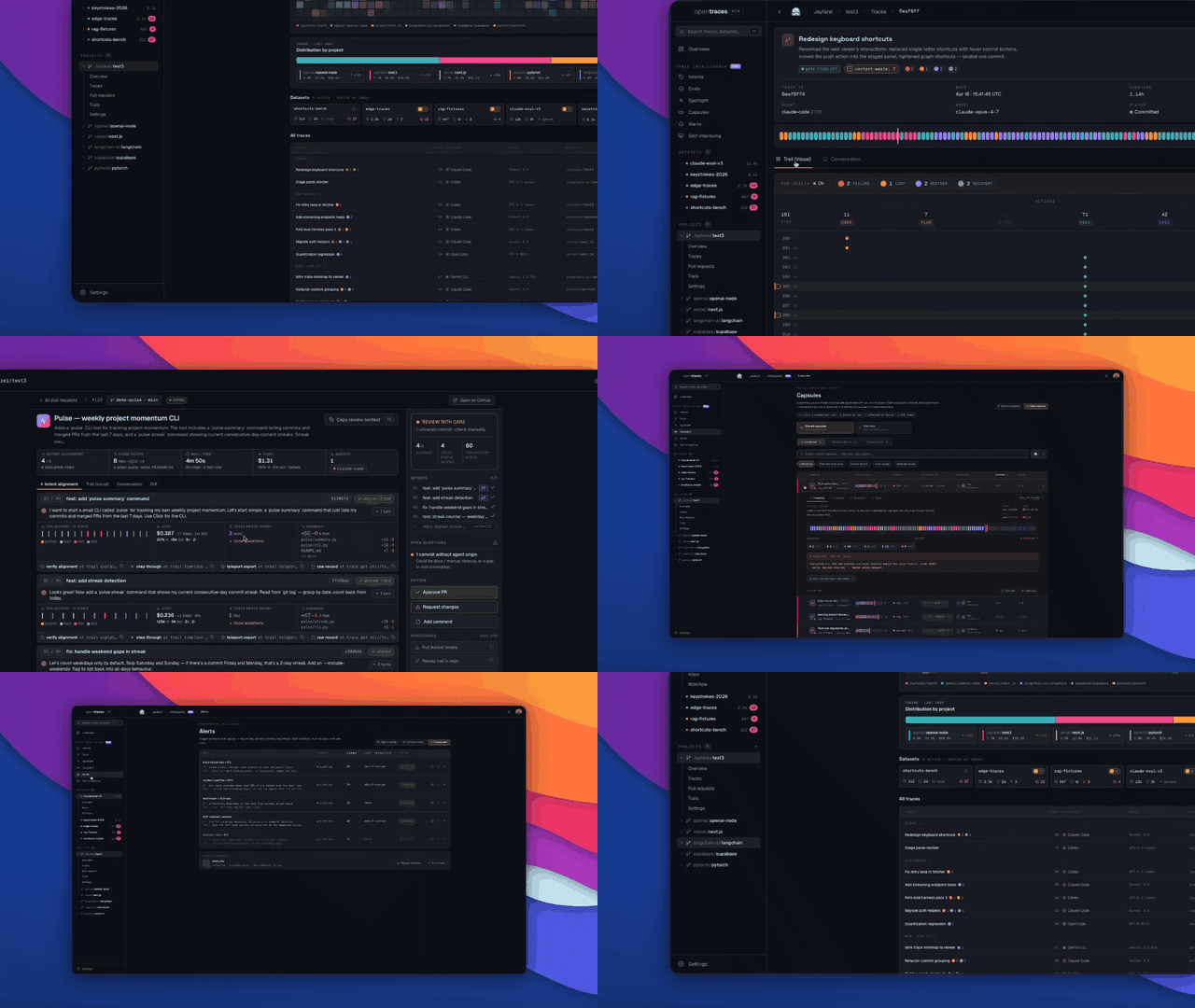
opentraces hub — reach out for early access
Open schema + CLI for capturing agent traces into a private bucket, linking them to Git and context evidence, building workflow-projected datasets, and publishing reviewed dataset rows to Hugging Face Hub.
Every coding session leaves behind the data you actually want: prompts, tool calls, reasoning, edits, outcome signals, and eventually the code that shipped. opentraces captures that locally as raw bucket evidence, links each change to the Git history that accepted it, reconstructs what the agent saw at each step, and lets workflows turn selected evidence into datasets.
Sharing traces can leak secrets, credentials, internal paths, or customer data. opentraces reduces that risk, but it does not remove it. Read the security docs before you publish anything.
What It Does
- Capture traces from supported agents (Claude Code and Codex CLI) via session hooks.
- Store capture-time evidence in a private bucket:
trace.json, patch history, Trail events, Context Tree events, source events, and content-addressed blobs. - Search, map, and slice retained traces without loading full transcripts.
- Correlate trace patches to Git history via Trace Trails: blame, graph, and track.
- Reconstruct what the agent saw at a step via the Context Tree.
- Sync the private bucket to a HuggingFace remote when you explicitly opt in.
- Run local workflow skills that turn traces into schema-valid dataset rows.
- Run named security tools over records before they leave the bucket.
- Review dataset rows and publish approved rows to HuggingFace remotes.
Concepts
opentraces is organized around a small set of subsystems. Knowing the boundaries makes the CLI predictable.
| Subsystem | What it holds | Primary commands |
|---|---|---|
| Capture | Inbound boundary: agent hooks, the attribution watcher, optional OTLP receiver | setup, init, capture-otlp |
| Bucket | Private, local-first store of raw captured evidence (one self-sufficient unit per trace) | bucket, ctx list/info |
| Trace | Search, map, and slice projections over retained traces | trace query/map/slice/get |
| Trace Intelligence | Deterministic signals about how a run went: context waste, run signals, run compare | trace --waste/--run-intel, trace compare |
| Trail | VCS-anchored lineage from a trace patch to the commit that accepted it | trail blame/graph/track |
| Context Tree | What the LLM saw at each step (system, messages, tools, runtime state) | ctx tree/show/reads/writes/... |
| Workflows + Datasets | Workflow skills that project bucket traces into reviewable HF dataset rows | workflow, dataset |
| Security | Per-record detectors, transformers, and judges run before publication | security, setup <tool> |
A bucket holds raw captured traces; a dataset holds workflow-projected rows. They are distinct stores.
What one coding session leaves behind, layered across the substrates:
opentraces <capture> · what happened between an agent and its environment

                ◄─ start ··········· session ··········· end ─►    patch trail ─►
                                                                    t+n      t+n+{}
  Git   │ attribution    HEAD ◇──────────────────────────────►  commit     ◇──◇
        │ across runs                                            └ anchor    survival
  ──────┼─────────────────────────────────────────────────────────────────────────
  Trail │ agent changes  snap▢ ····◌ patch ·······◌ patch ····▢  git_anchor_id
    ▲   │ to the env                                             trace_patch_id
  change│                                                        commit_sha · evidence
  ──────┼─────────────────────────────────────────────────────────────────────────
  Trace │ agent          ▮     ●      ●      ◍      ●      ●
        │ trajectory     user   read   read   agent  write  write
 observe│                └──────────── bash ───────────┘
    ▼   │
  ──────┼─────────────────────────────────────────────────────────────────────────
  Ctx   │ agent          ▤     ▤▤     ▤▤▤    ▤▤▤    ▤▤▤▤   ▤▤▤▤
        │ observations   (context the LLM saw, growing per step)
  ──────┼─────────────────────────────────────────────────────────────────────────
  LLM   │ ingest/produce ─────────────────────────────────────►  $ in / $$ out
Changes flow up to the Trail and are anchored to the commits that accepted them; observations flow down to the Context Tree as what the LLM actually saw.
Pipeline
Capture sources write into the local bucket; workflows project bucket traces into reviewable rows; approved rows publish to HuggingFace remotes. Everything above the dashed line is local; everything below is opt-in remote.
opentraces <pipeline> · traces become datasets

   capture sources       bucket (local)          workflow           dataset
  ┌────────────┐        ┌──────────────┐      ┌───────────┐      ┌───────────┐
  │ OT watcher │↻       │ manifest.json│      │ search API│      │ ▤▤▤▤▤▤▤▤▤ │
  │ agent hooks│─write─►│ traces/v1/   │◄────►│ security  │─run─►│ ✓ approve │
  │ OTel       │↻       │ blobs/v1/    │search│ custom    │ sync │ ✗ reject  │
  └────────────┘        │ events/v1/   │ sync └───────────┘      └───────────┘
        │ git           └──────┬───────┘            │                  │
        └── attribute ─────────┘                    │                  │
  ╌╌╌╌╌╌╌╌╌╌╌╌╌╌╌╌ sync ╌╌╌╌╌╌ │ ╌╌╌╌╌ run ╌╌╌╌╌╌╌╌ │ ╌╌╌╌ push ╌╌╌╌╌╌ │ ╌╌  local
                               ▼                      ▼                  ▼    remote
                         HF bucket ──────────►   ML Intern   ◄──── HF Hub dataset
                                                     └─ eval / training / scoring ─┘
Consumers
Traces are not only logs. Once capture keeps nothing lost and the pipeline makes that evidence searchable, secure, and shareable, consumers are what you build on top. A consumer is a small workflow that filters and projects bucket traces, plus a renderer that puts the result somewhere useful. Training data is one destination, not the only one.
opentraces <consumers> · traces become more than logs

  retained evidence                       proof-of-value clients
  ┌──────────────────┐                    ┌──────────────────────────────┐
  │ Trace  ▮ ● ● ◍   │ Skills · CLI · SDK │ Capsule    usage episodes    │
  │ Ctx    ▤ ▤ ▤     │──── read ────────► │ Skill Eval verifier factory  │
  │ Trail  ◌─◌─◌     │─── render ───────► │ Standup    yesterday rebuilt │
  │ Bucket  ▢        │                    │ Spotlight  search traces     │
  └──────────────────┘                    │ Alerts     standing reports  │
                                          │ Intent PR  why + the how     │
                                          └──────────────────────────────┘
Six examples, from shipped commands to prototypes:
| Consumer | What it is | Built on |
|---|---|---|
| Trace Capsule | Share a usage episode with a third party, attaching the real agent experience to a GitHub issue rather than just a summary of the bug | security + sharing infra |
| Skill Evaluation | A per-skill rubric verifier that turns "was this skill used effectively?" into a reward signal for SkillOpt. The agent proposes a rubric, the factory scores it mechanically against bounded evidence, a human approves promotion. Honest by design: returns blocked_* until trustworthy labels exist, never a fake green |
skill-verifier, workflow skill-intelligence |
| Standup | A daily report reconstructed from yesterday's sessions: what was attempted, what landed, what failed, and what is still open | bucket traces, narrative render |
| Spotlight | Fast search across your traces for relevant context mid-session, outside the active loop, or for a handoff | trace query |
| Alerts | Standing alerts and reports over trace usage: failure rate, context waste, third-party tools, secrets, policy violations | workflows |
| Intent Pull Request | Walk a PR's commits back to the originating sessions and compile a context pack of the "why" alongside the "how" | trail blame pr |
The pattern is always the same: filter and project retained evidence with a workflow, then render to one destination. New consumers (Slack, dashboards, CI gates) are a new workflow plus a new renderer, not a new subsystem.
Install
Preferred end-user install:
pipx install opentraces
Homebrew:
brew install JayFarei/opentraces/opentraces
skills.sh (installs the opentraces skill so your coding agent can drive the workflow):
npx skills add jayfarei/opentraces
From source:
git clone https://github.com/JayFarei/opentraces
cd opentraces
python3 -m venv .venv
source .venv/bin/activate
pip install -e packages/opentraces-schema
pip install -e ".[dev]"
Use plain pip install opentraces only in CI or disposable environments.
Quick Start
opentraces has a two-phase bootstrap: setup wires the machine once, init wires each repo.
# one-time machine setup — interactive wizard over every integration
# (capture hooks, attribution watcher, HF login, optional security tools)
opentraces setup

# initialize this repo (agent enrollment + committable marker)
opentraces init

# search retained trace evidence
opentraces trace query --lex "bug fix failing test"

# extract bounded trace slices for dataset rows
opentraces trace slice <trace-id> --template bursts --json

# walk Git-anchored trace lineage
opentraces trail track <trace-id>

# inspect or sync the private bucket of captured traces
opentraces bucket status
opentraces bucket remote push

# create and run a workflow-backed local dataset
opentraces dataset new bug-fixes --workflow ./workflows/bug-fix-curator/WORKFLOW.md
opentraces dataset run bug-fixes --dry-run --limit 5

# publish reviewed dataset rows when a remote is bound
opentraces dataset publish bug-fixes --check-only
init writes the committable marker at .opentraces.json. Captured traces, bucket state, and upload bookkeeping stay machine-local under ~/.opentraces/.
opentraces doctor checks auth, integrations, and pipeline health at any time.
Capture
opentraces setup runs an interactive wizard; each integration is also a direct subcommand:
setup claude-code/setup codex-cliinstall session-capture hooks.setup pichecks or writes the Pi package entry; the primary package path ispi install npm:opentraces-pi. Capture is opt-out: under global tracking (the default) every agent including Pi auto-enrolls each repo on first capture, private + review-required. Opt out withopentraces config tracking-mode manualor a per-projectexcludedmarker;opentraces init --agent <name>still enrolls a repo explicitly. (Codex Desktop is not covered.)setup gitinstalls a post-commit hook that correlates each commit to the trace that produced it (viarefs/notes/opentraces), poweringtrail blame.setup watcherinstalls a background attribution watcher (launchd on macOS, systemd--useron Linux; offered by default in the wizard). On an interval it walks enlisted projects, observes filesystem mutations as a backstop for writes hooks miss, reconciles them against open step windows, and matures Trace Trails over time. The watcher is polling-based today; a real-time (inotify/watchdog) observer that would narrow attribution windows is deferred. Subcommands:install/start/stop/status/tick.setup capture-otlppatches~/.claude/settings.jsonso Claude Code emits OpenTelemetry, enabling the higher-fidelity Context Tree capture source. Control the receiver withcapture-otlp start/stop/restart/status/flush.setup skillinstalls the shared agent skill into Claude Code, Codex CLI, and Pi harness skill directories.- In Pi, the package exposes
/ot-capture-status,/ot-setup,/ot-search <query>,/ot-trace <trace-id>,/ot-standup,/ot-capsule [trace-id], and/ot-dataset. Use/ot-searchto find candidates in the local/private bucket, then/ot-traceto load one trace's tool evidence. setup authlogs in to HuggingFace for dataset and bucket remotes.setup upgradeupgrades the CLI and refreshes the project skill file.
Trace
The trace surface returns bounded projections over a local BM25 + semantic Trace Index, so you can search and slice without loading full transcripts.
trace queryreturns bounded candidate packets;trace mapreturns a deterministic Trace Map;trace getresolves a trace, trace unit, map node, orot://Trail resource.trace slice <trace-id> --template burstsmaterializes one deterministic slice per detected change burst. Manual--from-step/--to-step,--around-step, and--around-patchwindows are available when a workflow needs an explicit range. A Trace Slice is context for audit and later dataset projection, not a training datum by itself.trace index rebuildrebuilds the local Trace Index after capture changes;trace teleportmoves a trace and its retained Git evidence between workspaces.
A trace patch is one Edit/Write tool call (roughly one hunk on one file). A change burst clusters nearby patches by step proximity.
Trace Intelligence
Deterministic, derive-on-demand signals about how a run actually went, sitting on top of the Trace surface. No LLM, no schema change, nothing persisted: each is computed on read and emitted as a frozen JSON envelope. Three capabilities:
- Context waste —
trace map <trace-id> --waste(ortrace get <trace-id> --waste) emitsopentraces.context_waste.v1: oversized tool outputs (>= 12000 chars), the same file read 3+ times in 20 minutes, and search commands repeated 5+ times in 10 minutes. - Run signals —
trace map <trace-id> --run-intel(ortrace get <trace-id> --run-intel) emitsopentraces.run_intel.v1: deterministicresteer/recovery/loop/failureannotations. Recovery only fires after an uncleared failure; failure prefers structured tool errors over substring guesses; a repeated command is oneloopsignal carryingevidence.repeat_count; a one-word approval never reads as a correction. - Run compare —
trace compare <trace-a> <trace-b>emitsopentraces.trace_compare.v1: per-side fidelity plus{a, b, delta}triples over token/cost metrics, deterministic quality persona scores, and burst/error/security signals, with both traces pinned to the same burst gap so the deltas are comparable.
Each detector derives from the TraceRecord and reports a fidelity of record or otel, preferring full wire fidelity when the trace was captured via the OTLP receiver.
Trail
Trace Trails are the evidence chain from a trace step to the Git history that accepted its patch. The substrate is VCS-anchored lineage: append-only TrailEvent batches under refs/opentraces/local/events/v1, plus rebuildable projections (CLI explanations, doctor checks, search/dataset views).
Visible commands:
trail blame commit <sha>attributes a commit's lines back to the traces that authored them.trail blame pr render | create | updateprojects that blame across a branch range into a GitHub PR body (deterministic synthesis, no LLM) and wrapsghfor idempotent create-or-update.trail graphrenders commit + trace history.trail track <trace-id>walks a trace's lineage through Git history and reportsHEADsurvival. Pass--patch/--anchorto track one patch or anchor,--since/--allfor batch JSONL, and--history-limit Nto bound the per-anchor walk.
Survival states reported per anchor: alive_on_path, alive_transformed, alive_moved, partially_preserved, repaired, reverted, lost, unknown. Anchor identity is tiered: an exact range hash first, then a structural (line-similarity) fallback, so identity survives format-then-commit pipelines (firmness drops firm → provisional). Substrate commands (explain, sync, timeline, resolve, attach, rebuild, diff, resume, snapshots) remain callable for scripting and debugging but are hidden from --help. See the Trace Trails docs for the full model.
Context Tree
The Context Tree captures what the LLM actually saw at each step of a session: system, messages, tool_registry, and runtime_state layers, content-addressed and joined to the trace via Step.context_node_id and TraceRecord.context_tree_summary.
opentraces ctx tree/show/step/reads/writes/diff/compactions/prune/resume/resolve/anchor-for-step navigate it. ctx list and ctx info read the bucket manifest with zero blob loads.
Two capture sources feed the same substrate. The JSONL parser (harness-side) ships shared session-level layers per node — walk-back to "what did the LLM see at step 7" is a session-level approximation in that path. The OTLP receiver (setup capture-otlp) closes the assembled-system-prompt, tool-schema, and sampling-params gaps for sessions captured over OpenTelemetry. See the Context Tree docs.
Bucket
Every captured trace lands in a local-first private bucket under ~/.opentraces/bucket/: a per-trace envelope (trace.json plus gzip-deterministic Trail/context/source companions), content-addressed blobs, a canonical event-log mirror, and a top-level manifest. The bucket is the self-sufficient unit — read verbs accept --remote <hf-repo> for symmetric local/remote access.
bucket status,bucket manifest,bucket verify,bucket repair,bucket rebuild,bucket prune,bucket prefetchinspect and maintain the local bucket.setup bucketopts into remote-by-default sync against a private (S3-backed) HuggingFace bucket remote, reusing existing HF auth. Runopentraces auth loginfirst; without itsetup bucketexits with arun 'opentraces auth login'hint. The wizard also prompts for a bucket security policy (recommended / basic / strict / off / custom) before configuring remote sync.bucket securitycontrols how raw captured evidence is protected before it syncs. Bucket security protects raw captured traces before they sync to the private bucket.bucket securitywith no flags is a read-only inspector;bucket security --policy recommended(alsobasic,strict,off) applies a named bundle;bucket security --tool regex --enable/--tool entropy --disableedits one tool at a time. A policy is just a named bundle over the samecfg.security.<tool>.enabledflags thatsetup <tool>andconfig set security.<tool>.enabledflip. Policy bundles:off(nothing),basic(regex, entropy),recommended(regex, entropy, business_logic, path_anonymizer, classifier),strict(regex, entropy, trufflehog, privacy_filter, business_logic, path_anonymizer, classifier).bucket remote push/pull/diff/statussyncs (push order: blobs → events → envelopes → manifest);bucket replay --reporeconstructs the canonical Git event ref byte-identically.
Workflows and Datasets
A dataset is a workflow-driven row projection over one or more bucket traces.
workflow create/list/templates/removemanages local dataset workflow skill packages. The bundledskill-command-trajectory-eval-v1template is materialized withworkflow create <workflow-name> --template skill-command-trajectory-eval-v1.dataset new <name> --workflow <path>creates the manifest;dataset runexecutes the workflow (dry-run, current-agent, or headless);dataset review/approve/rejectcontrols per-row publication state;dataset remote createbinds a HuggingFace dataset remote;dataset publishships approved rows;dataset schedulecontrols recurring runs;dataset status/list/removeround out the surface.workflow optimizeruns the SkillOpt skill optimizer (arXiv 2605.23904): the bundledskill-opt-v1workflow projects captured traces into scored-rollout rows (a real outcome reward fromoutcome.success/committed/Trail survival), then a propose-and-rank loop applies boundedadd/delete/replaceedits to a skill, accepting only edits that strictly improve a held-out gate (--proposer default|llm,--budget,--schedule,--epochs). It writesbest_skill.md+ anedit_apply_report.jsonaudit; without--dry-runit promotes the winning skill to a versioned managed location and records skill-version lineage. The held-out gate can re-roll a candidate skill on a live agent (the consumer's re-rollout runner); the offline default scores against the reward-weighted failure modes of captured traces.skill-verifier status/autoverify/align/scoreis the trace-grounded reward that SkillOpt optimizes against.workflow skill-intelligencemines bucket traces into per-skill episodes;skill-verifierbuilds a weighted-criteria rubric over that evidence (each criterion judgeddeterministic/agent/human) and calibrates it. The trust ladder is mechanical, never author-set:blocked_<reason>→provisional_weak_only→calibrated, where self-judged signal can never exceed provisional andcalibratedalways requires real human gold. On the current near-one-class bucket every seed skill correctly returnsblocked_*— that is the honest answer, not an unfinished feature; the bottleneck is trustworthy labels, not the framework. The public verifier candidate workflow template lives insrc/opentraces/workflow_templates/skill-verifier-candidates-v1/.
Security
The security pipeline is versioned independently from the CLI and schema (currently SECURITY_VERSION = 0.6.0). The contract is deliberately simple: all per-record security tools default off, and workflows opt into the named tools they need.
| Tool | Kind | Default | What it does |
|---|---|---|---|
regex |
detector | off | Built-in token/key pattern detectors |
entropy |
detector | off | High-entropy secret-like strings |
trufflehog |
detector | off | Optional deep secret detector, configured with opentraces setup trufflehog |
privacy_filter |
detector | off | Optional local/HF NER PII detector, configured with opentraces setup privacy-filter |
llm_pii |
detector | off | Advanced per-field LLM PII detector, configured directly |
business_logic |
detector | off | Redactable spans for internal hostnames, URLs, DB connection strings, and AWS account ids |
path_anonymizer |
transformer | off | Rewrites local usernames in filesystem paths |
capsule_scope |
transformer | off | Field-path exclusion for prompt-bearing capsule content |
classifier |
judge | off | Heuristic sensitivity verdict without mutating content |
Run opentraces security tools list to see the active config, and pipe JSON through opentraces security sanitize --tools regex,entropy when a workflow wants explicit sanitization. --use-config runs only tools you have enabled. Session-level LLM review (opentraces dataset review) is a separate, on-demand publication gate, not a per-record tool.
Bucket security protects raw captured traces before they sync to the private bucket. opentraces bucket security --policy recommended (also basic, strict, off) applies a named bundle of these same tools; opentraces bucket security --tool regex --enable edits one tool at a time; opentraces bucket security with no flags is a read-only inspector. The --policy flag accepts only off|basic|recommended|strict. A bucket policy is a named bundle over the same cfg.security.<tool>.enabled flags shown above, while security tools list|info and security sanitize stay the generic registry surface. Dataset-row publication security is covered separately.
See security tools and scanning details.
Schema
The trace format lives in packages/opentraces-schema/. Each JSONL line is one TraceRecord, with:
- task and agent identity
- TAO-loop steps
- tool calls and observations
- token and cost metrics
- outcome signals
- security metadata
- optional attribution and commit correlation data
The schema is a superset of ATIF and borrows ideas from Agent Trace, ADP, and OTel GenAI. Current schema version: 0.6.0. TraceRecord is the spine; Step.context_node_id and TraceRecord.context_tree_summary are the Context Tree join keys, and TraceRecord.patches[] is the authoritative output set. Outcome.patch was removed; clients assemble diffs from patches[] and the trace's trail.jsonl.gz.
Tell Your Agent
Paste this into your coding agent:
Set up opentraces in this project.

1. Check whether `opentraces --version` works.
   If not, install with `pipx install opentraces`.

2. Run the one-time machine setup:
   `opentraces setup`

   This walks each integration (capture hooks, attribution watcher,
   HuggingFace login, optional TruffleHog, optional privacy-filter,
   optional LLM review).

3. Confirm authentication:
   `opentraces auth whoami`
   If unauthenticated, use browser login (`opentraces auth login`)
   or token login (`opentraces auth login --token`).

4. Initialize the repo:
   `opentraces init`
   For Pi, first install `pi install npm:opentraces-pi`. Under global tracking
   (the default) Pi auto-enrolls; `opentraces init --agent pi` or `/ot-setup`
   enrolls a project explicitly. Dataset remotes and review policy live under
   `opentraces dataset ...`.

5. After init, the daily workflow is:
   - `opentraces status`
   - `opentraces trace query ...`
   - `opentraces trail track <trace-id>`
   - `opentraces dataset run <name>`
   - `opentraces dataset publish <name>`

6. Optional hardening:
   - `opentraces doctor`
   - `opentraces setup trufflehog`
   - `opentraces setup llm-review`
   - `opentraces dataset publish <name> --check-only`

7. Attribution queries (run `opentraces setup git` once to install the post-commit correlator):
   - `opentraces trail blame commit <sha>`
   - `opentraces trail graph`
   - `opentraces trail track <trace-id>`

8. Private bucket sync (optional):
   - `opentraces auth login` first; `setup bucket` requires authentication
   - `opentraces setup bucket` to configure the remote-by-default private
     bucket; it prompts for a bucket security policy (recommended / basic /
     strict / off / custom) before configuring remote sync
   - `opentraces bucket security --policy recommended` to set the policy later,
     or `opentraces bucket security` to inspect the active policy and tools
   - `opentraces bucket status` to inspect local bucket health
   - `opentraces bucket remote push/pull` to sync with the configured remote
Docs
Packages
| Package | Description |
|---|---|
src/opentraces/ |
CLI, capture, review, publish, security, enrichment |
packages/opentraces-schema/ |
Standalone Pydantic schema package |
packages/opentraces-ui/ |
Shared design tokens and UI primitives |
packages/opentraces-pi/ |
Pi package with OpenTraces capture/search extension resources |
Project Layout
packages/
  opentraces-schema/
  opentraces-ui/
  opentraces-pi/
src/opentraces/
  cli/                  # Click command groups: trace, trail, ctx, bucket, dataset, workflow, setup, ...
  core/                 # Domain glue: config, paths, state, pipeline, datasets, bursts, intent, ...
    trails/             # VCS-anchored Trace Trails substrate (event log, snapshots, anchors, ...)
    context_tree/       # Context Tree substrate (layers, nodes, ctx projections)
  capture/              # Inbound boundary: claude_code, codex_cli, pi, hermes, git, fs_watcher, otlp, tool_boundary
  watcher/              # Background attribution daemon (launchd/systemd polling worker)
  publish/              # Outbound boundary: format serializers and HuggingFace publisher
  enrichment/           # Read-only enrichers: git signals, attribution, dependencies, metrics
  quality/              # Parser gates and publication scoring helpers
  security/             # Secret scanning, anonymization, classification
  clients/              # Legacy TUI/web review clients (currently decommissioned)
  workflow_templates/   # Bundled dataset workflow skill templates
web/
  viewer/               # Legacy React trace review UI (currently decommissioned)
  site/                 # Next.js marketing site
  coming-soon/          # Static coming-soon page (Vercel)
skill/                  # Claude Code skill definition (skills.sh convention)
tests/
Development
python3 -m venv .venv
source .venv/bin/activate
pip install -e packages/opentraces-schema
pip install -e ".[dev]"
pytest tests/ -v
License
MIT