





The premier self-hosted, open-source payment gateway automation platform.
Professional · Secure · Developer-First.

 Namepart — Powering open-source fintech infrastructure. Become a Sponsor →
💎 What is OwnPay?
OwnPay is a self-hosted payment gateway automation platform — built for developers, entrepreneurs, and businesses who refuse to hand their financial infrastructure to a third party.
Your payment gateway. Your server. Your data. Your rules — forever.
|
🛡️ Complete Ownership Your financial infrastructure stays on your server. No middlemen. No third-party access. Ever. |
⚡ Built for Builders Engineered for developers and businesses who demand professional-grade payment infrastructure. |
🌍 Community-Driven AGPL-3.0 licensed. Open source forever. Shaped by the community, for the community. |
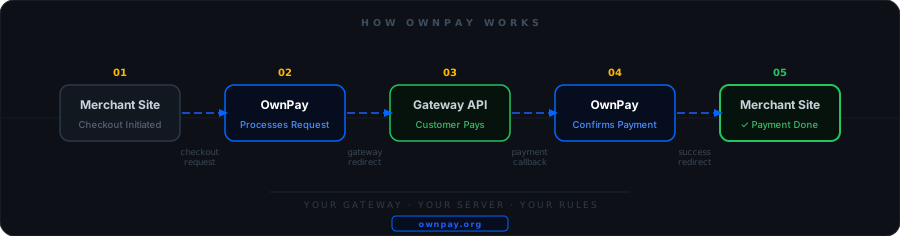
⚡ How OwnPay Works
▶️ Live Demo
The OwnPay live demo is coming soon.
Experience the full platform firsthand before the official public release.

🏗️ Tech Stack
|
⚙️ Backend
|
🔐 Security & Quality
|
❓ Frequently Asked Questions
What is the current project status?
OwnPay has completed its core development phase. The platform is currently undergoing bug fixing and final validation before the Public Beta v0.1.0 release.
When will OwnPay officially release?
The Public Beta v0.1.0 release is coming soon. We do not commit to a specific date — the release will happen when the quality bar is met, not when a calendar says so. Star the repository to get notified the instant it drops.
Why is the release taking longer than expected?
Because we refuse to release something that isn't secure. OwnPay handles real financial transactions — a rushed release with unresolved vulnerabilities would be a disservice to the community. The additional time is invested in thorough security hardening, bug fixing, and edge case validation. Quality over speed. Always.
Why was a custom framework built instead of using Laravel or Symfony?
OwnPay was architected around very specific requirements that off-the-shelf frameworks don't solve cleanly — primarily around multi-brand domain isolation, a sandboxed plugin execution model, and a domain-specific hook engine. Using a full framework would mean fighting against its conventions rather than leveraging them. The custom foundation gives us full control over the boot pipeline, zero dead code, and a security surface that we own completely. It's more work upfront, and the right call long-term.
Do you accept sponsors?
Yes. OwnPay welcomes sponsors who align with the open-source mission. If you're interested in supporting the project and gaining visibility in the community, visit ownpay.org/donate or reach out at [email protected].
Do you accept donations?
Yes. Every contribution, however small, helps keep the project moving. Donations go directly toward infrastructure costs, developer time, and security tooling.

Is OwnPay production-ready?
The platform is approaching its Public Beta v0.1.0 release. For production deployments, we recommend waiting for the official beta tag, which will include installation documentation, migration tooling, and a full security disclosure report. Star the repository to get notified.
🔗 Quick Links
🌐 Platform




🤝 Community




📈 Star History
⭐ Star OwnPay now — be the first to know when Public Beta v0.1.0 drops.


💛 Sponsors
OwnPay is made possible by the generous support of our sponsors.
⚡ Elite Sponsor
🤝 Community Sponsors
 FlexoHost |
 Hostazy |
 Bangla Hoster |
 HostSire24 |
Interested in sponsoring? → ownpay.org/donate
👥 Contributors
 🔧 Lead Developer & Main Maintainer 🌐 iamnaime.info.bd |
 🎨 Logo & Brand Design |
Want to contribute? Check CONTRIBUTING.md — contributions open with Public Beta.
🛡️ Security
If you discover a security vulnerability, do not open a public issue.
Report privately: [email protected] — see SECURITY.md for the full disclosure policy.
⚖️ License
Distributed under the GNU Affero General Public License v3.0 (AGPL-3.0). The core platform is, and will always remain, free and open source.
Built by the Community, for the Community. 🌍
#OwnPay
#OpenSourcePaymentGateway
#SelfHosted
#DataSovereignty
#Fintech
#OpenSource