
ParkinSUM Companion

A provenance-first Parkinson medication-food interaction prototype for explainable CDSS architecture, Firebase governance, and synthetic-data demos.
Educational architecture prototype only. Not medical advice or a clinical decision tool.





ParkinSUM Companion is a local-first Flutter prototype that demonstrates how a health-adjacent app can combine synthetic meal logging, medication context, deterministic rule checks, evidence-oriented explanations, and release safety guardrails without making clinical claims.
It is a production-architecture prototype designed for educational demonstrations, software architecture review, and academic discussion of local-first digital health prototypes. It is not a medical device and must not be used for diagnosis, treatment, medication timing, dietary guidance, clinical decision-making, patient care, or emergency support.
Public demos should use synthetic or sample data only.
What It Demonstrates
- Meal logging and medication-context capture for a Parkinson's disease education scenario.
- Deterministic food-drug interaction checks instead of black-box medical advice.
- Evidence-oriented explanations that show why a prototype rule fired.
- Local-first app behavior for public demos and development.
- Optional Firebase-backed paths for internal operator validation and governance.
- Public-release guardrails around disclaimers, security, contribution rules, and synthetic data.
Algorithm and Safety Boundary
ParkinSUM's conflict engine is deterministic and evidence-linked: no LLM sits inside it, and every educational rule that fires carries a structured explanation with source references, provenance, the input fields actually used, any missing or uncertain inputs, an explicit limitation, and a hard not-advice boundary.
Medication context must be catalog-backed and unit-explicit before any
food-medication rule is evaluated. A bare numeric dose such as 100, an
unstructured string such as "100 tablets", or a name without a unit such as
levodopa 100 is rejected outright — ParkinSUM does not infer mg, tablet
count, schedule, formulation, or release type from such input. Entries
without an active ingredient, drug product variant, formulation, or
provenance are treated as insufficient context and do not produce a conflict
result.
High-value contributor work in this area includes:
- Medication context validation (
lib/domain/usecases/medication_entry_validator.dart). - Evidence-linked rule explanations (
lib/domain/entities/rule_explanation.dart). - Importer provenance fields (basis, scope, jurisdiction, confidence, source).
- Negative safety tests that prevent educational copy from drifting into
medication timing, dose, dietary, or clinical-validation claims
(
test/medication_entry_validator_test.dart,test/rule_explanation_safety_test.dart).
See docs/RULE_ENGINE.md for the medication context gate, the structured rule-explanation template, a worked levodopa+protein example, and the negative-test expectations.
Mechanistic Conflict and Recommendation Engine
ParkinSUM now includes a deterministic, time-axis, literature-informed
educational conflict engine that models meal composition, gastric
emptying assumptions, small-intestinal arrival, a levodopa absorption
opportunity window, an amino-acid competition proxy, overlapping-meal
effects, and uncertainty bands. Every modeled assumption is backed by a
local source registry (lib/domain/usecases/model_assumption_registry.dart)
that cites entries in Bibliographies.md (MLA format).
The next-meal recommendation engine accepts a user-defined time window
and a regional food library, then ranks candidate foods inside that window
by modeled overlap with the educational simulation. The engine does not
decide when the user eats, does not produce medication timing or dietary
advice, and returns insufficient_context whenever the window or
medication context is missing.
The mechanistic engine is now the primary ranker for next-meal
recommendations whenever the request carries a user-defined time window
and the engine has at least medium confidence — see
docs/CONFLICT_ENGINE_MODEL.md for the promotion contract and the
rankerUsed field. Candidate scoring uses deterministic multi-point
sampling (5–12 samples, capped) across the user-provided window; the
worst-case overlap drives ranking and the best/average/per-sample summary
is surfaced for trace and UI. Gastric-emptying numerics live in a single
GastricEmptyingParameterSet with per-parameter sourceRefs, and the
amino-acid competition layer now applies a coarse, direction-only
LNAA load factor per protein source (animal vs plant). The runtime
food repository is augmented at app boot with foods projected from CDSS
observations so the scorer can rank real catalog-backed candidates, not
only synthetic replay items.
The data chain preserves fidelity end-to-end: missing nutrient data is
carried as unknown, never coerced to a fake 0 g (missingNutrientFields
→ null components → lowered composition completeness → widened uncertainty);
actual USDA FDC amino-acid fields (verified nutrient-number mapping) feed
the LNAA layer in preference to the protein-source proxy; per-candidate
CandidateMetadata (authority, jurisdiction match, completeness, provenance)
is built from imported source data so official-in-jurisdiction outranks
synthetic/seed. The medication dose is taken only from the user's entered
dosage note (value + unit must both be explicit) — there is no private
default; a missing/ambiguous dose yields insufficient context and blocks
dose-dependent interpretation. The conflict engine evaluates each levodopa
dose on a multi-dose time axis and aggregates with deterministic
max-overlap, keeping per-dose traces.
Compact mechanistic-trace UI cards render alongside the existing
recommendation and conflict-result views via an ExpansionTile so the
new surface stays out of the way until a reviewer expands it. Raw trace
JSON is never shown by default.
Synthetic replay scenarios are available via the CLI:
dart run tool/run_mechanistic_replay.dart
# or
npm run mechanistic:replay
The runner writes build/mechanistic_replay/latest.{json,md} and exits
non-zero on any expectation mismatch or banned-phrase hit.
See docs/CONFLICT_ENGINE_MODEL.md for the layered model description and docs/REPLAY_RUNNER.md for the scenario format and CLI details. ParkinSUM does not overclaim clinical accuracy; the engine is an educational simulation, not a patient-care tool.
Educational Model Guardrails
The mechanistic conflict engine is not clinically calibrated. Its gastric-emptying values are literature-informed prototype parameters; the amino-acid (LNAA) competition layer is an educational proxy. It makes no patient-specific pharmacokinetic/pharmacodynamic prediction, gives no medication-timing, dietary, or dose guidance, and carries no clinical-validation claim. All importer adapters are fixture-validated (not live production ingestion); the optional live-source smoke harness is opt-in, excluded from normal tests, fetches official metadata only, and is not used for clinical advice. Source-specific legal/license review remains future work — see docs/SOURCE_ACCESS_AND_LICENSES.md.
Multi-Jurisdiction Metadata & Protein Redistribution
ParkinSUM's importer layer is multi-jurisdiction: source-adapter specs cover DailyMed (US), Health Canada DPD (CA), EMA + EU national registers (EU/EEA), NHS dm+d (GB), PMDA (JP), NMPA (CN), and food-composition sources (USDA FDC, Ciqual, China CDC), with a deterministic source-authority scorer (official-in-jurisdiction outranks others; reference translations are downgraded; seed/synthetic never overrides official; cross-jurisdiction conflicts are preserved, not merged). Canonical source/provenance metadata — jurisdiction, language, unit, basis, authority tier, completeness, limitation — is preserved from importer to runtime so the mechanistic engine and scorer can reason about it.
The next-meal scorer models protein redistribution, not global protein minimization: protein is penalized only in modeled high-overlap windows and allowed in low-overlap windows, with a non-clinical nutrition-adequacy proxy so zero-protein does not automatically win. Window role is decided primarily from modeled overlap, not the clock. The next-meal page lets the user provide a meal-time window; mechanistic-primary ranking activates only with a user-provided window and sufficient context.
See docs/IMPORTER_METADATA_FLOW.md for the canonical metadata model, source-authority policy, cross-jurisdiction conflict policy, completeness gate, and the protein-redistribution objective, and docs/MANUAL_VALIDATION.md for a hands-on walkthrough.
Fixture-tested medication source parsers now cover DailyMed, Health Canada
DPD, EMA, PMDA, NHS dm+d (identity/coding — not a complete food-effect
source), EU national registers (member-state identity vs full SmPC), and
NMPA (fixture-validated / prototype, honestly downgraded). A
SourceFetchClient abstraction (with an offline FixtureSourceFetchClient
returning structured SourceFetchResults) keeps all tests deterministic;
live fetch is optional and never used for clinical advice. Per-food
amino-acid fields, when present, drive the LNAA competition layer in
preference to the protein-source proxy. The legacy heuristic can only order
results when rankerEligibility.mechanisticPrimaryEligible == false, with the
reason surfaced in UI + replay.
Evidence & Traceability Architecture
ParkinSUM's most reviewable surface is its evidence and provenance layer. Every educational output is deterministic, source-linked, and serializable for review — without any patient data.
- Deterministic mechanistic replay — 41 synthetic scenarios, banned-phrase
scanned (
docs/REPLAY_RUNNER.md). - CDSS-style source/provenance metadata with source-authority and
metadata-completeness gates (
docs/IMPORTER_METADATA_FLOW.md). - FDC nutrient provenance tiers (analytical / calculated / imputed / unknown) as source-quality signals that affect modeled confidence, not advice.
- Multi-dose medication traces with per-dose modeled overlap.
- Local EvidenceTraceBundle — a ParkinSUM-local artifact (explicitly not a
FHIR Bundle) pairing the two inspired views (
docs/EVIDENCE_TRACE_BUNDLE.md). - FHIR-inspired, non-conformant NutritionIntake / MedicationKnowledge views
(PHI-free;
inspired_not_conformant) with a conservative LOINC section-code trace. - Source-quality perturbation report — shows how scoring moves when only
source/provenance quality changes (
docs/SOURCE_QUALITY_PERTURBATION_REPORT.md). - Public preflight + Firestore rules contract release guardrails.
source/importer metadata → normalized facts (missing ≠ zero)
  → metadata completeness + source authority
  → mechanistic engine (per-dose) → replay / source-quality report
  → FHIR-inspired views + local EvidenceTraceBundle
Reviewer entry points: docs/EVIDENCE_AND_TRACEABILITY_DEMO_GUIDE.md (guided walkthrough), docs/CAPABILITY_MATRIX.md (implemented vs future work), docs/PUBLIC_VERIFICATION.md (exact commands), and the docs index. These artifacts are deterministic synthetic-data demonstrations — they are not clinical validation, and the source-quality report is not a clinical dashboard.
Demo Media
The screenshots below use synthetic local demo data only. Real account identifiers are redacted or replaced with a synthetic demo address. They show the current public prototype flow and are not medical advice, clinical validation, or patient data.
| Feature shown | Demo screenshot | What it demonstrates |
|---|---|---|
| Account entry | 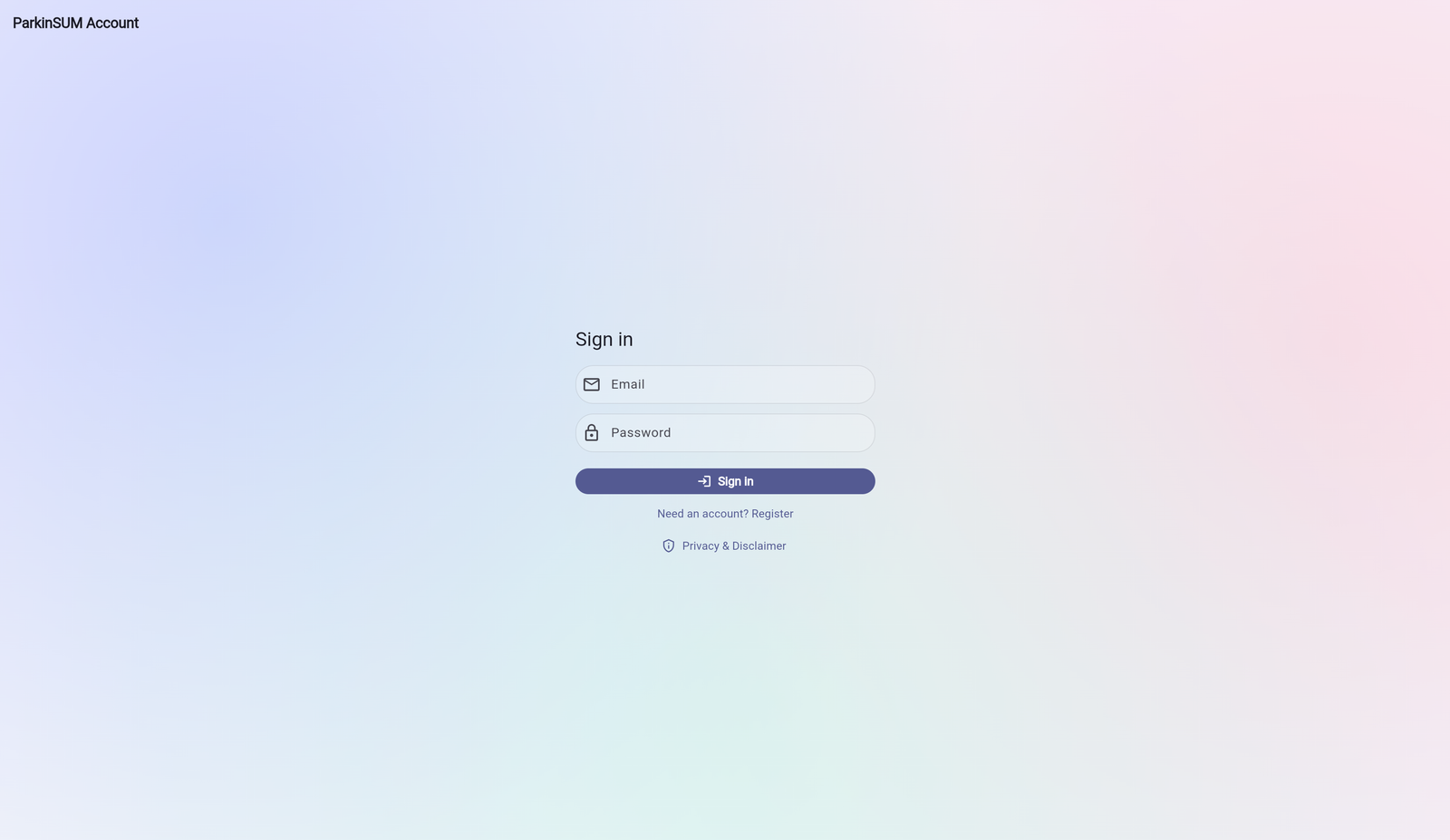 |
Authentication shell and privacy/disclaimer entry point. |
| Next-meal setup | 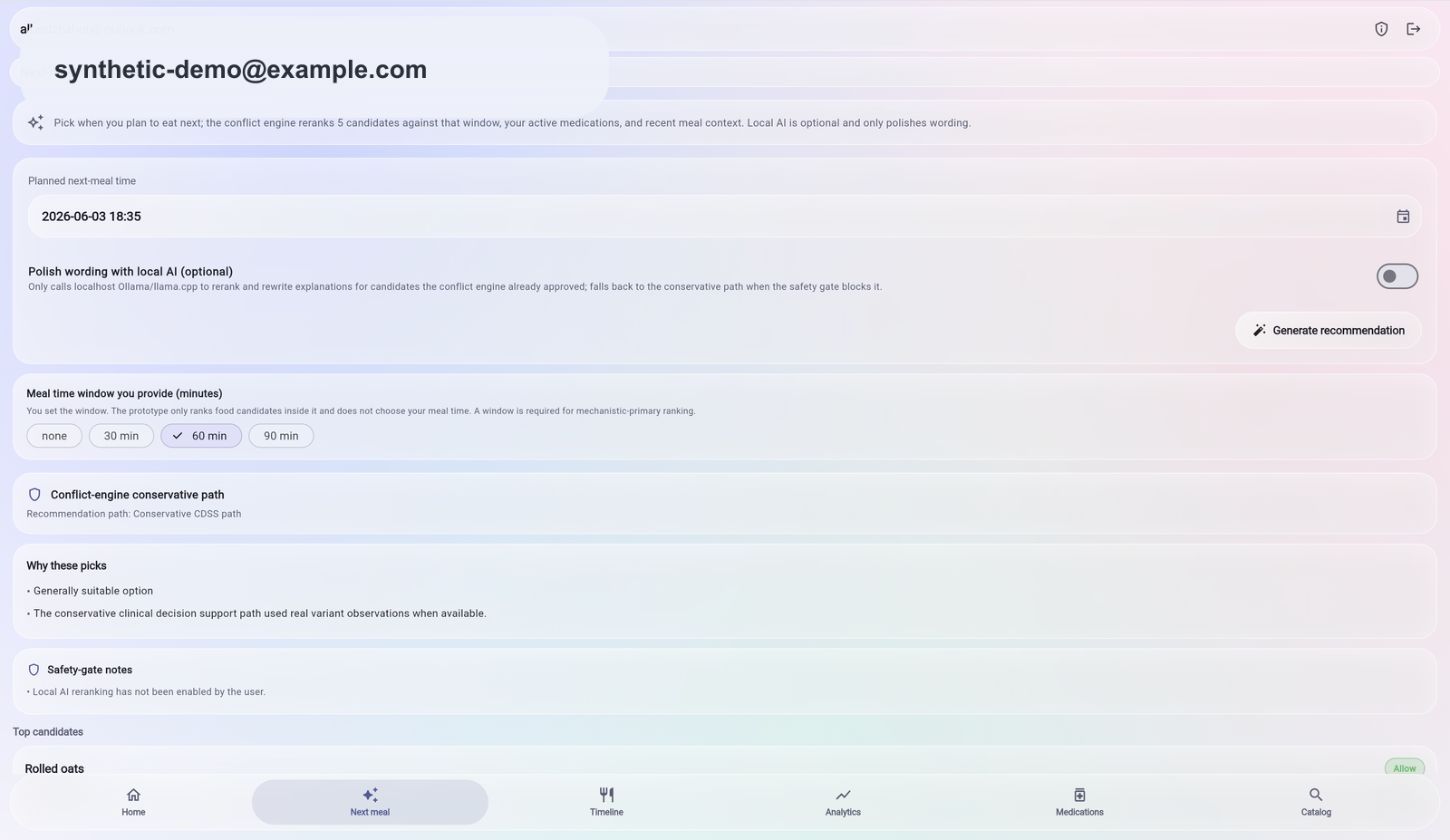 |
User-provided meal timing window, conservative path, and optional local-AI wording polish. |
| Next-meal results | 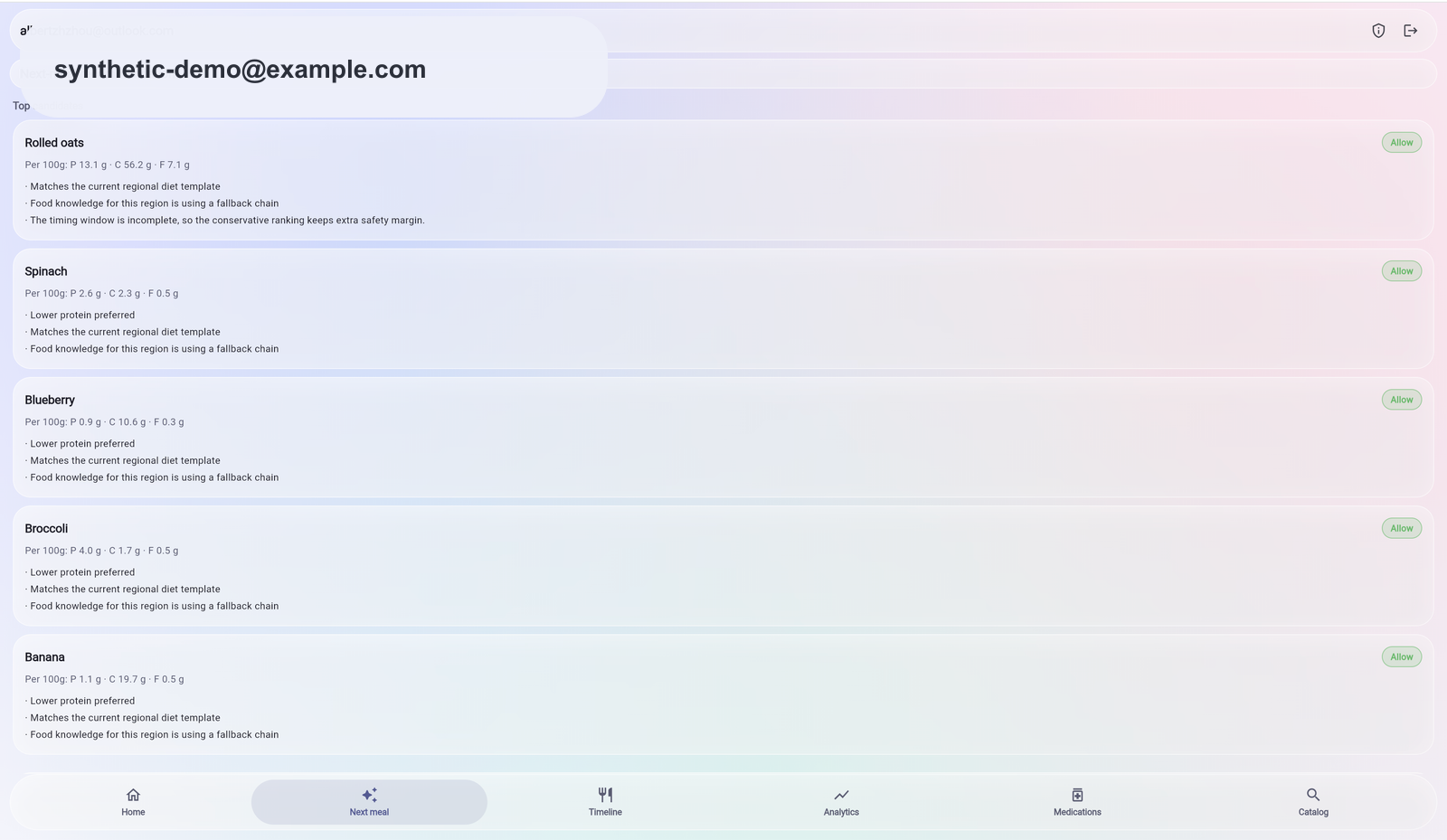 |
Ranked food candidates, allow labels, and explanation bullets from the deterministic recommendation flow. |
| Timeline overview | 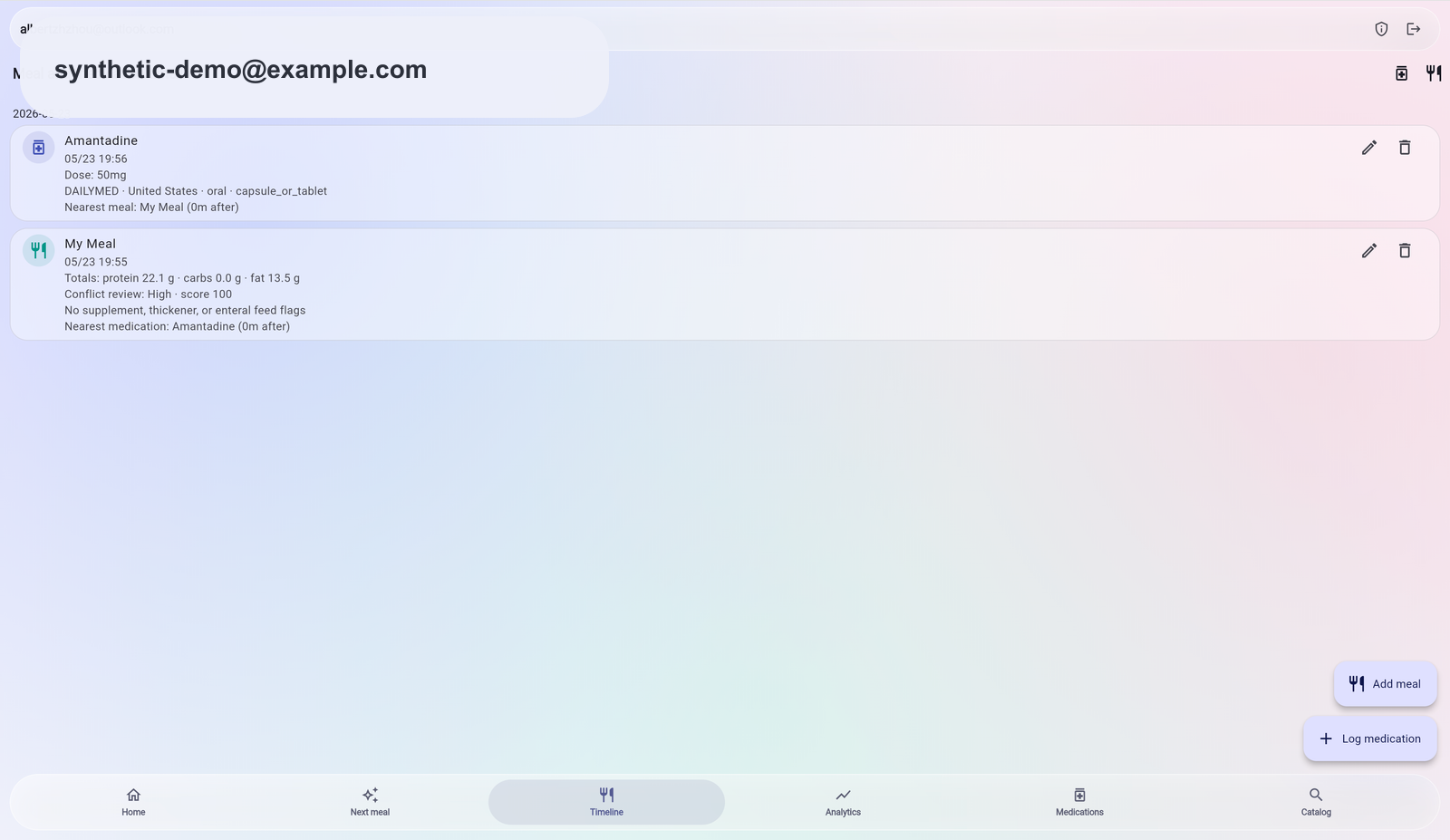 |
Meal-medication chronology, nearest-event context, and editing controls. |
| Timeline action state | 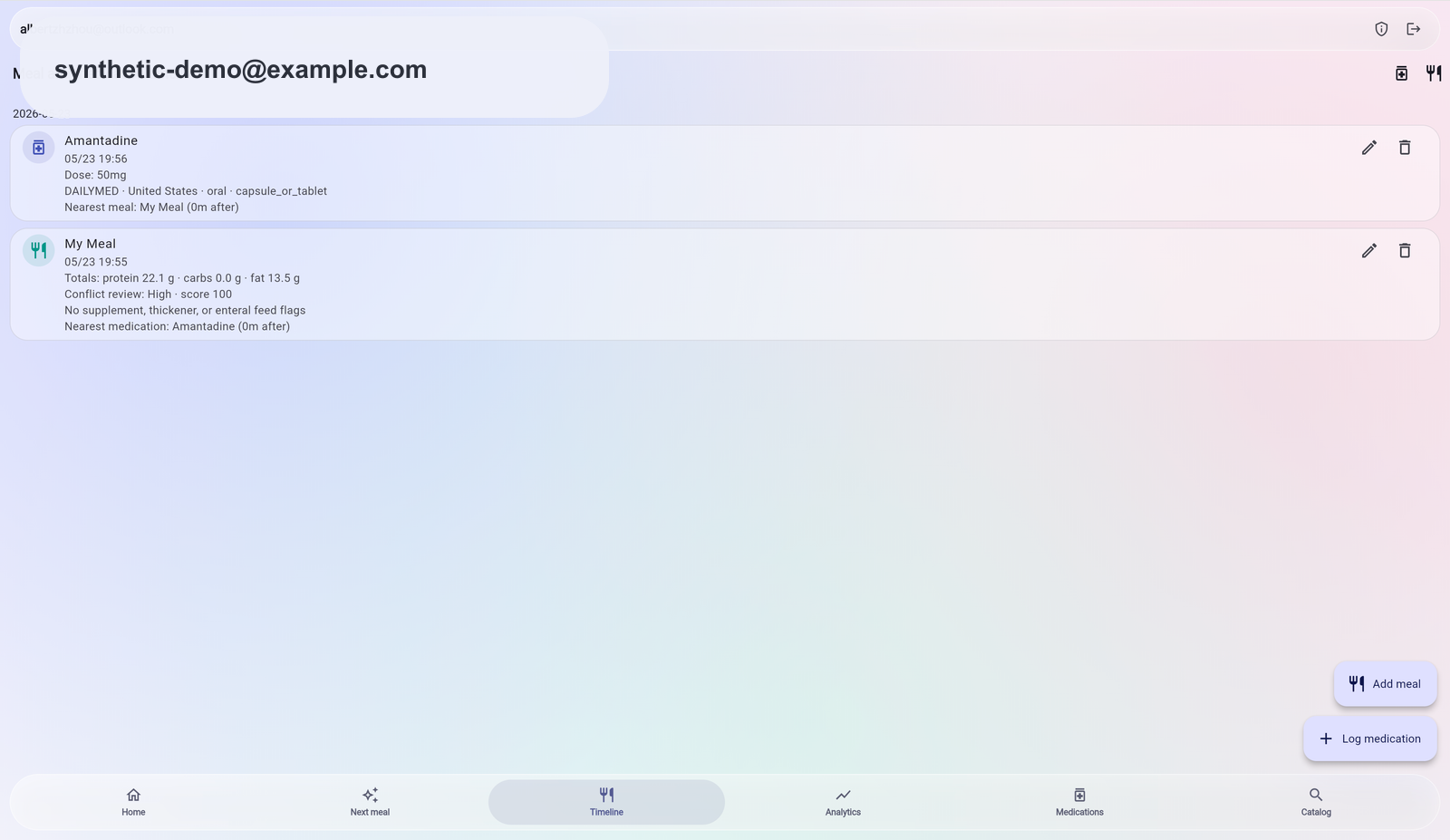 |
Floating meal and medication logging actions in the timeline workflow. |
| Medication catalog | 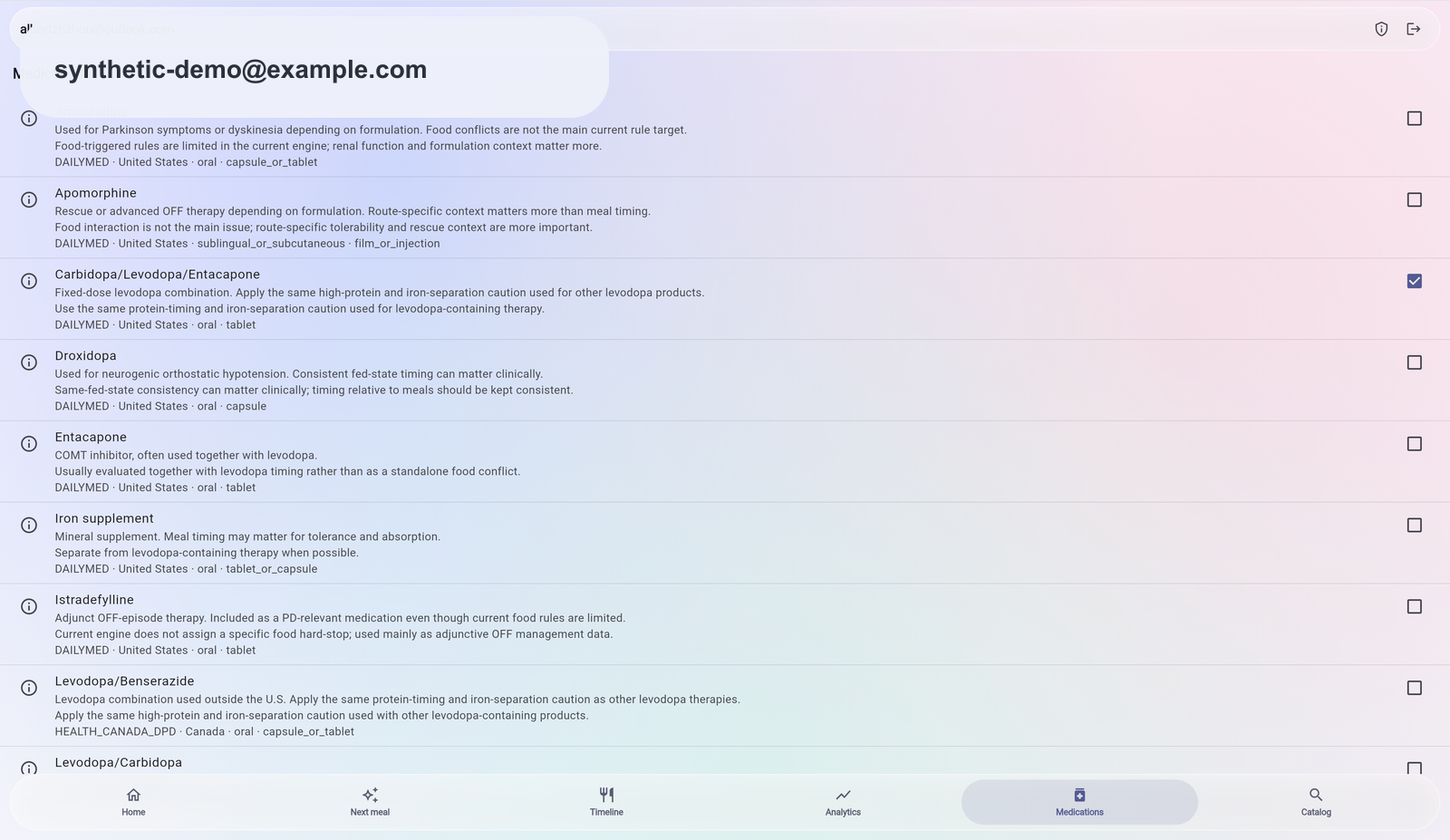 |
Medication catalog entries, jurisdiction source labels, and selected medication context. |
| Search/catalog showcase | 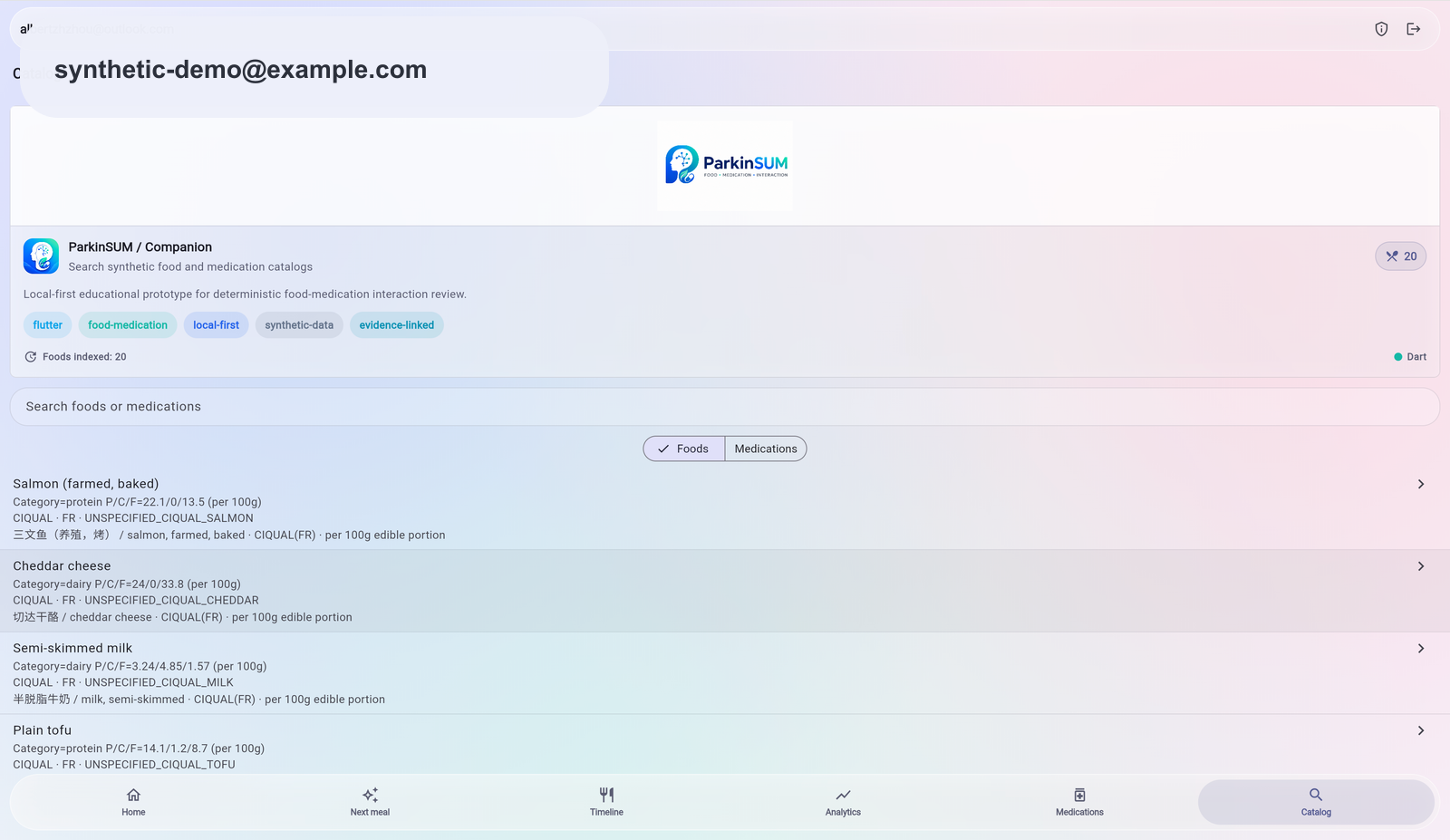 |
GitHub-style branded repository module integrated into catalog search. |
| Conflict explanation | 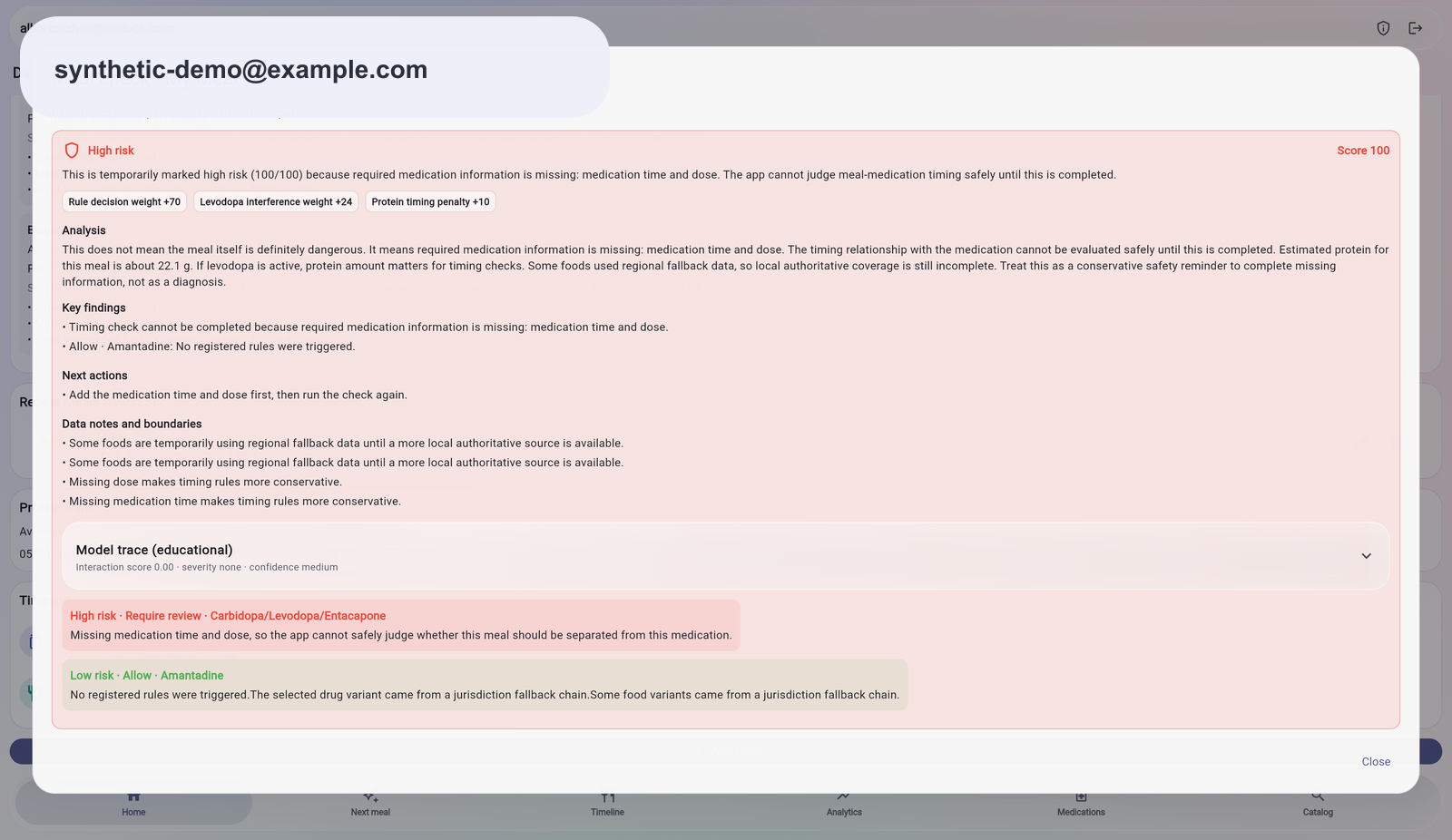 |
Evidence-oriented safety explanation, rule weights, model trace, and non-clinical boundary copy. |
| Analytics and local AI | 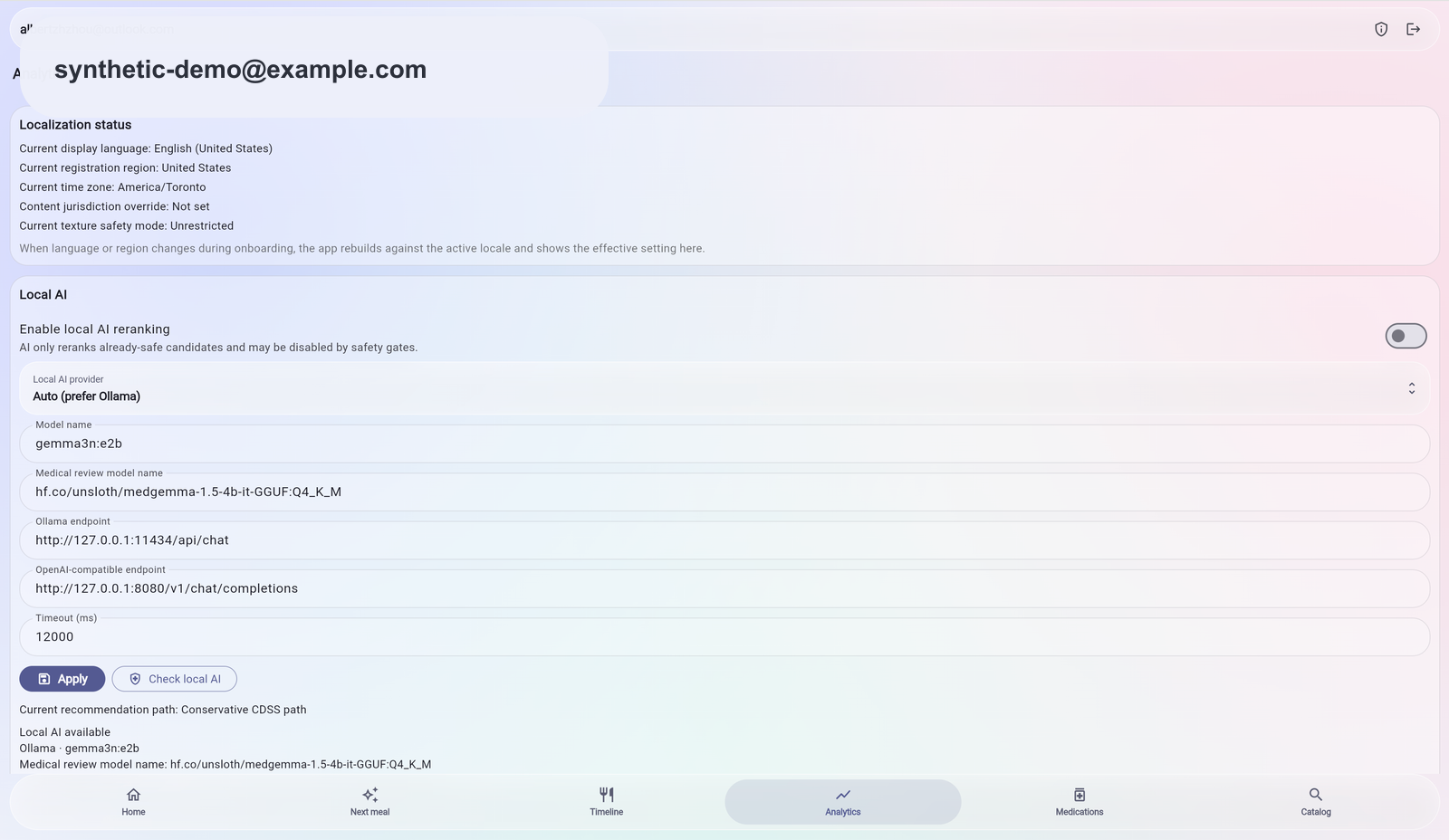 |
Localization status, local AI provider settings, model names, endpoints, and conservative recommendation path. |
Capture requirements are tracked in docs/media-capture-checklist.md, with asset-folder notes in docs/assets/screenshots/README.md and docs/assets/demo/README.md.
Quick Start
High-Impact Contribution Request
The current priority is Issue #8: mapping one educational rule explanation to explicit evidence fields.
The most valuable contribution right now is not adding new medical rules. Instead, contributors should help make existing rule explanations more traceable and reviewable by improving:
- source references
- provenance clarity
- limitation text
- safety-boundary wording
- negative tests that prevent unsupported clinical claims
See docs/RULE_ENGINE.md for the contributor-facing rule explanation template and worked example.
Install Flutter, Node.js, and npm first. Then run these commands from the repository root:
git clone https://github.com/albertzhzhou-droid/ParkinSUM.git
cd ParkinSUM
flutter pub get
flutter run -d chrome
Evaluate the prototype locally:
dart format --output=none --set-exit-if-changed .
flutter analyze
flutter test
npm ci
npm run public:preflight
npm run rules:contract
Run the deterministic evidence artifacts (synthetic data; not clinical validation):
dart run tool/run_mechanistic_replay.dart            # or: npm run mechanistic:replay
dart run tool/run_source_quality_perturbation_report.dart  # or: npm run source:quality
See docs/PUBLIC_VERIFICATION.md for what each command checks, its expected output, and what failure means.
The default public-demo path is local mode. Firebase-backed commands are retained for internal operator validation and require project access.
Release
The current public showcase target is v0.2.0-beta. Release materials are tracked in CHANGELOG.md, docs/release/v0.2.0-beta-notes.md, docs/release/synthetic-demo-data.md, and docs/release/release-checklist.md. The earlier alpha materials remain at docs/release/v0.1.0-alpha-notes.md.
A scoped release-metadata package is published to GitHub Packages (npm registry) as @albertzhzhou-droid/parkinsum-companion on each tagged release; see packages/npm/README.md.
Any Android APK generated for this beta must be labeled as a beta/demo/debug artifact unless production signing is handled in a separate release process.
Project Website
A lightweight GitHub Pages landing page is available in docs/site/index.html. Setup instructions are in docs/site/README.md.
An animated Liquid Glass-style showcase wiki is available in docs/wiki/index.html. GitHub Wiki-compatible Markdown pages are staged in docs/github-wiki/ so they can be published to the repository Wiki interface.
Contribute
Start with the contribution guide, then choose a scoped item from the public contribution backlog. Use the structured GitHub issue templates for bugs, features, documentation improvements, and research-rule evidence requests. A small real contributor PR request is drafted in docs/mentor-pr-request.md for classmates or mentors who want to test the project without making medical claims. Public examples must use synthetic or sample data only.
Secondary creators who need to fork the project, configure local GitHub authentication, and submit updates by pull request should follow the secondary creator token flow. The repository documents fork-scoped token permissions and setup steps, but never stores real token values.
Architecture Overview
flowchart LR
  UI["Flutter UI"]
  State["App State"]
  Data["Local-first Data Layer"]
  Rules["Deterministic Rule Engine"]
  Evidence["Evidence Explanation Layer"]
  Output["Educational Awareness Output"]

  UI --> State
  State --> Data
  Data --> Rules
  Rules --> Evidence
  Evidence --> Output
The app separates user-facing screens, app state, local data handling, deterministic rule evaluation, and evidence-oriented explanation copy. Firebase services are available for internal validation, but the public prototype should be evaluated with synthetic data and conservative claims.
See docs/ARCHITECTURE.md and docs/RULE_ENGINE.md for more detail.
Safety Boundary
ParkinSUM Companion is an educational awareness prototype only.
- It does not diagnose, treat, monitor, prevent, or manage disease.
- It does not provide individualized dietary, medication, clinical, or emergency advice.
- It has no patient-outcome validation or clinical-use approval.
- It should not be connected to real health records for public demos.
- Screenshots, tests, walkthroughs, and examples should use synthetic or sample data only.
Read DISCLAIMER.md and docs/PUBLIC_DEMO_BOUNDARY.md before presenting or reusing the project.
Repository Map
| Path | Purpose |
|---|---|
lib/app/ |
Flutter app bootstrap and top-level app wiring. |
lib/features/ |
User-facing flows such as dashboard, meals, medications, onboarding, import, and recommendations. |
lib/core/ |
Shared models, state, services, database adapters, constants, i18n, and copy helpers. |
lib/domain/ |
Entities, repositories, deterministic rule use cases, recommendation orchestration, and evidence-oriented runtime logic. |
lib/data/ |
Local and remote data-source implementations, importers, and repository implementations. |
test/ |
Focused Flutter and Dart tests for rule execution, importers, onboarding, Firebase boundaries, and recommendation copy. |
tool/ |
Public preflight, Firebase governance, release, monitoring, and operator-validation scripts. |
docs/ |
Architecture, rule-engine, release, public-boundary, risk, security-adjacent, and operations documentation. |
Current Status
- Public release type: prototype showcase.
- Current public release target:
v0.2.0-beta. - Package name:
parkinsum_companion. - Current app version:
0.2.0+2. - Default public-demo backend: local mode.
- Firebase backend mode: internal operator validation only.
- Public contact:
[email protected]. - Public readiness gate:
npm run public:preflightshould report zeroBLOCKERfindings before publication.
Public GitHub visibility does not claim external clinical, legal, privacy, regulatory, or patient-outcome approval.
Roadmap
Near-term work is tracked in ROADMAP.md. Current priorities include:
- Capture clean synthetic-data screenshots and a short demo GIF.
- Keep the rule engine evidence-linked and auditable.
- Improve accessibility, localization, and caregiver-oriented educational flows.
- Expand sample-data walkthroughs without adding real patient data.
- Maintain release, security, and public-readiness checks as the prototype changes.
Citation / Academic Use
ParkinSUM Companion may be cited as a software prototype or educational research artifact. Do not cite it as a clinical intervention, medical device, treatment system, or patient-outcome study.
Suggested citation format:
Zhou, Z. ParkinSUM Companion: a local-first Flutter prototype for Parkinson's disease diet-medication education. GitHub repository, 2026. Available at: https://github.com/albertzhzhou-droid/ParkinSUM
If you discuss the project academically, include the safety boundary: educational awareness only, synthetic/demo data only, and no diagnosis, treatment, medication timing, dietary guidance, clinical decision-making, or patient-care use.
Documentation
Start here
- Documentation index
- Public verification guide
- Contribution guide
- Rule engine overview
- Project website
- Animated showcase wiki
- GitHub Wiki source pages
Architecture
Safety and release
- Disclaimer
- Security policy
- Roadmap
- Contribution guide
- Contribution backlog
- Secondary creator token flow
- Mentor/classmate PR request
- Changelog
- Citation metadata
- Repository metadata recommendations
- Social preview brief
- Rule engine testing
- Impact one-page summary
- Impact technical case study
- Impact project pitch
- Impact FAQ
- Impact safety and ethics
- v0.2.0-beta release notes
- v0.1.0-alpha release notes
- Synthetic demo data
- Synthetic demo scenarios
- Release checklist
- Project website
- Animated showcase wiki
- GitHub Wiki source pages
- GitHub Pages setup
- Public showcase readiness
- Public demo boundary
- Release checklist
- Known risks
Demo and impact
Contributing
Contributions are welcome when they keep the public prototype boundary intact. Good first areas include documentation, UI strings, accessibility notes, synthetic sample interactions, and focused tests. Start with CONTRIBUTING.md.
Do not submit personal health information, real medication schedules, credentials, service account keys, private Firebase exports, or raw operator logs.