
simpleRTOS
A lightweight Real-Time Operating System (RTOS) designed for ARM Cortex-M4 microcontrollers. Features include tasks, timers, semaphores, mutexes, queues, and task notifications.
Intended for learning and experimentation. Supports both preemptive and non-preemptive priority-based scheduling using SysTick, with a minimal memory footprint.
⚠️ Note: This is not intended for production use. Requires GCC compiler.
Table of Contents
Features
- O(1) Scheduler: Bitmap-based priority selection for constant-time task switching
- 32 Priority Levels: Each priority supports multiple tasks with round-robin scheduling
- Priority Inheritance: Automatic priority boosting to prevent priority inversion
- Low Memory Footprint: Optimized for resource-constrained embedded systems
- Synchronization: Semaphores, mutexes, queues, and task notifications
- Software Timers: Periodic and one-shot timers
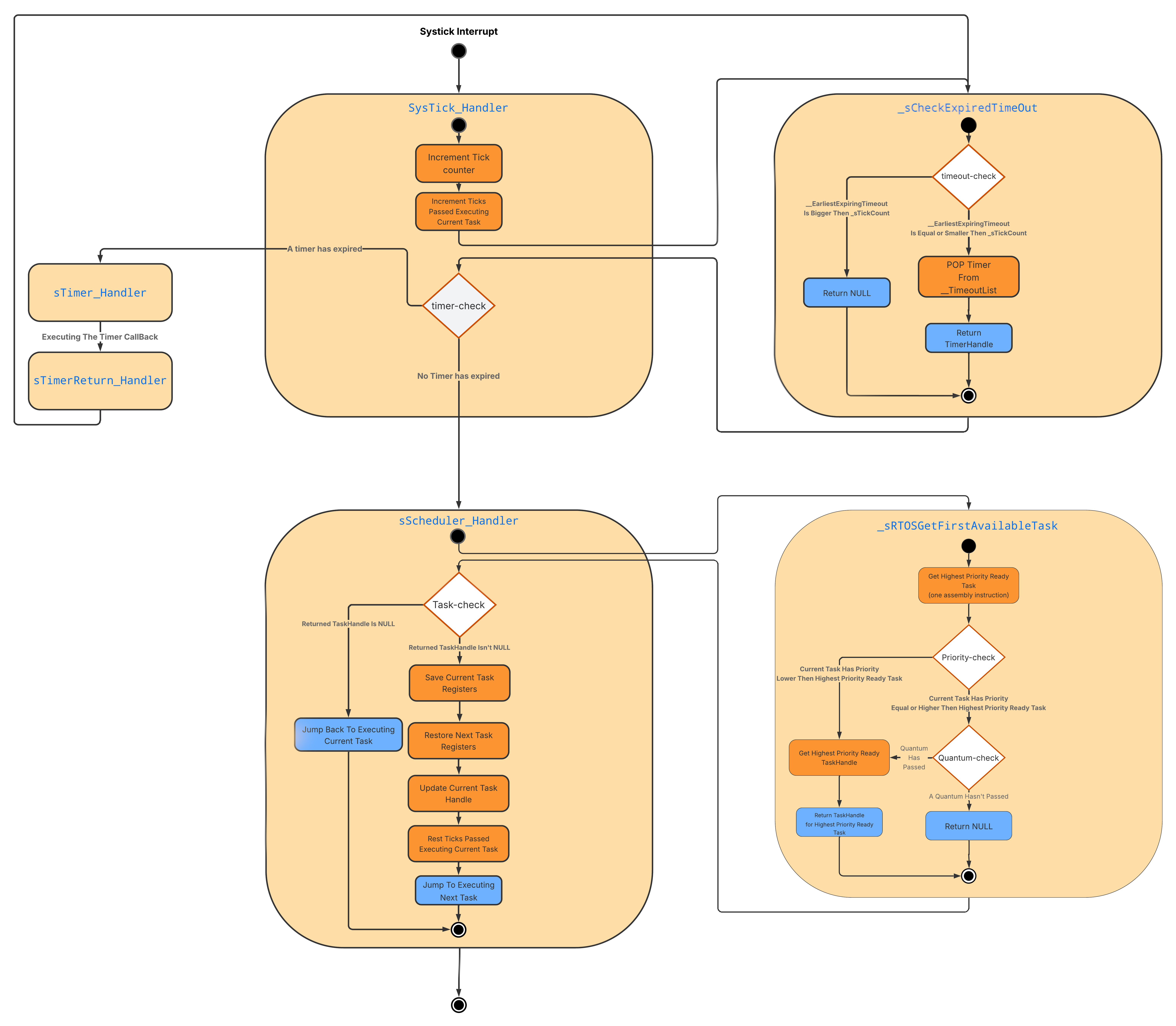
Architecture
- O(1) Scheduler: Uses a bitmap to select the highest-priority runnable task in constant time
- 32 Priority Levels: Each priority is mapped to a bit in the bitmap; tasks at the same priority are organized in a circular doubly linked list for efficient O(1) enqueue/dequeue and fair round-robin scheduling
- Priority Inheritance: Tasks waiting on mutexes or notifications automatically inherit the priority of blocking tasks to mitigate priority inversion
Scheduler Overview
Getting Started
Prerequisites
- Hardware: ARM Cortex-M4 microcontroller (e.g., STM32F4 series)
- Toolchain: GCC ARM compiler (arm-none-eabi-gcc)
- Build System: Make or compatible build tool
Installation
- Clone or download this repository into your project directory
- Add source files to your build:
- All source files from the
src/directory
- All source files from the
- Include headers in your project:
- Add
inc/directory to your include path
- Add
- Include the main header in your application:
#include "simpleRTOS.h"
Configuration
Configure the kernel behavior by editing inc/simpleRTOSConfig.h:
System Tick Resolution
Choose how frequently the system timer (SysTick) fires:
#define __sRTOS_SENSIBILITY_10MS   100    // Tick every 10ms
#define __sRTOS_SENSIBILITY_1MS    1000   // Tick every 1ms
#define __sRTOS_SENSIBILITY_500us  2000   // Tick every 500µs (default)
#define __sRTOS_SENSIBILITY_250us  4000   // Tick every 250µs
#define __sRTOS_SENSIBILITY_100us  10000  // Tick every 100µs

#define __sRTOS_SENSIBILITY __sRTOS_SENSIBILITY_500us
Note: Higher sensitivity (shorter tick period) provides more responsive timing but increases interrupt overhead.
Scheduler Mode
#define __sUSE_PREEMPTION 1 // 1 = Preemptive, 0 = Cooperative
Time Quantum
#define __sQUANTA 2 // Time slices for round-robin scheduling
Tasks at the same priority level are rotated every __sQUANTA ticks.
Timer Task Stack
#define __sTIMER_TASK_STACK_DEPTH 256 // Stack size in words (4 bytes each)
Maximum Delay
#define __sMAX_DELAY 0xFFFFFFFF // Infinite wait for blocking calls
Quick Start Example
Here's a minimal example showing how to initialize the RTOS and create tasks:
#include <stdint.h>
#include "stm32f4xx.h"
#include "simpleRTOS.h"

// Task handles
sTaskHandle_t task1Handle;
sTaskHandle_t task2Handle;

// Task 1: Blinks LED every 500ms
void Task1(void *arg)
{
  while (1)
  {
    // Toggle LED
    GPIOA->ODR ^= GPIO_PIN_5;
    // Delay for 500ms
    sRTOSTaskDelay(500);
  }
}

// Task 2: Processes data
void Task2(void *arg)
{
  while (1)
  {
    // Process some data
    // ...

    // Yield to other tasks
    sRTOSTaskYield();
  }
}

int main(void)
{
  // Initialize system clock
  SystemCoreClockUpdate();

  // Initialize the RTOS
  sRTOSInit(SystemCoreClock);

  // Create Task 1 (Normal priority, 128 words stack)
  sRTOSTaskCreate(Task1,
                  "LED Task",
                  NULL,
                  128,
                  sPriorityNormal,
                  &task1Handle,
                  sFalse);

  // Create Task 2 (High priority, 256 words stack)
  sRTOSTaskCreate(Task2,
                  "Data Task",
                  NULL,
                  256,
                  sPriorityHigh,
                  &task2Handle,
                  sFalse);

  // Start the scheduler (does not return)
  sRTOSStartScheduler();

  // Should never reach here
  while (1);
}
For a more complete example with timers and multiple tasks, see example/main.c.
API Reference
System Control
sRTOSInit
Initializes the RTOS core infrastructure.
sRTOS_StatusTypeDef sRTOSInit(sUBaseType_t BUS_FREQ);
- @brief: Configures SysTick and creates the idle task.
- @param
BUS_FREQ: Core/system clock frequency in Hz. - @retval
sRTOS_OK: Initialization succeeded. - @retval
sRTOS_ERROR: Initialization failed. - @warning: Must be called only once before starting the scheduler.
sRTOSStartScheduler
Starts the RTOS scheduler.
extern void sRTOSStartScheduler(void);
- @brief: Begins multitasking. This function does not return unless the scheduler is stopped.
- @note: Tasks can still be created after the scheduler has started.
__sCriticalRegionBegin
Enters a critical section.
__STATIC_FORCEINLINE__ void __sCriticalRegionBegin(void);
- @brief: Disables IRQ interrupts to protect a code section from being preempted.
- @note: Critical sections should be kept as short as possible.
__sCriticalRegionEnd
Exits a critical section.
__STATIC_FORCEINLINE__ void __sCriticalRegionEnd(void);
- @brief: Re-enables IRQ interrupts.
sGetTick
Returns the current tick counter.
sUBaseType_t sGetTick(void);
- @brief: Gets the current system tick count since the scheduler started.
- @return: Current tick value.
Task Management
sRTOSTaskCreate
Creates a new task.
sRTOS_StatusTypeDef sRTOSTaskCreate(
  sTaskFunc_t task,
  char *name,
  void *arg,
  sUBaseType_t stacksizeWords,
  sPriority_t priority,
  sTaskHandle_t *taskHandle,
  sUBaseType_t fpsMode);
- @brief: Allocates and initializes a task control block (TCB) and stack.
- @param
task: The function that implements the task. - @param
name: A descriptive name for the task (can be NULL). - @param
arg: Argument passed to the task function. - @param
stacksizeWords: Stack depth in 32-bit words. - @param
priority: Task priority (higher value means higher priority). - @param
taskHandle: Pointer to a handle that will reference the created task. - @param
fpsMode: Flag for floating-point context saving. - @retval
sRTOS_OK: Task created successfully. - @retval
sRTOS_ERROR: Failed to create the task. - @warning: Ensure sufficient stack size is provided to prevent overflow.
sRTOSTaskUpdatePriority
Changes a task's priority.
void sRTOSTaskUpdatePriority(sTaskHandle_t *taskHandle, sPriority_t priority);
- @param
taskHandle: The handle of the task to modify. - @param
priority: The new priority for the task.
sRTOSTaskStop
Suspends a task.
void sRTOSTaskStop(sTaskHandle_t *taskHandle);
- @param
taskHandle: The handle of the task to suspend. If NULL, the calling task is suspended. - @note: Suspending the currently running task triggers a context switch.
sRTOSTaskResume
Resumes a suspended task.
void sRTOSTaskResume(sTaskHandle_t *taskHandle);
- @param
taskHandle: The handle of the task to resume. - @note: May cause a context switch if the resumed task has a higher priority than the current task.
sRTOSTaskDelete
Deletes a task.
void sRTOSTaskDelete(sTaskHandle_t *taskHandle);
- @param
taskHandle: The handle of the task to delete. If NULL, the calling task is deleted. - @warning: Do not use the task handle after the task has been deleted.
sRTOSTaskDelay
Delays the calling task.
void sRTOSTaskDelay(sUBaseType_t duration_ms);
- @param
duration_ms: The delay duration in milliseconds. - @note: Can only be called from within a task.
sRTOSTaskYield
Yields the processor.
__STATIC_FORCEINLINE__ void sRTOSTaskYield(void);
- @brief: Forces a context switch to allow other tasks to run.
Task Notifications
sRTOSTaskNotifyTake
Waits for a task notification.
sUBaseType_t sRTOSTaskNotifyTake(sUBaseType_t timeoutTicks);
- @brief: Blocks the calling task until a notification is received or a timeout occurs.
- @return: The message value from the notification, or 0 on timeout.
- @warning: Not safe to call from an ISR.
sRTOSTaskNotify
Sends a notification to a task.
void sRTOSTaskNotify(sTaskHandle_t *taskToNotify, sUBaseType_t message);
- @param
taskToNotify: Handle of the task to notify. - @param
message: A 32-bit value to send with the notification. - @warning: Not safe to call from an ISR.
sRTOSTaskNotifyFromISR
Sends a notification to a task from an ISR.
void sRTOSTaskNotifyFromISR(sTaskHandle_t *taskToNotify, sUBaseType_t message);
- @param
taskToNotify: Handle of the task to notify. - @param
message: A 32-bit value to send with the notification.
Timer Management
sRTOSTimerCreate
Creates a software timer.
sRTOS_StatusTypeDef sRTOSTimerCreate(
  sTimerFunc_t timerTask,
  sUBaseType_t id,
  sBaseType_t period,
  sUBaseType_t autoReload,
  sTimerHandle_t *timerHandle);
- @param
timerTask: The callback function to execute when the timer expires. - @param
id: A user-defined ID for the timer. - @param
period: The timer period in ticks. - @param
autoReload: If non-zero, the timer is periodic; otherwise, it is a one-shot timer. - @param
timerHandle: Pointer to a handle that will reference the created timer. - @retval
sRTOS_OK: Timer created successfully. - @retval
sRTOS_ERROR: Failed to create the timer.
sRTOSTimerStop
Stops a timer.
void sRTOSTimerStop(sTimerHandle_t *timerHandle);
- @param
timerHandle: The handle of the timer to stop.
sRTOSTimerResume
Starts or resumes a timer.
void sRTOSTimerResume(sTimerHandle_t *timerHandle);
- @param
timerHandle: The handle of the timer to resume.
sRTOSTimerDelete
Deletes a timer.
void sRTOSTimerDelete(sTimerHandle_t *timerHandle);
- @param
timerHandle: The handle of the timer to delete. - @warning: Do not delete a timer from its own callback function to avoid use-after-free issues.
sRTOSTimerUpdatePeriod
Updates a timer's period.
void sRTOSTimerUpdatePeriod(sTimerHandle_t *timerHandle, sBaseType_t period);
- @param
timerHandle: The handle of the timer to modify. - @param
period: The new period in ticks.
Semaphore Management
sRTOSSemaphoreCreate
Creates a counting semaphore.
void sRTOSSemaphoreCreate(sSemaphore_t *sem, sBaseType_t n);
- @param
sem: Pointer to the semaphore object to initialize. - @param
n: The initial count of the semaphore.
sRTOSSemaphoreGive
Gives (increments) a semaphore.
void sRTOSSemaphoreGive(sSemaphore_t *sem);
- @param
sem: The semaphore to give.
sRTOSSemaphoreTake
Takes a semaphore with a non-cooperative wait.
sbool_t sRTOSSemaphoreTake(sSemaphore_t *sem, sUBaseType_t timeoutTicks);
- @param
sem: The semaphore to take. - @param
timeoutTicks: Maximum ticks to wait (busy-wait). - @retval
true: Semaphore was taken. - @retval
false: Timeout occurred.
sRTOSSemaphoreCooperativeTake
Takes a semaphore with a cooperative wait.
sbool_t sRTOSSemaphoreCooperativeTake(sSemaphore_t *sem, sUBaseType_t timeoutTicks);
- @param
sem: The semaphore to take. - @param
timeoutTicks: Maximum ticks to wait (yields while waiting). - @retval
true: Semaphore was taken. - @retval
false: Timeout occurred.
Mutex Management
sRTOSMutexCreate
Creates a mutex.
void sRTOSMutexCreate(sMutex_t *mux);
- @param
mux: Pointer to the mutex object to initialize.
sRTOSMutexGive
Releases a mutex.
sbool_t sRTOSMutexGive(sMutex_t *mux);
- @param
mux: The mutex to release. - @retval
true: Mutex was released. - @retval
false: The calling task was not the owner. - @note: May cause a yield if a higher-priority task was waiting.
sRTOSMutexGiveFromISR
Releases a mutex from an ISR.
sbool_t sRTOSMutexGiveFromISR(sMutex_t *mux);
- @param
mux: The mutex to release. - @warning: Ownership is not checked.
sRTOSMutexTake
Acquires (takes) a mutex.
sbool_t sRTOSMutexTake(sMutex_t *mux, sUBaseType_t timeoutTicks);
- @param
mux: The mutex to take. - @param
timeoutTicks: Maximum ticks to wait. - @retval
true: Mutex was acquired. - @retval
false: Timeout or failure. - @warning: Can lead to deadlock if not used carefully.
Queue Management
sRTOSQueueCreate
Creates a queue.
void sRTOSQueueCreate(sQueueHandle_t *queueHandle, sUBaseType_t queueLengh, sUBaseType_t itemSize);
- @param
queueHandle: Pointer to the queue handle to initialize. - @param
queueLengh: The maximum number of items the queue can hold. - @param
itemSize: The size of each item in bytes.
sRTOSQueueReceive
Receives an item from a queue.
sbool_t sRTOSQueueReceive(sQueueHandle_t *queueHandle, void *itemPtr, sUBaseType_t timeoutTicks);
- @param
queueHandle: The handle of the queue. - @param
itemPtr: A pointer to a buffer to store the received item. - @param
timeoutTicks: Maximum ticks to wait for an item. - @retval
true: An item was received. - @retval
false: Timeout occurred. - @warning: Not safe to call from an ISR.
sRTOSQueueSend
Sends an item to a queue.
sbool_t sRTOSQueueSend(sQueueHandle_t *queueHandle, void *itemPtr, sUBaseType_t timeoutTicks);
- @param
queueHandle: The handle of the queue. - @param
itemPtr: A pointer to the item to be sent. - @param
timeoutTicks: Maximum ticks to wait for space in the queue. - @retval
true: The item was sent. - @retval
false: Timeout occurred. - @warning: Not safe to call from an ISR.
sRTOSQueueSendFromISR
Sends an item to a queue from an ISR.
sbool_t sRTOSQueueSendFromISR(sQueueHandle_t *queueHandle, void *itemPtr);
- @param
queueHandle: The handle of the queue. - @param
itemPtr: A pointer to the item to be sent. - @retval
true: The item was sent. - @retval
false: The queue was full.
Utilities
srMS_TO_TICKS
Converts milliseconds to RTOS ticks.
__STATIC_FORCEINLINE__ sUBaseType_t srMS_TO_TICKS(sUBaseType_t timeoutMS);
- @param
timeoutMS: The time in milliseconds. - @return: The equivalent time in RTOS ticks.
Complete Example
For a comprehensive example demonstrating tasks, timers, and various RTOS features, see the example/main.c file in the repository.