
stainful
The open-source Stainless. Generate an idiomatic Python SDK from an OpenAPI
spec and a stainless.yml — open source, runs locally and in CI, no hosted service.




stainful turns an OpenAPI 3.x spec and a Stainless config into a Python SDK
that reads like it was written by hand — typed models, real error classes,
retries, auto-pagination, streaming, sync and async. It reuses the
stainless.yml format, so if you already have one, you can point stainful at it
as-is.
Migrating from Stainless? Anthropic acquired Stainless and is winding down the hosted SDK generator. stainful is a drop-in continuation path — see
docs/migrating-from-stainless.mdfor the step-by-step (it should be a few minutes).
Features
- 🧬 Typed everything — pydantic v2 models, real discriminated unions from
oneOf - 🔁 Auto-pagination —
for item in client.things.list(): ... - 🛡️ Typed errors —
except RateLimitError:instead of checking status codes - 🔄 Resilient — retries with exponential backoff + jitter,
Retry-After, idempotency keys - 📡 Streaming — typed Server-Sent Events, identical surface in sync and async
- 🎯 Precise optionality —
required,optional, andnullablestay distinct - 🧭 Domain-shaped clients —
client.chat.completions.create(...), not flat stubs - ⚡ Sync + async generated from one model
- 📦 Self-contained output — the generated SDK depends only on
httpx+pydantic - 📑
stainful docs— emit a Stainless-styleapi.mdfrom the same inputs (per-resource sections, Methods lists with verb+path, Mintlify-compatible) - 🧰
stainful mcp— emit a Model Context Protocol server (one tool per HTTP method) so Claude / Cline / mcp-cli can call your API as tools
Quickstart
pip install stainful

# generate an idiomatic Python SDK from your OpenAPI spec + stainless.yml
stainful generate --spec openapi.yml --config stainless.yml --out ./sdk

# OR emit a Stainless-style api.md doc from the same inputs
stainful docs --spec openapi.yml --config stainless.yml --out ./api.md

# OR emit an MCP server inside the generated SDK
stainful mcp --spec openapi.yml --config stainless.yml --out ./sdk/<pkg>/mcp_server.py
The generated SDK feels like an official client:
from onebusaway import OnebusawaySDK

client = OnebusawaySDK(api_key="...")          # or set ONEBUSAWAY_API_KEY
agency = client.agency.retrieve("1")           # typed, retried, idiomatic
print(agency.data.entry.name)
Streaming, async, and typed errors work the way you'd expect:
import asyncio
from chat import AsyncChatSDK
from chat import RateLimitError

async def main():
    client = AsyncChatSDK(api_key="...")
    try:
        stream = await client.chat.completions.create(
            model="m", messages=[{"role": "user", "content": "hi"}], stream=True
        )
        async for chunk in stream:
            print(chunk.delta, end="")
    except RateLimitError as e:
        print("rate limited:", e.request_id)

asyncio.run(main())
What you get vs. a mechanical generator
# typical OpenAPI generator                      # stainful
api = DefaultApi(ApiClient(cfg))                  client = OnebusawaySDK()
resp = api.agency_agency_id_json_get(id)          agency = client.agency.retrieve(id)
# loosely typed, no retries, no error classes,    # typed model, retries, typed errors,
# you hand-write the pagination loop              # auto-pagination, request id, async twin
How it works
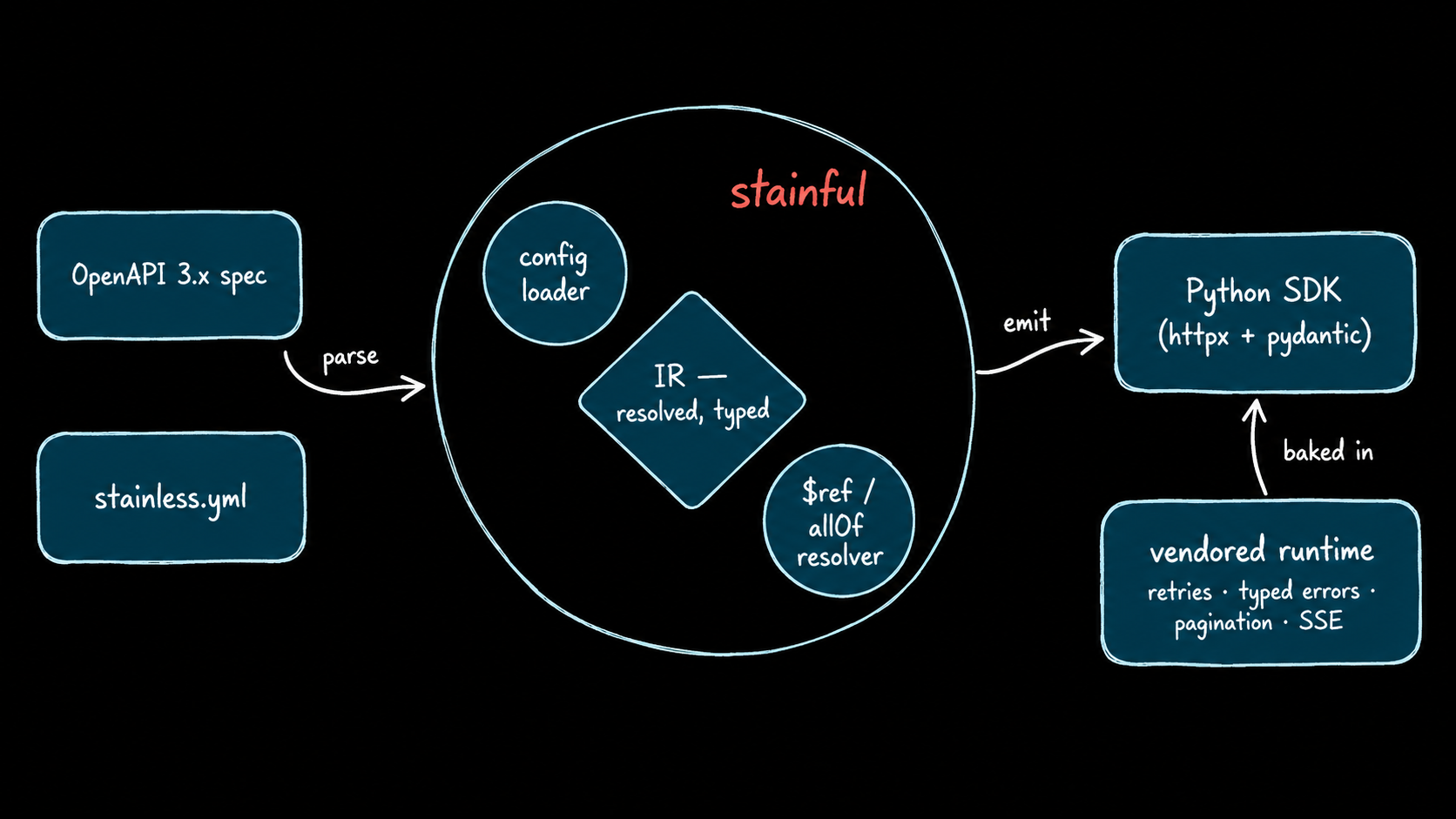
The pipeline is shown above: an OpenAPI spec and stainless.yml are parsed,
resolved, and lowered into an intermediate representation, which the emitter
renders into a Python SDK over a vendored runtime.
The intermediate representation is a fully-resolved, language-agnostic model:
allOf is merged, oneOf becomes a real tagged union, and optionality is
three-valued. The emitter is a thin renderer over a hand-written runtime, so the
idiomatic behavior lives in audited code rather than per-endpoint templates.
How it compares
| OpenAPI Generator | Fern | Stainless | stainful | |
|---|---|---|---|---|
| Open source | ✅ | ✅ | — | ✅ |
| Runs fully locally, no account | ✅ | ✅ | — | ✅ |
Reads the stainless.yml format |
— | — | ✅ | ✅ |
| Idiomatic output (pagination, typed errors, streaming) | — | ✅ | ✅ | ✅ |
stainful's niche: idiomatic, fully-open, and a drop-in for the Stainless config you may already have. Different tools fit different teams — this one is for people who want that workflow without a hosted service.
Project layout
| Path | What |
|---|---|
src/stainful/config/ |
stainless.yml loader with precise, located diagnostics |
src/stainful/openapi/ |
OpenAPI 3.x loader + cycle-safe $ref / allOf resolver |
src/stainful/ir/ |
the intermediate representation |
src/stainful/emit/ |
the Python emitter |
src/stainful/runtime/ |
the hand-written runtime vendored into generated SDKs |
tests/fixtures/ |
conformance fixtures (chat / paginated / multipart / binary / webhooks / …) |
examples/onebusaway/ |
committed dogfood — regenerated SDK is bit-stable; CI guards it |
examples/openai/ |
real-world test: the public openai-openapi spec → mypy-clean SDK |
docs/ |
migration guide and other docs |
Status
v0.4.0. One stainless.yml → SDK + Mintlify-shaped api.md + MCP
server. Verified against the real Stainless-generated SDKs at pinned
SHAs in CI:
- OneBusAway: 29/29 (100%) of Stainless's own
OneBusAway/python-sdktest files import unchanged against stainful's output; generated SDK is mypy-clean; regeneration is byte-stable (the repo dogfoods itself). - OpenAI: the public
openai-openapispec (162 paths, 983 schemas) generates a mypy-clean SDK — seeexamples/openai/anddocs/migrating-from-stainless.mdfor what's verified and what's still on the gap list.
End-to-end behavioral conformance covers: cursor pagination (wire param
config-driven — ?after=<last_id> matches openai), anthropic-shape
bi-directional pagination (before_id ↔ after_id), SSE streaming with
@overload pairs, multipart / file upload, binary download
(audio/mpeg, octet-stream), raw binary request bodies (S3-style PUT),
typed webhook unwrap (Standard Webhooks scheme), rich APIResponse[T]
from with_raw_response.*, typed error-body models
(<pkg>.types.shared.ErrorObject auto-detected from the spec), spec-
specific page class symbols (SyncTokenPage/SyncNextCursorPage/…),
custom_casings, .to_json()/.to_dict() aliases, webhook
<BRAND>_WEBHOOK_SECRET env-var fallback.
118 tests, mypy 0 on 253 generated files, ruff clean, CI green on py3.10–3.12.
Known scope boundary: multi-content request bodies (one operation
declaring multiple requestBody.content types) still pick the first
match — no public Stainless oracle to verify the exact API surface.
Documented in the migration guide.
Roadmap: Python SDK → MCP server from the same model → a second language → docs site. One language done well first.
Contributing
PRs welcome — see CONTRIBUTING.md and the
Code of Conduct.
git clone https://github.com/stainlu/stainful && cd stainful
uv venv && uv pip install -e ".[dev,generated-runtime]"
uv run pytest -q
uv run ruff check src tests

# regenerate the dogfood SDK (the repo dogfoods itself; CI fails if a
# regeneration changes a byte — see examples/onebusaway/):
uv run stainful generate \
  --spec   examples/onebusaway/openapi.yml \
  --config examples/onebusaway/stainless.yml \
  --out    examples/onebusaway/sdk
License
MIT. The vendored runtime ships inside generated SDKs under the same terms.