

Vektori
Memory that remembers the story, not just the facts.



👋 Questions, ideas, bugs → GitHub Issues · Discussions
If Vektori has been useful, a ⭐ goes a long way.
Why Vektori
Building agents that actually remember people is harder than it looks:
- Facts aren't enough. Knowing a user prefers WhatsApp is different from knowing they've asked three times and are getting frustrated. Most systems give you the what, not the why or how it changed.
- Patterns stay invisible. Spotting that someone's tone has been shifting across sessions requires more than point-in-time retrieval — you need to see the trajectory.
- Context overhead explodes. Stuffing raw conversation history into every prompt doesn't scale. You need structure, not just storage.
Vektori solves this with a three-layer sentence graph. Agents don't just recall preferences — they understand how things got there.
FACT LAYER (L0)      <- vector search surface. Short, crisp statements.
        |
EPISODE LAYER (L1)   <- patterns auto-discovered via graph traversal.
        |
SENTENCE LAYER (L2)  <- raw conversation. Sequential NEXT edges. The full story.
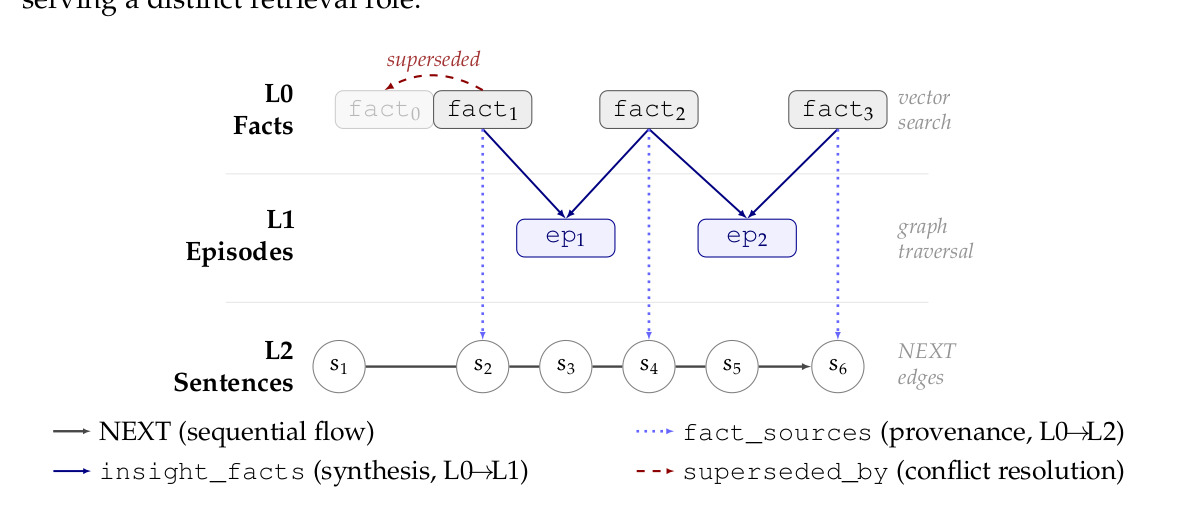
Search hits Facts, graph discovers Episodes, traces back to source Sentences. SQLite by default — swap to Postgres, Neo4j, Qdrant, or Milvus when you're ready to scale.
Benchmarks
Tested on long-horizon memory benchmarks — hundreds of turns, real user details buried deep in history.
| System | LoCoMo | LongMemEval-S | DMR | F1 avg (LoCoMo)† | Search p95 | Total p95 |
|---|---|---|---|---|---|---|
| Vektori | 66% | 73% | — | — | — | 1.48s |
| Mem0 | 66.88% | — | — | 41.0 | 0.48s | 2.59s |
| Zep | 75.14%‡ | 71.2% | 94.8% | — | 0.778s | 2.926s |
| Supermemory | — | 81.6% | — | — | — | — |
| Letta | 74.0% | — | — | — | — | — |
†F1 = harmonic mean of precision (how much of the answer was correct) and recall (how much of the correct answer was covered). Only Mem0 publishes token-level F1; 41.0 is the average across single-hop 38.72, multi-hop 28.64, open-domain 47.65, temporal 48.93.
‡Zep self-reported; Mem0's paper measured Zep at 65.99% on the same run. Latency from Mem0's paper. Model choice significantly shifts all scores — we used gemini-2.5-flash-lite for cost.
On LoCoMo and LongMemEval, the retrieved context contains the answer in 95% of questions — the gap to 66% is a synthesis problem, not a retrieval one. Actively working on closing it, exploring RL.
Still improving — PRs and evals welcome. Run your own: /benchmarks
Install
pip install vektori                      # SQLite + Postgres
pip install 'vektori[neo4j]'             # + Neo4j support
pip install 'vektori[qdrant]'            # + Qdrant support
pip install 'vektori[milvus]'            # + Milvus support
pip install 'vektori[neo4j,qdrant,milvus]'  # all backends
No Docker, no external services. SQLite by default.
30-Second Quickstart
import asyncio
from vektori import Vektori

async def main():
    v = Vektori(
        embedding_model="openai:text-embedding-3-small",
        extraction_model="openai:gpt-4o-mini",
    )

    await v.add(
        messages=[
            {"role": "user", "content": "I only use WhatsApp, please don't email me."},
            {"role": "assistant", "content": "Got it, WhatsApp only."},
            {"role": "user", "content": "My outstanding amount is ₹45,000 and I can pay by Friday."},
        ],
        session_id="call-001",
        user_id="user-123",
    )

    results = await v.search(
        query="How does this user prefer to communicate?",
        user_id="user-123",
        depth="l1",  # facts + episodes
    )

    for fact in results["facts"]:
        print(f"[{fact['score']:.2f}] {fact['text']}")
    for episode in results["episodes"]:
        print(f"episode: {episode['text']}")

    await v.close()

asyncio.run(main())
Output:
[0.94] User prefers WhatsApp communication
[0.81] Outstanding balance of ₹45,000, payment expected Friday
episode: User consistently avoids email — route all comms to WhatsApp
Retrieval Depths
Pick how deep you want to go.
| Depth | Returns | ~Tokens | When to use |
|---|---|---|---|
l0 |
Facts only | 50-200 | Fast lookup, agent planning, tool calls |
l1 |
Facts + Episodes + source Sentences | 300-800 | Default. Full answer with context |
l2 |
Facts + Episodes + Sentences + ±N context window | 1000-3000 | Trajectory analysis, full story replay |
# Just the facts
results = await v.search(query, user_id, depth="l0")

# Facts + episodes (recommended)
results = await v.search(query, user_id, depth="l1")

# Everything, with surrounding conversation context
results = await v.search(query, user_id, depth="l2", context_window=3)
Build an Agent with Memory
Three lines to wire memory into any agent loop:
import asyncio
from openai import AsyncOpenAI
from vektori import Vektori

client = AsyncOpenAI()

async def chat(user_id: str):
    v = Vektori(
        embedding_model="openai:text-embedding-3-small",
        extraction_model="openai:gpt-4o-mini",
    )
    session_id = f"session-{user_id}-001"
    history = []

    print("Chat with memory (type 'quit' to exit)\n")
    while True:
        user_input = input("You: ").strip()
        if user_input.lower() == "quit":
            break

        # 1. Pull relevant memory
        mem = await v.search(query=user_input, user_id=user_id, depth="l1")
        facts = "\n".join(f"- {f['text']}" for f in mem.get("facts", []))
        episodes = "\n".join(f"- {ep['text']}" for ep in mem.get("episodes", []))

        # 2. Inject into system prompt
        system = "You are a helpful assistant with memory.\n"
        if facts:    system += f"\nKnown facts:\n{facts}"
        if episodes: system += f"\nBehavioral episodes:\n{episodes}"

        # 3. Get response
        history.append({"role": "user", "content": user_input})
        resp = await client.chat.completions.create(
            model="gpt-4o-mini",
            messages=[{"role": "system", "content": system}, *history],
        )
        reply = resp.choices[0].message.content
        history.append({"role": "assistant", "content": reply})
        print(f"Assistant: {reply}\n")

        # 4. Store exchange
        await v.add(
            messages=[{"role": "user", "content": user_input},
                      {"role": "assistant", "content": reply}],
            session_id=session_id,
            user_id=user_id,
        )

    await v.close()

asyncio.run(chat("demo-user"))
More examples in /examples:
quickstart.py— fully local, zero API keys (Ollama)openai_agent.py— OpenAI native harness loopvektori_agent_demo.py— minimalVektoriAgentdemogemini_agent_integration_demo.py— Gemini extraction + agent chat showcasegemini_agent_ui.py— single-file local web UI that shows chat + live memory traceintegrating_hermes_openclaw.py— Hermes/OpenClaw adapter wiring examplereal_world_support_case.py— realistic support handoff / follow-up smoke test
For a live end-to-end harness check, run scripts/test_agent_e2e.py. It exercises retrieval, profile learning, tool calling, and window persistence against real providers.
Hermes/OpenClaw support in this repo is currently an integration starter path (adapter/plugin wiring), not a widely benchmarked default harness.
Storage Backends
# SQLite (default) — zero config, starts instantly
v = Vektori()

# PostgreSQL + pgvector — production scale
v = Vektori(database_url="postgresql://localhost:5432/vektori")

# Neo4j — native graph traversal for Episode layer
v = Vektori(
    storage_backend="neo4j",
    database_url="bolt://localhost:7687",
    embedding_dimension=1024,   # must match your embedding model
)

# Qdrant — dedicated vector DB, cloud-ready
v = Vektori(
    storage_backend="qdrant",
    database_url="http://localhost:6333",
    embedding_dimension=1024,
)

# Qdrant Cloud
v = Vektori(
    storage_backend="qdrant",
    database_url="https://your-cluster.qdrant.io",
    qdrant_api_key="your-api-key",
    embedding_dimension=1024,
)

# Milvus — high-scale vector store with partition-key isolation
v = Vektori(
    storage_backend="milvus",
    database_url="http://localhost:19530",
    embedding_dimension=1024,
)

# Milvus / Zilliz Cloud
v = Vektori(
    storage_backend="milvus",
    database_url="https://your-cluster-endpoint",
    milvus_token="your-api-key-or-token",
    embedding_dimension=1024,
)

# In-memory — tests / CI
v = Vektori(storage_backend="memory")
All backends via Docker:
git clone https://github.com/vektori-ai/vektori
cd vektori
docker compose up -d                 # starts Postgres, Neo4j, Qdrant, and Milvus

# Postgres
DATABASE_URL=postgresql://vektori:vektori@localhost:5432/vektori python examples/quickstart_postgres.py

# Neo4j
VEKTORI_STORAGE_BACKEND=neo4j VEKTORI_DATABASE_URL=bolt://localhost:7687 vektori add "I prefer dark mode" --user-id u1

# Qdrant
VEKTORI_STORAGE_BACKEND=qdrant VEKTORI_DATABASE_URL=http://localhost:6333 vektori add "I prefer dark mode" --user-id u1

# Milvus
VEKTORI_STORAGE_BACKEND=milvus VEKTORI_DATABASE_URL=http://localhost:19530 vektori add "I prefer dark mode" --user-id u1

# Milvus Cloud
MILVUS_TOKEN=your-api-key VEKTORI_STORAGE_BACKEND=milvus VEKTORI_DATABASE_URL=https://your-cluster-endpoint vektori add "I prefer dark mode" --user-id u1
CLI storage flags:
vektori config --storage-backend qdrant --database-url http://localhost:6333
vektori config --storage-backend milvus --database-url http://localhost:19530
vektori add "my note" --user-id u1
vektori search "preferences" --user-id u1
Model Support
Bring whatever model stack you have. Works with 10 providers out of the box.
# OpenAI
v = Vektori(
    embedding_model="openai:text-embedding-3-small",
    extraction_model="openai:gpt-4o-mini",
)

# Azure OpenAI
# Ensure AZURE_OPENAI_ENDPOINT and AZURE_OPENAI_API_KEY are set
# Note: The string after "azure:" must match your specific Azure deployment names
v = Vektori(
    embedding_model="azure:my-embedding-deployment",
    extraction_model="azure:my-gpt-4o-deployment",
)

# GitHub Models (Copilot)
# Requires GITHUB_TOKEN. You can get one by running `./scripts/get_github_token.sh`
v = Vektori(
    embedding_model="github:text-embedding-3-small",
    extraction_model="github:gpt-4o",
)

# Anthropic
v = Vektori(
    embedding_model="anthropic:voyage-3",
    extraction_model="anthropic:claude-haiku-4-5-20251001",
)

# Fully local, no API keys, no internet
v = Vektori(
    embedding_model="ollama:nomic-embed-text",
    extraction_model="ollama:llama3",
)

# Sentence Transformers (local, no Ollama required)
v = Vektori(embedding_model="sentence-transformers:all-MiniLM-L6-v2")

# BGE-M3 — multilingual, 1024-dim, best local embeddings we've found
v = Vektori(embedding_model="bge:BAAI/bge-m3")

# LiteLLM — 100+ providers through one interface
v = Vektori(extraction_model="litellm:groq/llama3-8b-8192")
NVIDIA NIM - GPU-optimized models via NVIDIA NIM.
# NVIDIA embedding models (Matryoshka: 384-2048 dimensions)
v = Vektori(
    embedding_model="nvidia:llama-nemotron-embed-1b-v2",
    embedding_dimension=1024,  # Optional: 384, 512, 768, 1024, or 2048
)

# NVIDIA LLM models (nvidia/ prefix auto-added)
v = Vektori(extraction_model="nvidia:llama-3.3-nemotron-super-49b-v1")

# Third-party models hosted on NVIDIA NIM (use full path)
v = Vektori(extraction_model="nvidia:z-ai/glm5")
Contributing
Vektori is early and there's a lot of ground to cover. If you're building agents that need memory, your real-world feedback is the most valuable thing you can contribute.
- Found a bug or an edge case? Open an issue
- Have an idea or want to discuss direction? Start a discussion
- Want to contribute code? See CONTRIBUTING.md
git clone https://github.com/vektori-ai/vektori
cd vektori
pip install -e ".[dev]"
pytest tests/unit/
Star History
License
Apache 2.0. See LICENSE.