
WebAI-to-API
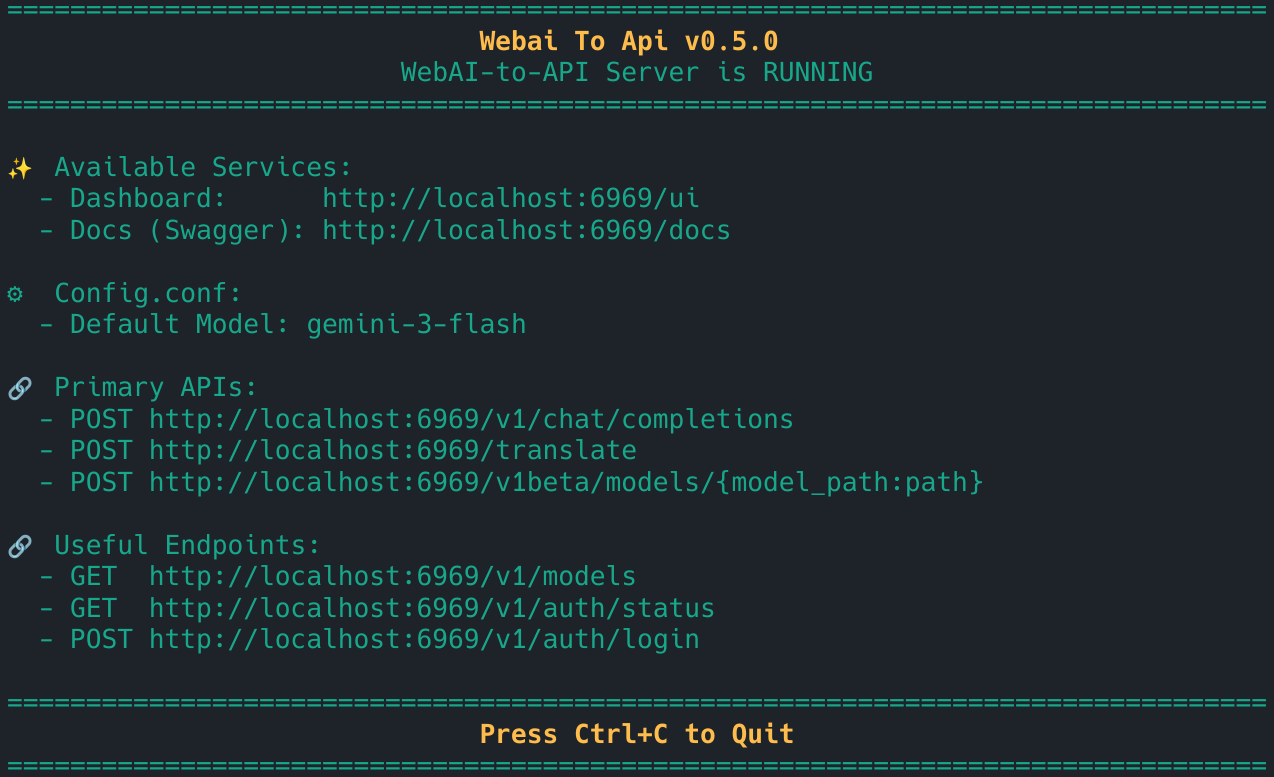
WebAI-to-API is a browser-native AI runtime that exposes browser-based AI services through OpenAI-compatible APIs.
WebAI-to-API combines browser-native automation with WebAPI-based provider integrations to expose AI services through a flexible OpenAI-compatible API layer.
Features
- OpenAI-compatible
/v1/chat/completionsAPI - Provider-based architecture with unified routing
- Streaming response support (SSE)
- Conversation continuation support
- Health, readiness, and runtime diagnostics endpoints
- Docker deployment support
- Authentication management and browser login workflows
Available Providers
Gemini
Provides access to Google Gemini models through either the WebAPI backend or a browser-native Playwright runtime.
Atlas Cloud
Provides access to cloud-hosted AI models through a native API integration powered by Atlas Cloud.
Quick Start
1. Install Dependencies
poetry install
poetry run playwright install chromium
2. Configuration
cp config.conf.example config.conf
For detailed settings (including logging verbosity and access log configurations), see Configuration Guide.
3. Authenticate
python verify_login.py
4. Start the Server
poetry run python src/run.py
[!TIP] New users can run
make setupandmake doctorfor automated setup and diagnostics. See Convenience Shortcuts below.
Optional: Convenience Shortcuts
WebAI-to-API includes a bootstrap utility and a Makefile for common setup tasks.
| Command | Description |
|---|---|
make setup |
One-step install, directory creation, and config setup. |
make doctor |
Run environment and dependency diagnostics. |
Alternative (no Make): python scripts/bootstrap.py and python scripts/doctor.py
Authentication
Gemini requires an authenticated Google session.
| Method | Recommended For |
|---|---|
Browser Login (verify_login.py) |
Recommended. Playwright backend, Docker, and long-term usage. |
| Manual Cookies | Quick testing and WebAPI-only usage. |
1. Browser Login (Recommended)
- Run the interactive login helper:
python verify_login.py - Complete the sign-in process in the browser window.
- This creates
runtime/auth/gemini.json, used by both backends.
2. Manual Cookies
- Sign in to Gemini.
- Copy
__Secure-1PSIDand__Secure-1PSIDTSfrom your browser cookies. - Paste them into the
[Gemini]section ofconfig.conf.
Send Your First Request
curl -X POST http://localhost:6969/v1/chat/completions \
  -H "Content-Type: application/json" \
  -d '{
    "model": "gemini-3-flash",
    "messages": [
      {
        "role": "user",
        "content": "Hello!"
      }
    ]
  }'
Dashboard
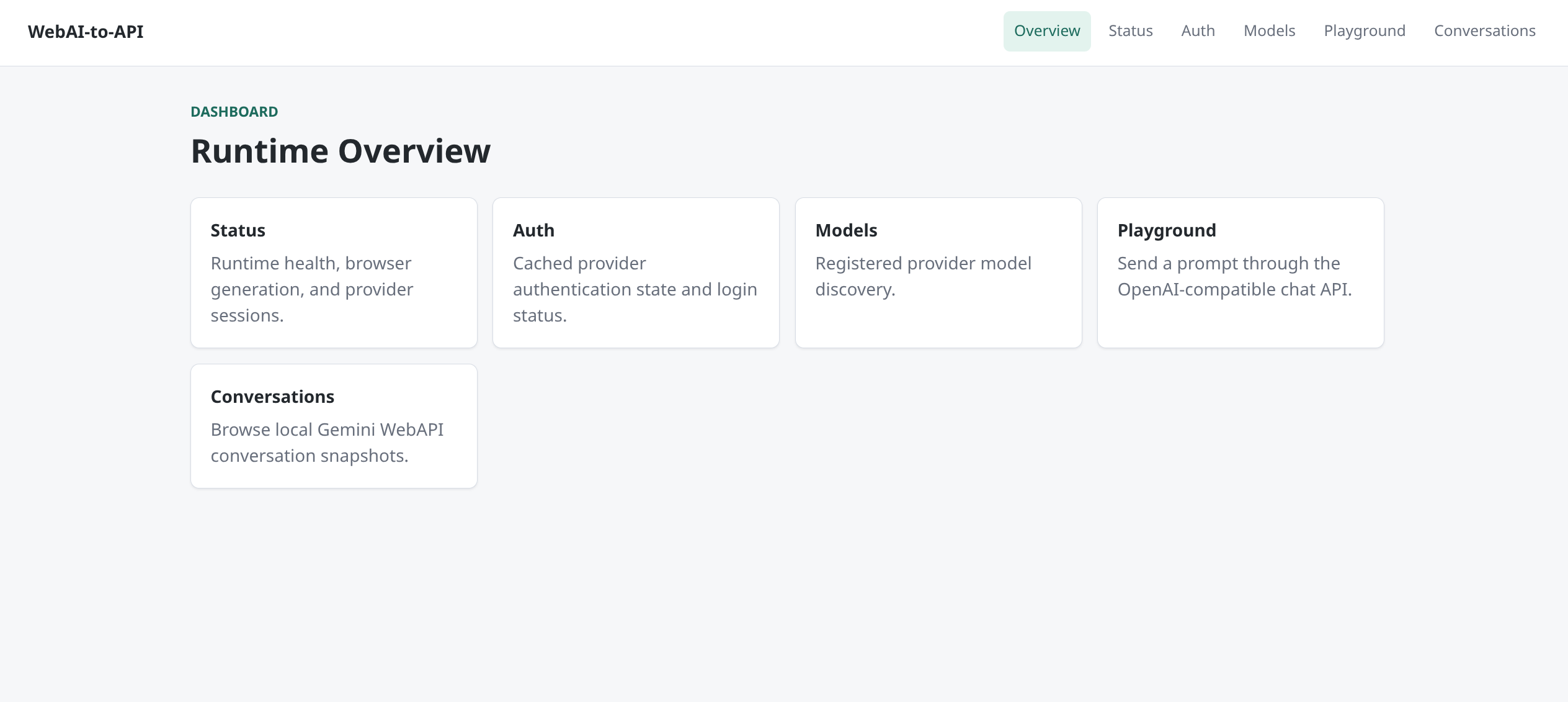
Open the dashboard at http://localhost:6969/ui.
The dashboard provides a visual interface for runtime status, authentication management, API discovery, and interactive testing.
Available Endpoints
| Endpoint | Purpose |
|---|---|
/v1/chat/completions |
OpenAI-compatible chat completions |
/v1/temporary/chat/completions |
Gemini WebAPI temporary chat |
/v1/models |
List supported models |
/v1/auth/status |
Check authentication status |
/v1/auth/login |
Start authentication flow |
/v1/conversations |
Manage Gemini WebAPI conversation snapshots |
/translate |
Legacy translation compatibility |
/ui/* |
Dashboard and playground |
Temporary Gemini Chat
/v1/temporary/chat/completions is Gemini WebAPI-only and uses Gemini temporary requests (temporary=True).
Requests are not stored in Gemini history and do not create SQLite conversation snapshots.
It supports streaming, non-streaming, multimodal file inputs, and artifact outputs. See docs/api.md for details.
Legacy Translate Endpoint
The /translate endpoint is maintained for compatibility with the Translate It! browser extension.
It uses Gemini temporary requests and a shared in-memory session. See docs/api.md for additional details.
File Support
File input is supported through OpenAI-style content parts on /v1/chat/completions when routed to the Gemini WebAPI backend.
The currently verified file formats are documented in docs/api.md.
[!NOTE] File parts are supported only by the Gemini WebAPI backend in the MVP. Gemini Playwright and Atlas reject file parts with a clear capability error. For Gemini WebAPI, text content parts are concatenated into one prompt and file parts are passed as attachments. Exact text/file interleaving order is not preserved. The built-in
/ui/playgroundpage uses the same contract for file attachments.
Supported Models
Available models may vary depending on the configured provider and backend.
Use the /v1/models endpoint to retrieve the current list of supported models.
Model Routing
WebAI-to-API uses model prefixes to route requests to specific backends.
| Model | Backend |
|---|---|
gemini-3-flash |
Gemini (default configured backend) |
playwright/gemini-3-flash |
Gemini Playwright |
atlas/<model-id> |
Atlas Cloud via OpenAI-compatible API, with 50 validated chat models exposed in /v1/models |
[!TIP] Model prefixes force backend selection and override the default Gemini backend configured in
config.conf. Useplaywright/...model prefixes to force the Playwright backend explicitly.
Documentation
Interactive API documentation is available through Swagger UI when the server is running.
Star History
License
WebAI-to-API is licensed under the Apache License 2.0. See LICENSE for the full text.