

A Simple and Universal Product Rehearsal Engine, Speccing Anything. 简洁通用的产品推演引擎,推演万物。
TRAE Skill Challenge / Community Showcase Project
Progress note: The engineering app currently trails the WhyBuddy Skill. For the complete product rehearsal experience, use the WhyBuddy Skill first; the engineered project is still moving forward.









⚡ 30 Second Overview
You enter one sentence. The system rehearses a complete product plan for you.
Spec documents · System architecture · Route planning · Prompt pack · Effect preview
Fully visible. Fully exportable. Fully backed by an evidence trail.
🎯 PainYou spend days writing a PRD, weeks aligning the team, and months before you know whether the direction is right. |
💡 SolutionEnter an idea → 5 minutes → full rehearsal → decide whether it is worth building → if not, move to the next idea. |
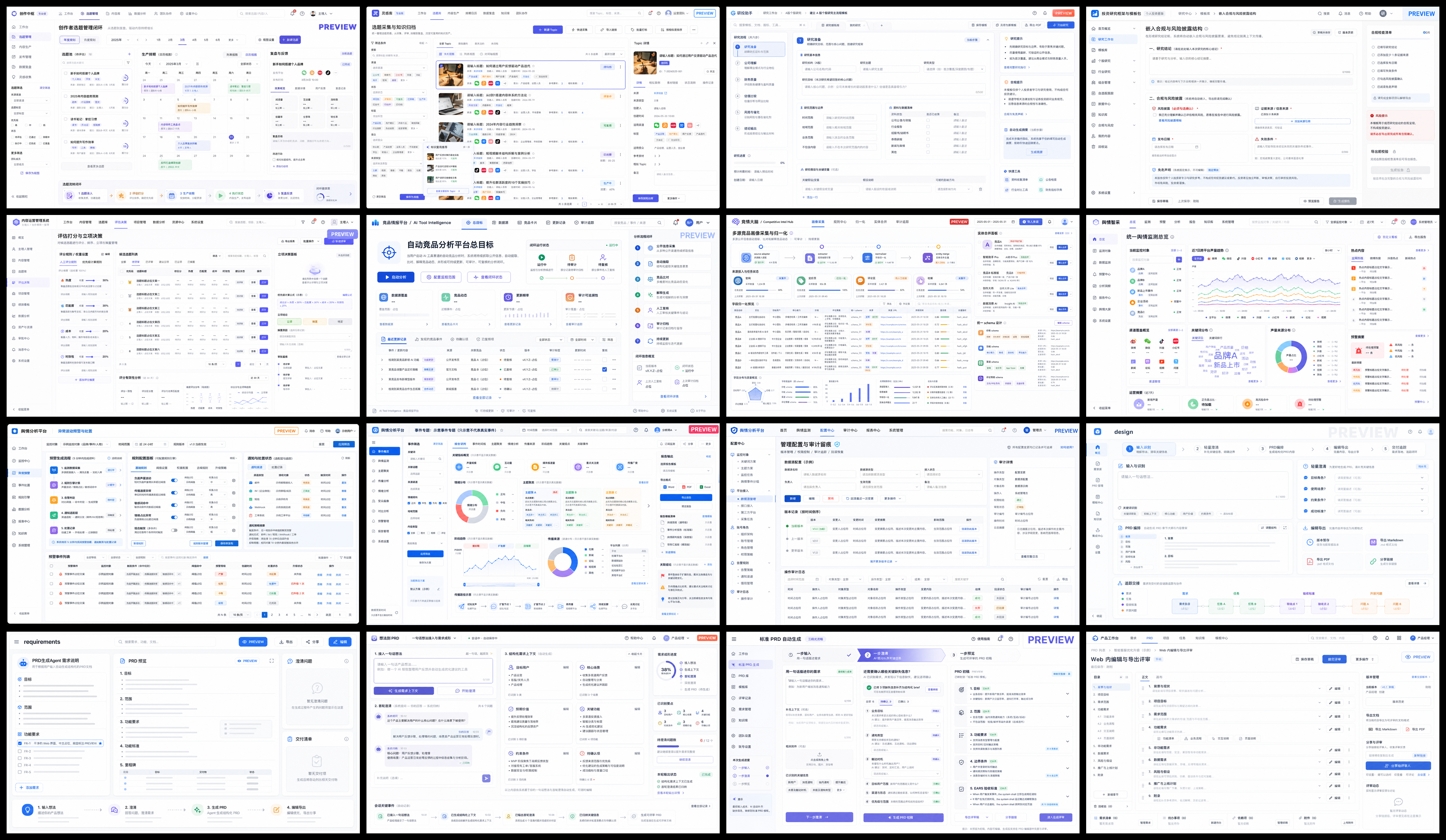
Product Screens
A consolidated 16-screen photo wall from WhyBuddy example rehearsals.
Watch the Full Rehearsal Demo
TRAE SOLO-based product rehearsal automation: from a one-sentence idea to executable specs.
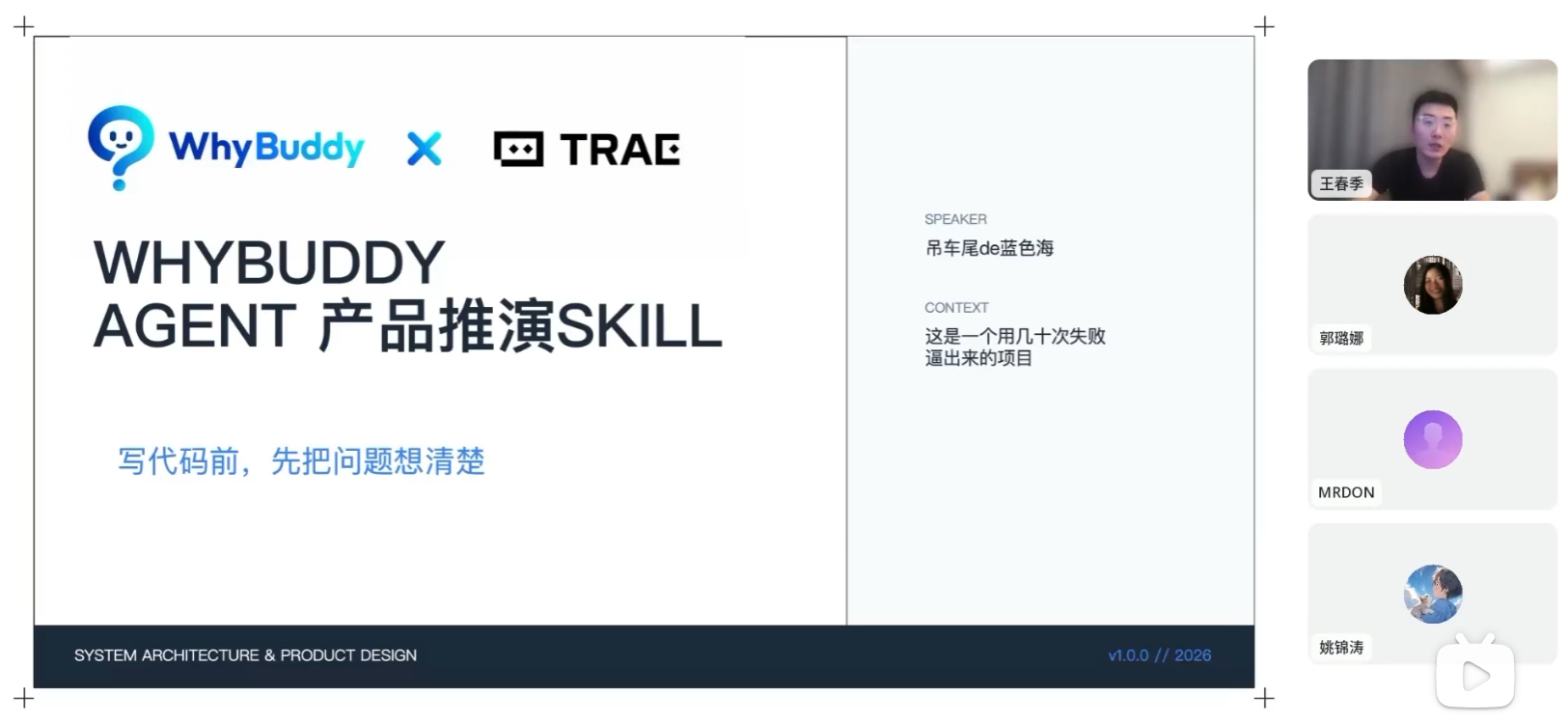
Click the video cover above to open the Bilibili demo.
🧩 The whybuddy Skill Package (Portable · Embeddable in Any Agent)
Besides the full app, WhyBuddy also ships a self-contained Skill package that can be dropped into Trae, Claude, or any host that supports Agent Skills. One sentence in → a reviewable, deliverable spec package out, with every gate actually run by scripts instead of merely claimed by the model.
Guarantee the floor, not the ceiling. Deterministic scripts guarantee the floor — valid structure, success criteria covered by requirements, EARS acceptance, cited evidence, gate results logged, every artifact provenance-labeled. They do not promise the ceiling; real depth still needs a real repo and a human. Everything it generates is labeled with how much you can trust it.
How to Use
The ready-to-import Skill archive is included at skills/whybuddy.zip.
# 1. Drop the skill package into your agent host's skills directory
#    (Trae: Skills · Claude: skill)
# 2. Give it a one-sentence idea — it produces the full spec package below
# 3. For image previews, provide an image endpoint key:
export IMAGE_API_KEY=sk-...           # or fill image_config.json -> api_key
# default: gpt-image-2 · 2K · 16:9 · 600s timeout (all configurable)

# Generate or regenerate images yourself at any time, one per module:
python scripts/finalize_previews.py           # module images from spec_tree
python scripts/batch_images.py prompts.txt    # batch generation against your endpoint

# Audit any image run in one command, catching fake, fallback, or duplicated images:
python scripts/check_previews_real.py
Image Generation Configuration
All image settings live in a single file: image_config.json at the project root.
{
  "enabled": true,
  "mode": "http",                    // "http" | "dry_run" | "mcp" | "command"
  "model": "gpt-image-2",           // ← change model here
  "api_key": "",                     // ← put your key here (or use env var below)
  "timeout": 600,                    // seconds per image request
  "out_dir": "previews",
  "http": {
    "url": "",                       // ← put your endpoint URL here
    "method": "POST",
    "headers": {
      "Content-Type": "application/json",
      "Authorization": "Bearer ${IMAGE_API_KEY}"   // resolves from env
    },
    "body_template": {
      "model": "${MODEL}",           // auto-filled from top-level "model"
      "prompt": "${PROMPT}",         // auto-filled per module
      "response_format": "b64_json",
      "image_size": "2K",            // "512" | "1K" | "2K" | "4K"
      "aspect_ratio": "16:9",
      "n": 1
    }
  }
}
Three things to configure:
| What | Where | Example |
|---|---|---|
| API Key | Env var IMAGE_API_KEY (recommended) OR image_config.json → api_key |
export IMAGE_API_KEY=sk-abc123... |
| Endpoint URL | image_config.json → http.url |
https://api.openai.com/v1/images/generations |
| Model | image_config.json → model |
gpt-image-2 / gemini-2.5-flash-image / gemini-3.1-flash-image-preview |
Priority: environment variable
IMAGE_API_KEY> config fileapi_key. If both are empty, image generation is skipped and the gate records "no key".
Use Cases
| Category | Examples |
|---|---|
| 🆕 Build a product from zero | AI meeting minutes · income dashboard · OKR tracker · lightweight CRM · resume optimizer |
| 🤖 Build an AI agent | PRD generator · issue triage · code review · investment research · sentiment analysis |
| 🧩 Add a feature to an existing project | RBAC for React · i18n for Next.js · audit logging for a Node API · OpenAPI enhancement for FastAPI |
Output Package Structure
<project-name>/
├─ spec_tree.json            ← structure source; docs / matrix / images all derive from it
├─ clarified_brief.json      goal · constraints · numbered success criteria
├─ route_options.json · selected_route.json · decision_mode.json
├─ traceability_matrix.json  traceability matrix: requirement ↔ design ↔ task ↔ evidence ↔ test case
├─ docs/
│  ├─ requirements.md · design.md · tasks.md
│  ├─ interface_contracts.md · test_cases.md · open_items.md
│  └─ prompt_pack.md · effect_preview.md · architecture.mmd
├─ checks_ledger.json        every gate's real script + exit code + output (not hand-waved)
├─ companion_log.json        companion trace: what the critic flagged · which real sources were cited
├─ handoff_manifest.json     delivery manifest: every artifact carries source + confidence labels
├─ previews/                 per-module UI mockups ("preview · unverified") + provenance.json
└─ scripts/                  deterministic scripts — the floor itself
   ├─ gate.py                     ledger wrapper: run any check and record the result
   ├─ validate_spec_tree.py       SPEC tree validation: structure · coverage · EARS · evidence sources
   ├─ check_content_quality.py    document validation: required sections · length · EARS acceptance
   ├─ check_companion.py          companion trace must be real
   ├─ finalize_previews.py        image gate: generate real module images, judged by real success count
   ├─ check_previews_real.py      audit: catch fake / fallback / duplicate images
   ├─ batch_images.py             standalone batch image generation
   └─ fallback_tree.py            naturally valid minimal tree when the LLM is unavailable
How to Know It Is Not Faking It
checks_ledger.json— what ran, exit code, and output. Written automatically by scripts.companion_log.json— what the critic flagged and which real sources the grounding cited.- Provenance labels —
previews/*.pngare marked "preview · unverified";interface_contracts.mdis marked "draft · unverified". check_previews_real.py— one command tells you whether images are real generations or placeholders.
🔄 Workflow
The closed-loop route follows the v4 architecture diagram: solid lines are the main delivery path; dashed lines are runtime support, feedback, invalidation, and recovery.
User idea / repo / file / screenshot
        │
        ▼
01 Input
   Raw input → repo URL gate → deep GitHub ingestion or fallback → normalized project context
        │
        ▼
02 Clarification
   Missing info → questions → readiness gate → clarified brief with goals, constraints, success criteria
        │
        ▼
03 Route Planning
   Standard / deep / upgraded routes → compare risk and cost → route selection → confirm gate
        │
        ▼
Decision & Collaboration
   Simple work stays single-agent; complex work enters brainstorm mode with roles, synthesis, and tools
        │
        ▼
04 SPEC Tree Core
   Prompt builder → redaction → LLM JSON → schema validator → invariant guard → provenance → SPEC tree
        │
        ▼
05 SPEC Documents
   requirements.md · design.md · tasks.md, tied back to acceptance, evidence, and tests
        │
        ▼
06 Preview & Handoff
   prompt pack · effect preview · generated UI mockups · rendered Mermaid architecture · traceability matrix · ZIP/MD export
        │
        ▼
Review & Feedback Loop
   accept and ship, or feed changes back into clarification, route planning, dependency invalidation, and re-generation
The runtime layer runs beside the main path: job/artifact store, event bus, socket relay, realtime store, derived node status, and replay. The quality gate closes the loop with tests, content checks, merge checks, and a checks ledger that records real script output.
🤖 FSD Agent Fleet
The v4 diagram no longer treats the team as a fixed meeting room of roles. WhyBuddy switches between a single-agent path and a multi-role collaboration path through the Decision Gate.
| Role layer | When it appears | Responsibility |
|---|---|---|
| Single Agent | The route is simple and low-risk | Runs the direct path from clarified brief to SPEC tree and documents |
| Brainstorm Board | The route is complex or ambiguous | Opens discussion, voting, division of labor, and audit mode |
| Decision | Before expensive generation | Chooses standard / deep / upgraded routes and records confidence |
| Planning | Route and dependency work | Breaks the goal into staged work, fallback paths, and replan budgets |
| Architecture | SPEC tree and handoff design | Keeps requirements, design, tasks, evidence, and interfaces aligned |
| Execution | Tool-backed work is needed | Uses Docker, MCP, GitHub, and Skills through the tool proxy |
| Audit | Quality or evidence risk appears | Checks invariants, provenance, ledger output, and review gaps |
| UI | Preview or delivery surface is needed | Turns specs into generated mockups and visible handoff artifacts |
| Critic | Triggered by ambiguity, real repo risk, or weak evidence | Finds holes, missing evidence, and overconfident assumptions |
| Grounding | Triggered when claims must touch real code or sources | Reads the repo and forces real citations into the result |
| Synthesizer | After multi-role work | Merges proposals, confidence scores, and dissent into one route |
All roles use the same tool proxy, but the companion roles are deliberately on-demand: they cut across input, clarification, route planning, and SPEC generation only when risk justifies the extra loop.
✨ Core Capabilities
01 Grounded InputRaw ideas can include a sentence, repository, files, or screenshots. Repo URLs trigger deep ingestion; inaccessible sources become explicit fallback states instead of silent failure. |
02 Route DecisionWhyBuddy compares standard, deep, and upgraded routes before generation. The confirmation gate makes cost, risk, and takeover points visible early. |
03 SPEC Tree GuardThe SPEC tree is not just model output. Schema validation, stable ID normalization, invariant guards, provenance, and deterministic fallback protect the structure. |
04 Delivery TraceabilityRequirements, design, tasks, evidence, tests, prompt packs, previews, interfaces, open items, and exports are tied through a traceability matrix and handoff manifest. |
05 Runtime TruthJob store, artifact store, event bus, socket relay, realtime store, derived node status, and replay keep the visible workflow synced with persisted artifacts. |
06 Feedback & InvalidationReviews, user edits, dependency invalidation, stale indexes, auto-recompute, escalation, and replan budgets make iteration part of the system, not an afterthought. |
07 Companion ReviewCritic and grounding roles are triggered by ambiguity, real-repo risk, and evidence gaps, then force the flow to cite sources and expose weak assumptions. |
08 Preview SplitGenerated UI mockups are labeled as previews, while structural architecture diagrams are rendered deterministically from the SPEC tree instead of image-model guesses. |
09 Quality LedgerTests, content checks, merge gates, and ledger entries record the script, exit code, and output behind each quality claim. |
🚀 Quick Start
git clone https://github.com/xiaojilele-glitch/WhyBuddy.git && cd WhyBuddy
pnpm install
pnpm run dev:all          # full stack: frontend + server + executor
💻 Browser-only mode (no server, no .env)
pnpm run dev:frontend # open localhost:5173
Or open the repository at xiaojilele-glitch/WhyBuddy.
📋 Requirements
- Node.js 22+
- pnpm
- Docker (optional, for full executor mode)
📝 Rehearsal Examples
Every rehearsal is a shareable piece of content. 50 rehearsals = 50 distribution opportunities.
| 💬 Input | 📦 Output |
|---|---|
| "AI comic platform" | 6 SPEC modules · content pipeline · monetization model · system architecture |
| "Permission management SaaS" | 8 SPEC modules · RBAC · multi-tenant · API contracts |
| "Sentiment analysis tool" | 5 SPEC modules · data pipeline · model selection · alert engine |
| "Indie developer bookkeeping app" | 4 SPEC modules · local-first · sync plan · privacy compliance |
| "Enterprise knowledge base" | 7 SPEC modules · RAG pipeline · permission model · incremental indexing |
| "Cross-border product picker" | 6 SPEC modules · data sources · scoring algorithm · competitor analysis |
🏗️ System Architecture
┌─────────────────────────────────────────────────────────────────┐
│  🌐 Entry Layer       Browser · Feishu Relay · destination input│
├─────────────────────────────────────────────────────────────────┤
│  🖥️ Frontend Layer    3D scene · task cockpit · route view      │
│                       drive state · takeover panel · replay     │
├─────────────────────────────────────────────────────────────────┤
│  🧠 Cube Brain        10-stage workflow · Mission Runtime       │
│                       dynamic roles · cost governance · review  │
├─────────────────────────────────────────────────────────────────┤
│  🔮 Projection Layer  Mission→Destination · Workflow→Route      │
│                       State→DriveState · Decision→Takeover      │
├─────────────────────────────────────────────────────────────────┤
│  💡 Intelligence      3-level memory · knowledge graph · RAG    │
│                       self-evolution · LLM multi-provider       │
├─────────────────────────────────────────────────────────────────┤
│  🛡️ Trust Layer       hash-chain audit · lineage DAG · evidence │
├─────────────────────────────────────────────────────────────────┤
│  ⚙️ Execution Layer   Docker containers · HMAC · sandbox · TTY  │
├─────────────────────────────────────────────────────────────────┤
│  🔗 Interop Layer     A2A protocol · Swarm · Guest Agent market │
└─────────────────────────────────────────────────────────────────┘
Source: WhyBuddy Skill closed-loop architecture v4
flowchart TB

U["用户想法 / User Idea<br/>一句话目标 · 仓库 · 文件 · 截图"]:::entry

subgraph S1["01 输入层 / Input"]
  direction TB
  IN_RAW["原始输入 / Raw Input"]:::input
  IN_GH{"有 GitHub 链接? / Has repo URL?"}:::gate
  IN_INGEST["★ GitHub 深度解析 / Deep Ingestion<br/>文件 · 符号 · 接口契约"]:::input
  IN_FALL["降级状态 / Fallback<br/>权限失败 · 仓库不可访问"]:::fallback
  IN_NORM["归一化 / Normalize<br/>去重 · 证据 · 失败状态"]:::input
  IN_CTX["项目上下文 / Project Context<br/>目标 · 摘要 · 来源 · 证据"]:::input
end

subgraph S2["02 澄清层 / Clarification"]
  direction TB
  CL_GAP["缺失信息 / Missing Info<br/>阻塞 · 非阻塞"]:::clarify
  CL_Q["澄清问题 / Questions"]:::clarify
  CL_READY{"就绪度 / Readiness<br/>可规划? 还是继续补充?"}:::gate
  CL_BRIEF["澄清简报 / Clarified Brief<br/>目标 · 约束 · 成功标准"]:::clarify
end

subgraph S3["03 路线规划 / Route Planning"]
  direction TB
  RT_GEN["多路线生成 / Multi-Route<br/>标准 · 深度 · 升级"]:::route
  RT_CMP["对比 · 风险 / Compare · Risk"]:::route
  RT_SEL["路线选择 / Route Selection"]:::route
  RT_GATE{"轻量确认闸 / Confirm Gate"}:::gate
end

subgraph DG["决策与协作 / Decision and Collaboration"]
  direction TB
  D_GATE{"决策门 / Decision Gate<br/>简单 or 复杂?"}:::decision
  D_SA["单 Agent / Single-Agent"]:::decision
  D_BO["头脑风暴 / Brainstorm<br/>模式: 讨论 · 投票 · 分工 · 审计"]:::decision
  D_ROLES["多角色 / Roles<br/>决策 · 规划 · 架构 · 执行 · 审计 · UI"]:::decision
  D_SYN["综合器 / Synthesizer<br/>方案 · 信心分 · 分歧意见"]:::decision
  D_TOOLS["工具代理 / Tool Proxy<br/>Docker · MCP · GitHub · Skills"]:::tool
  D_DEG["降级兜底 / Degradation"]:::fallback
end

subgraph CO["★ 伴随式审查与接地 / Companion · 按需触发:模糊度·真仓库·风险"]
  direction TB
  CO_CRIT["★ 挑刺者 / Critic<br/>找漏洞 · 证据不足处"]:::companion
  CO_GROUND["★ 接地者 / Grounding<br/>读真代码 · 逼挂真实出处"]:::companion
end

subgraph S4["04 规格树生成核心 / SPEC Tree Generation Core"]
  direction TB
  SP_PROMPT["★ 提示词构造 / Prompt Builder<br/>成功标准→需求 · 验收用 EARS"]:::spec
  SP_REDACT["脱敏 / Redaction"]:::spec
  SP_LLM["LLM JSON 生成 / callJson<br/>retryAttempts = 1"]:::spec
  SP_SCHEMA{"Schema 校验 / Validator"}:::gate
  SP_NORM["归一化 / Normalizer<br/>稳定 ID 重映射"]:::spec
  SP_INV{"★ 不变量守卫 / Invariant Guard<br/>唯一根 · 父可达 · 深度 · 无环<br/>+ 需求覆盖成功标准 · 每节点挂证据"}:::gate
  SP_FALL["确定性兜底 / Deterministic Fallback<br/>已预先满足不变量"]:::fallback
  SP_PROV["来源追踪 / Provenance<br/>llm · llm_fallback · template"]:::spec
  SP_TREE["规格树 / SPEC Tree<br/>Requirements · Design · Tasks · Evidence(带真实出处)"]:::artifact
end

subgraph S5["05 规格文档 / SPEC Document"]
  direction TB
  SD_GEN["文档生成器 / Doc Generator"]:::doc
  SD_DOCS["文档 / Docs<br/>requirements.md · design.md · tasks.md"]:::doc
  SD_ACC["验收 · 证据 · 用例 / Acceptance · Evidence · Tests"]:::doc
end

subgraph S6["06 效果预览与交付 / Preview and Handoff"]
  direction TB
  EP_PACK["提示词包 / Prompt Pack"]:::preview
  EP_PREV["效果预览 / Effect Preview"]:::preview
  EP_VIS_GEN["◆ 视觉预览·生成 / Gen Preview<br/>按模块(每需求一页)→生图模型<br/>只认真成功张数·防复制·禁兜底·503重试<br/>UI 草样 · 标『预览·未验证』"]:::preview
  EP_VIS_REND["★ 结构图·渲染 / Rendered<br/>规格树→Mermaid 确定性出图<br/>架构总图 · 不交给生图模型"]:::preview
  EP_VIS_AUDIT["◆◆ 出图审计 / check_previews_real<br/>查 provenance:兜底·假成功(ok却带error)·复制充数<br/>用户自跑,agent 改不了这步"]:::companion
  EP_MATRIX["★ 可追溯矩阵 / Traceability<br/>需求↔设计↔任务↔证据↔用例"]:::preview
  EP_HAND["交付包 · 导出 / Handoff · Export<br/>md·zip · 接口契约(草稿·待核) · 验收用例<br/>未决项登记 · 校验台账 · 视觉预览(标来源)"]:::preview
end

subgraph S7["07 运行时与状态 / Runtime and State"]
  direction TB
  WF_JOB["任务仓 · 产物 / Job · Artifact Store"]:::runtime
  WF_EVT["事件总线 / Event Bus<br/>每阶段产出都落事件"]:::runtime
  WF_SOCK["实时推送 / Socket Relay"]:::runtime
  WF_STORE["实时状态仓 / Realtime Store<br/>按 sessionId 隔离"]:::runtime
  WF_DERIVE["状态派生器 / deriveNodeStatus<br/>实时进度 + 已存文档 → 单一真相"]:::runtime
  WF_ROW["节点行 / Node Row<br/>待生成 · 生成中 · 完成 · 失败 · 重试成功"]:::runtime
  WF_REPLAY["回放 / Replay"]:::runtime
end

subgraph S8["08 失效与依赖 / Invalidation and Dependency"]
  direction TB
  DEP["依赖图 / Dependency Graph<br/>上游变更 → 下游影响"]:::danger
  INV["失效引擎 / Invalidation Engine"]:::danger
  STALE["失效索引 / Stale Index<br/>staleSince · reason · fromStage"]:::danger
  RECOMP["自动重算 / Auto-Recompute<br/>沿依赖链重建下游"]:::danger
end

subgraph S9["评审与反馈闭环 / Review and Feedback"]
  direction TB
  RV{"评审 / Review<br/>交付 or 回炉?"}:::feedback
  FB["反馈 / Feedback"]:::feedback
  RP{"重规划 / Replan<br/>预算 · 收敛阈值"}:::feedback
  ESC["失败 · 中止 · 转人工 / Fail · Abort · Escalate"]:::fallback
  ITER["用户修改再推演 / User Iterate"]:::feedback
end

subgraph QA["质量门 / Quality Gate"]
  direction TB
  QA_TEST["测试 / Tests<br/>状态 · SSR · E2E · 截图"]:::qa
  QA_CONTENT["★ 内容质量校验 / Content Check<br/>规格成立 · 验收为 EARS 句式"]:::qa
  QA_MERGE{"合并门槛 / Merge Gate<br/>自动断言 + 人工目检"}:::gate
  QA_LEDGER["★ 校验台账 / Checks Ledger<br/>脚本 · 退出码 · 输出"]:::ledger
end

DONE["交付完成 / Shipped"]:::artifact

subgraph LEGEND["图例 / Legend (颜色与连线一致)"]
  direction TB
  LG_B["蓝 实线 / Blue<br/>主流程 Main flow"]:::pBlue
  LG_O["橙 实线 / Orange<br/>决策与协作 Decision"]:::pOrange
  LG_P["紫 实线 / Purple<br/>规格树生成核心 SPEC core"]:::pPurple
  LG_G["绿 实线 / Green<br/>产物 · 文档 · 交付 Artifacts"]:::pGreen
  LG_GR["灰 虚线 / Gray dashed<br/>运行时 · 工具 · 支撑 Runtime"]:::pGray
  LG_R["红 虚线 / Red dashed<br/>失效 · 回炉 · 反馈 Loops"]:::pRed
  LG_NEW["★ 青虚线 / Teal dashed<br/>新增:伴随角色·视觉·矩阵·台账"]:::pLedger
end

%% ===== 蓝色 主流程 (0-14) =====
U --> IN_RAW
IN_RAW --> IN_GH
IN_GH -->|有仓库 / yes| IN_INGEST
IN_GH -->|无仓库·直接跳过 / no| IN_NORM
IN_INGEST --> IN_NORM
IN_NORM --> IN_CTX
IN_CTX --> CL_GAP
CL_GAP --> CL_Q
CL_Q --> CL_READY
CL_READY -->|就绪 / ready| CL_BRIEF
CL_BRIEF --> RT_GEN
RT_GEN --> RT_CMP
RT_CMP --> RT_SEL
RT_SEL --> RT_GATE
RT_GATE -->|确认 / confirm| D_GATE

%% ===== 橙色 决策与协作 (15-20) =====
D_GATE -->|简单 / simple| D_SA
D_GATE -->|复杂 / complex| D_BO
D_BO --> D_ROLES
D_ROLES --> D_SYN
D_SA --> SP_PROMPT
D_SYN --> SP_PROMPT

%% ===== 紫色 规格树生成核心 (21-28) =====
SP_PROMPT --> SP_REDACT
SP_REDACT --> SP_LLM
SP_LLM --> SP_SCHEMA
SP_SCHEMA -->|结构通过| SP_NORM
SP_NORM --> SP_INV
SP_INV -->|不变量通过| SP_PROV
SP_FALL --> SP_PROV
SP_PROV --> SP_TREE

%% ===== 绿色 产物·文档·交付 (29-40) =====
SP_TREE --> SD_GEN
SD_GEN --> SD_DOCS
SD_DOCS --> SD_ACC
SD_ACC --> EP_PACK
SD_DOCS --> EP_PACK
SP_TREE --> EP_PREV
EP_PACK --> EP_HAND
EP_PREV --> EP_HAND
SP_TREE --> WF_JOB
SD_DOCS --> WF_JOB
EP_HAND --> RV
RV -->|通过·交付| DONE

%% ===== 灰色虚线 运行时·工具·支撑 (41-60) =====
D_SA -. 调用工具 .-> D_TOOLS
D_ROLES -. 调用工具 .-> D_TOOLS
D_TOOLS -. 证据返回 .-> D_ROLES
WF_JOB -. 事件 .-> WF_EVT
WF_EVT -.-> WF_SOCK
WF_SOCK -.-> WF_STORE
WF_STORE -.-> WF_DERIVE
WF_JOB -. 已存文档 .-> WF_DERIVE
WF_DERIVE -.-> WF_ROW
WF_JOB -.-> WF_REPLAY
WF_REPLAY -. 按会话隔离 .-> WF_STORE
WF_ROW -. 驱动预览 .-> EP_PREV
WF_ROW -. 失效提示 .-> RV
CL_BRIEF -. 成功标准派生验收 .-> SD_ACC
WF_ROW -.-> QA_TEST
WF_STORE -.-> QA_TEST
SP_TREE -. 内容质量校验 .-> QA_CONTENT
QA_TEST -.-> QA_MERGE
QA_CONTENT -.-> QA_MERGE
QA_MERGE -. 放行发布 .-> DONE

%% ===== 红色虚线 失效·回炉·反馈 (61-92) =====
IN_INGEST -. 权限失败 .-> IN_FALL
IN_FALL -.-> IN_NORM
CL_READY -. 未就绪·回去补充 .-> CL_GAP
RT_GATE -. 调整·退回 .-> RT_SEL
D_GATE -. 失败·超时 .-> D_DEG
D_BO -. 异常 .-> D_DEG
D_TOOLS -. 不可达 .-> D_DEG
D_DEG -. 兜底→单Agent .-> D_SA
D_BO -. 可回灌路线 .-> RT_GEN
D_BO -. 可回灌澄清 .-> CL_GAP
SP_LLM -. 超时·非JSON·先重试 .-> SP_LLM
SP_SCHEMA -. 结构失败 .-> SP_FALL
SP_INV -. 不变量失败 .-> SP_FALL
DEP -. 计算下游影响 .-> INV
INV -.-> STALE
STALE -. 同步前端 .-> WF_STORE
STALE -.-> RECOMP
RECOMP -. 重建规格树 .-> SP_PROMPT
RECOMP -. 重建文档 .-> SD_GEN
RECOMP -. 重建预览 .-> EP_PREV
RV -. 回炉 .-> FB
FB -.-> RP
FB -. 上游变更 .-> INV
RP -. 回到澄清 .-> CL_GAP
RP -. 回到路线 .-> RT_GEN
RP -. 回到规格树 .-> SP_PROMPT
RP -. 重判模式 .-> D_GATE
RP -. 使下游失效 .-> INV
RP -. 超预算·不收敛 .-> ESC
EP_PREV -. 用户不满 .-> ITER
ITER -. 再推演 .-> RP
QA_MERGE -. 不通过·回炉 .-> FB

%% ===== ★ v1 改动 青虚线 (93-100) =====
CL_BRIEF -. 成功标准派生需求 .-> SP_PROMPT
SP_SCHEMA -. 校验结果 .-> QA_LEDGER
SP_INV -. 校验结果 .-> QA_LEDGER
QA_TEST -. 结果 .-> QA_LEDGER
QA_CONTENT -. 结果 .-> QA_LEDGER
QA_MERGE -. 结果 .-> QA_LEDGER
QA_LEDGER -. 随交付导出 .-> EP_HAND
QA_LEDGER -. 落盘存档 .-> WF_JOB

%% ===== ★ v2 新增:伴随角色 + 视觉分流 + 追溯矩阵 (101-111) =====
CO_CRIT -. 伴随挑刺 .-> CL_GAP
CO_GROUND -. 伴随接地 .-> IN_INGEST
CO_GROUND -. 伴随接地 .-> CL_BRIEF
CO_CRIT -. 伴随挑刺 .-> RT_CMP
CO_CRIT -. 伴随挑刺 .-> SP_PROMPT
SD_DOCS -. 转生图提示词 .-> EP_VIS_GEN
EP_VIS_GEN -.-> EP_HAND
SP_TREE -. 确定性渲染 .-> EP_VIS_REND
EP_VIS_REND -.-> EP_HAND
SP_TREE -. 汇总追溯 .-> EP_MATRIX
EP_MATRIX -.-> EP_HAND

%% ===== ◆ v3 新增:伴随留痕进台账 + 按模块出图 gate 进台账 (112-115) =====
CO_CRIT -. 留痕进台账 .-> QA_LEDGER
CO_GROUND -. 留痕进台账 .-> QA_LEDGER
SP_TREE -. 按模块驱动出图 .-> EP_VIS_GEN
EP_VIS_GEN -. 出图核验·进台账 .-> QA_LEDGER

%% ===== ◆◆ v4 新增:出图可信层 (116-118) =====
EP_VIS_GEN -. 出图后必审计 .-> EP_VIS_AUDIT
EP_VIS_AUDIT -. 审计结果进台账 .-> QA_LEDGER
EP_VIS_AUDIT -. 揪出假图·回炉重出 .-> EP_VIS_GEN

%% ===== 节点样式(按层)=====
classDef entry fill:#eef6ff,stroke:#2563eb,color:#0f172a,stroke-width:2px;
classDef input fill:#eff6ff,stroke:#2563eb,color:#111827,stroke-width:1.5px;
classDef clarify fill:#fff7ed,stroke:#f97316,color:#111827,stroke-width:1.5px;
classDef route fill:#fff7ed,stroke:#ea580c,color:#111827,stroke-width:1.5px;
classDef decision fill:#ecfeff,stroke:#0891b2,color:#111827,stroke-width:1.5px;
classDef tool fill:#cffafe,stroke:#0e7490,color:#111827,stroke-width:1.5px;
classDef spec fill:#f5f3ff,stroke:#7c3aed,color:#111827,stroke-width:1.5px;
classDef doc fill:#ecfdf5,stroke:#10b981,color:#111827,stroke-width:1.5px;
classDef preview fill:#ecfdf5,stroke:#16a34a,color:#111827,stroke-width:1.5px;
classDef runtime fill:#f8fafc,stroke:#64748b,color:#111827,stroke-width:1.5px;
classDef danger fill:#fff1f2,stroke:#ef4444,color:#111827,stroke-width:1.5px;
classDef feedback fill:#fff1f2,stroke:#ef4444,color:#111827,stroke-width:1.5px;
classDef fallback fill:#fee2e2,stroke:#dc2626,color:#111827,stroke-width:1.5px;
classDef artifact fill:#dcfce7,stroke:#16a34a,color:#111827,stroke-width:2px;
classDef qa fill:#f8fafc,stroke:#475569,color:#111827,stroke-width:1.5px;
classDef gate fill:#fffbeb,stroke:#d97706,color:#111827,stroke-width:2px;
classDef ledger fill:#ccfbf1,stroke:#0f766e,color:#0f172a,stroke-width:2px;
classDef companion fill:#ccfbf1,stroke:#0f766e,color:#0f172a,stroke-width:1.5px;

%% ===== 图例样式(描边=对应线色)=====
classDef pBlue fill:#eff6ff,stroke:#2563eb,color:#0f172a,stroke-width:3px;
classDef pOrange fill:#fff7ed,stroke:#ea580c,color:#0f172a,stroke-width:3px;
classDef pPurple fill:#f5f3ff,stroke:#7c3aed,color:#0f172a,stroke-width:3px;
classDef pGreen fill:#ecfdf5,stroke:#16a34a,color:#0f172a,stroke-width:3px;
classDef pGray fill:#f8fafc,stroke:#64748b,color:#0f172a,stroke-width:3px;
classDef pRed fill:#fff1f2,stroke:#ef4444,color:#0f172a,stroke-width:3px;
classDef pLedger fill:#ccfbf1,stroke:#0f766e,color:#0f172a,stroke-width:3px;

%% ===== 连线着色(按声明顺序,分段对应路径)=====
linkStyle 0,1,2,3,4,5,6,7,8,9,10,11,12,13,14 stroke:#2563eb,stroke-width:2.5px;
linkStyle 15,16,17,18,19,20 stroke:#ea580c,stroke-width:2.5px;
linkStyle 21,22,23,24,25,26,27,28 stroke:#7c3aed,stroke-width:2.5px;
linkStyle 29,30,31,32,33,34,35,36,37,38,39,40 stroke:#16a34a,stroke-width:2.5px;
linkStyle 41,42,43,44,45,46,47,48,49,50,51,52,53,54,55,56,57,58,59,60 stroke:#64748b,stroke-width:1.8px,stroke-dasharray:5 4;
linkStyle 61,62,63,64,65,66,67,68,69,70,71,72,73,74,75,76,77,78,79,80,81,82,83,84,85,86,87,88,89,90,91,92 stroke:#ef4444,stroke-width:1.8px,stroke-dasharray:6 4;
linkStyle 93,94,95,96,97,98,99,100 stroke:#0f766e,stroke-width:2.5px,stroke-dasharray:4 3;
linkStyle 101,102,103,104,105,106,107,108,109,110,111 stroke:#0f766e,stroke-width:2px,stroke-dasharray:4 3;
linkStyle 112,113,114,115 stroke:#db2777,stroke-width:2px,stroke-dasharray:3 3;
linkStyle 116,117,118 stroke:#dc2626,stroke-width:2px,stroke-dasharray:3 3;
🛠️ Tech Stack
| Layer | Technology |
|---|---|
| Frontend | React 19 · Vite · TypeScript · Zustand · Three.js (R3F) · Framer Motion |
| Server | Express · Socket.IO · TypeScript |
| AI | OpenAI-compatible APIs (any provider) |
| Execution | Docker (dockerode) · browser runtime · native runtime |
| Testing | Vitest · fast-check (PBT) |
| Storage | IndexedDB (browser) · JSON (server) |
📊 Project Scale
| Metric | Count |
|---|---|
| Project files | 5,457 |
| TypeScript/TSX files | 2,234 |
| TypeScript lines | 575,591 |
| Test files | 921 |
| Spec directories | 303 |
⚔️ Comparison With Other Platforms
| Feature | Dify | n8n | CrewAI | LangGraph | WhyBuddy |
|---|---|---|---|---|---|
| Open source | ✅ | ✅ | ✅ | ✅ | ✅ |
| One sentence to a complete product | ❌ | ❌ | ❌ | ❌ | ✅ |
| Spec document generation (requirements + design + tasks) | ❌ | ❌ | ❌ | ❌ | ✅ |
| Multi-route planning | ❌ | ❌ | ❌ | ⚠️ | ✅ |
| Multi-role agent fleet | ❌ | ❌ | ✅ | ✅ | ✅ |
| Real-time 3D observability | ❌ | ❌ | ❌ | ❌ | ✅ |
| Human takeover governance | ⚠️ | ⚠️ | ❌ | ❌ | ✅ |
| Replay and audit | ❌ | ❌ | ❌ | ❌ | ✅ |
| Docker sandbox | ❌ | ⚠️ | ❌ | ❌ | ✅ |
| Export Markdown/ZIP | ❌ | ❌ | ❌ | ❌ | ✅ |
| Browser-only demo | ❌ | ❌ | ❌ | ❌ | ✅ |
🤝 Contributing
1. Fork & clone → pnpm install
2. pnpm run dev:frontend (UI) or pnpm run dev:all (full stack)
3. Before submitting: node --run check && pnpm run test
See CONTRIBUTING.md for details.
⭐ Star History
Every rehearsal generated by the engine is content that helps others discover new possibilities. Star this repository to help more people find it.
MIT License · Hosted at xiaojilele-glitch/WhyBuddy