
WombatKV









Object-storage-native KV cache system for LLM inference.
Wombat has your Blocks.
Philosophy: object-storage-native
The database world has been solving this shape: hold the durable truth in object storage, let RAM / NVMe / mmap be the hot path. Compute is free to die, restart, move, and scale without dragging the durable state with it. The pattern is not "S3 is RAM"; it is "durable truth on the bottom, free-to-die compute on top."
- Turbopuffer: vector and full-text search.
- SlateDB: embedded LSM.
- WarpStream: Kafka.
- TigerBeetle: OLTP, with diagonal scaling tiering lower LSM levels to object storage.
- AWS S3 Vectors + Hugging Face Xet: object storage moving upward into AI-native data types and content-addressed ML artifacts.
Inference memory hasn't had this renaissance. WombatKV is that move for KV cache.
WombatKV makes KV cache a shared, addressable resource. Anything an engine prefills once (system prompts, RAG context, codebase context, shared documents, conversation history) lands in an S3 bucket as content-addressed blocks. Any other engine pointing at the same bucket inherits it: the next process, the next conversation, the next agent in a fan-out, the next teammate on a different laptop, a sibling ds4 reading from the same MinIO on the NAS.
The wins compound across dimensions:
- Cross-restart: process dies and comes back, no re-prefill.
- Cross-conversation: same shared doc, five conversations, conv 1 pays once, convs 2-5 inherit.
- Cross-agent: five concurrent reviewers of the same PR, prefill paid once for all.
- Cross-engine, cross-machine: two ds4 servers pointed at the same bucket pool prefix-cache between each other.
Content-addressing makes this transparent: the bucket key is a function of (model + tokenizer + dtype + LoRA + prefix chain), so any engine computing the same chain finds the same blocks. No engine-id, no session-id, no coordination.
The 0.1.0-alpha ships with the ds4 adapter (DeepSeek-V4-Flash), validated on M3 Max with local MinIO and on Linux with the daemon-mode transport benches.
Architecture
              embedded mode                daemon mode
              (in-process)                 (sidecar)

         +----------------+               +----------------+
         | engine         |               | engine         |
         |  libwombatkv   |               +-------+--------+
         +-------+--------+                       | SHM, TCP, HTTP
                 |                       +--------v-------+
                 |                       | wombatkv-daemon|
                 |                       +--------+-------+
                 |                                |
         +-------v--------+-----------+-----------v-------+
         |              L0 in-process RAM cache           |
         +------------------------------------------------+
         |              L1 local SSD cache                |
         +------------------------------------------------+
         |  L2 object store: S3, MinIO, R2, GCS, Tigris,  |
         |  Azure.  Durable truth, content-addressed,     |
         |  CRC32C end-to-end                             |
         +------------------------------------------------+

         PUT once.  GET & REUSE many.  MIGRATE freely.  OUTLIVE everything.
How fast?
ds4 + WombatKV vs ds4 native, M3 Max with local Docker MinIO. All three charts below are from the single 2026-05-24 deployment-mode-matrix campaign (p50 TTFT, n=5 warmup-primed; canonical 5k-char Gutenberg prompt). No cross-campaign number-mixing in this section.
Cross-restart wiped, every WombatKV mode beats native cold-prefill
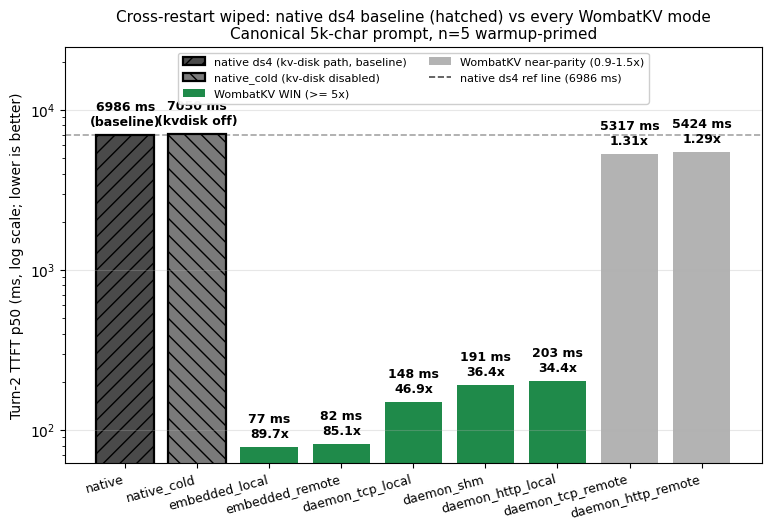
Engine restarted between turn-1 and turn-2; kvdisk wiped, so native ds4 must re-prefill from scratch. embedded_local hits 89.7×; cross-host modes over WiFi LAN still hold 1.29-1.31× parity-plus.
Even with ds4's kvdisk preserved, partial-prefix beats warm ds4
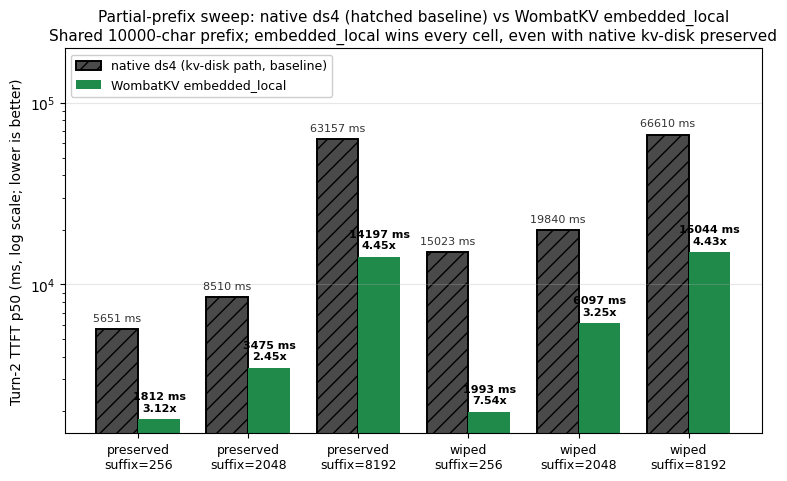
Shared 10000-char prefix, 6 cells (3 suffix sizes × 2 restart policies). embedded_local wins every cell: 2.45-4.45× even when native's kvdisk is preserved, 3.25-7.54× when wiped. Not "cold cache vs warm" — wkv's partial-prefix lookup avoids the full re-prefill that ds4's kvdisk requires for a changed suffix.
Honest losses, where ds4 alone is still the right tool
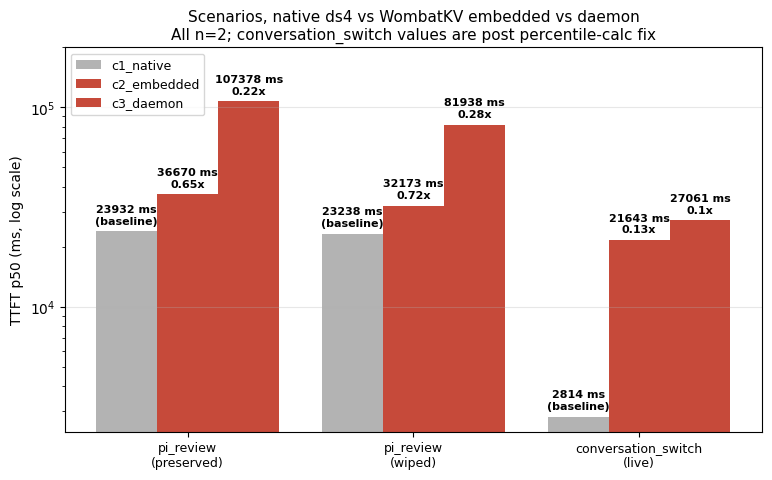
Same campaign, the honest limits. Round-robin conversation switching (0.10-0.13×) and pi_review on one machine with kvdisk preserved (0.65×) are workloads where ds4's own kvdisk + warm engine already handle the state. WombatKV's save+load is pure overhead with nothing to amortize.
All charts, three campaigns (including public-corpus ShareGPT + Gutenberg
multi-round), full methodology, per-row breakdowns:
BENCHMARKS.md + artifacts/.
Quickstart
Try it (5 minutes)
Run pi (an agent harness) with ds4 + WombatKV via
the recipe in examples/pi_ds4_wombatkv/:
pre-built ds4-server binary, 5 env vars, local MinIO via docker run.
Read that example's README for the full step-by-step.
Build from source
# 1. Clone the ds4 fork (this branch carries the WombatKV C ABI hooks)
git clone -b release/0.1.0-alpha.pre1.0 https://github.com/Venkat2811/ds4

# 2. Clone wombatkv + build the C ABI cdylib (libwombatkv.{so,dylib})
git clone https://github.com/Venkat2811/wombatkv
cd wombatkv && cargo build --release -p wombatkv-cabi

# 3. Build ds4-server with WombatKV linked in
cd ../ds4 && make ds4-server WOMBATKV=1 WOMBATKV_DIR=../wombatkv

# 4. Start local MinIO (dev defaults: minioadmin/minioadmin on loopback)
docker run -d --name minio-wombatkv -p 9000:9000 -p 9001:9001 \
    -e MINIO_ROOT_USER=minioadmin -e MINIO_ROOT_PASSWORD=minioadmin \
    -v $HOME/.minio-wombatkv:/data \
    quay.io/minio/minio server /data --console-address ":9001"

# 5. Configure + run ds4-server
export DS4_WOMBATKV_ENABLE=1
export WMBT_KV_BUCKET=wombatkv-cache-myteam
export WMBT_KV_S3_ENDPOINT=http://127.0.0.1:9000
export WMBT_KV_S3_ACCESS_KEY=minioadmin
export WMBT_KV_S3_SECRET_KEY=minioadmin
./ds4-server --model your-model.gguf --port 8000
WombatKV auto-derives the model fingerprint from the model path.
You must explicitly set the bucket + S3 credentials. Dev-default
minioadmin/minioadmin is honored only on loopback endpoints; the
daemon rejects them for any non-loopback target so it can't
accidentally write to the wrong account / bucket. Full env reference:
book/src/operations/env.md.
Rust integration (embedding the crates)
Add the C-ABI surface crate (this is what C / C++ engines link
against; Rust callers can use wombatkv-node directly):
[dependencies]
wombatkv-cabi = "0.1.0-alpha.pre1.0"   # alpha pin required; cargo add won't see pre-releases by default
# or for the high-level Rust API without the cdylib:
# wombatkv-node = "0.1.0-alpha.pre1.0"
# wombatkv-daemon = "0.1.0-alpha.pre1.0"
Crates
Most users want one of the top three. The rest are pulled in transitively or used only when contributing.
| Crate | Audience | What it gives you |
|---|---|---|
wombatkv-node |
Rust integrators | High-level async API |
wombatkv-cabi |
C / C++ / non-Rust engines | libwombatkv.{so,dylib} + wombatkv.h |
wombatkv-daemon |
Sidecar deployments | wombatkv-daemon binary + transports |
wombatkv-core |
transitive | Primitive types, errors, reuse helpers |
wombatkv-format |
transitive | Wire envelope, on-disk segment, CRC32C, BLAKE3 |
wombatkv-radix |
transitive | Prefix-radix metadata index |
wombatkv-store |
transitive | Object-store backend, WAL, CAS |
wombatkv-dst |
contributors | Deterministic-simulation test harness |
wombatkv-bench |
contributors | Operator and benchmark binaries |
Per-crate READMEs live in crates/*/README.md.
What's inside
- Storage: any S3-compatible object store. KV blocks are content-addressed; no database, no coordinator.
- Identity: BLAKE3 over
(model + tokenizer + dtype + TP/PP + LoRA + prefix chain). - Block size: 128 tokens (token-aligned, multi-token-quantization safe).
- Local cache: 3-tier hierarchy. See
book/src/concepts/architecture.md. - Metadata index: in-memory radix tree; SlateDB-backed implementation for durability.
- Compression: zstd by default.
- Modes: embedded (linked into the engine via C ABI) or daemon (separate process).
- Testing: 336 unit tests +
wombatkv-dstfor deterministic-simulation chaos.
Features
Core
- Content-addressed KV blocks (BLAKE3 chain hashing).
- Token-aligned 128-token blocks.
- Prefix-share fall-through: prompts sharing their first M blocks store M blocks under identical keys.
- Restore from any prefix via deterministic block-prefix lookup.
- Universal wire envelope (magic, version, length, CRC32C, body) used by every transport and on disk.
- zstd block compression.
- Same-model save and restore.
- Cross-model restore (research, post-alpha).
Memory hierarchy & hot tiers
- L0 in-process RAM cache.
- L1 local SSD cache.
- L2 object store.
- Block prefetcher with scored hydration.
- Lookup-path memory guardrail.
- HBM tier (engine-resident).
- Typed CPU-RAM tier.
- CXL-attached memory tier (CXL.mem).
- L0.5 NVMe scratchpad.
- Engine-native block-manager bridge.
Metadata index
- In-memory radix tree.
- SlateDB-backed durable index.
- Bootstrap from object storage.
- Multi-region replication.
Storage backends
- AWS S3.
- MinIO.
- Cloudflare R2.
- Google Cloud Storage.
- AWS S3 Express One Zone.
- Tigris.
- Azure Blob Storage.
Deployment modes
- Embedded mode (C ABI, in-process).
- Daemon / sidecar mode (separate process).
- Multi-tenant prefix isolation.
- WombatKV Puffer Operator (Kubernetes deployment; cluster-level routing and prewarm).
- Daemon-to-daemon replication.
Transport & wire protocols
The wire envelope is transport-agnostic. The list below tracks which protocols are wired into the daemon's listener and dial side.
- POSIX shared memory.
- TCP.
- HTTP/1.1.
- WebSocket.
- HTTP range reads (partial-block fetch from object store).
- RDMA (RoCE v2 and native verbs).
- InfiniBand.
- NVLink (intra-node GPU-to-GPU peer-to-peer).
- GPUDirect Storage (RDMA-to-GPU memory).
- NVIDIA cuObject (GPUDirect Storage for Objects; KV blocks land directly in GPU memory).
- NIXL-style transfer.
- Mooncake-style transfer.
Engine integrations
-
antirez/ds4(reference integration). -
vllm-project/vllm -
sgl-project/sglang -
ggerganov/llama.cpp -
ollama/ollama -
ai-dynamo/dynamo(NVIDIA Dynamo) -
llm-d/llm-d(Kubernetes-native LLM serving)
Bindings
- C / C++.
- Rust.
- Python.
- Go.
- Zig.
CLI
-
wombatkvCLI binary (bucket inspect, block dump, metadata audit, DST seed-replay, cache warmup).
Testing & quality
- 336 unit tests across the workspace.
-
wombatkv-dst: BUGGIFY-style chaos, seeded fault injection, in-memory oracle. - 20 fault classes covering S3, daemon transport, wire format, SlateDB, multi-tenant, resource exhaustion, platform divergence.
- 200 deterministic plans per sweep (20 classes × 10 seeds).
- Adversarial-roundtrip integration test on the C ABI boundary.
- Linux + macOS CI matrix.
- Drift detectors for platform-specific code and clippy warnings.
-
cargo mirilane. - AddressSanitizer / ThreadSanitizer lanes.
- End-to-end ds4 cross-restart bench on Linux.
Operations
-
make cicanonical gate. - 10 operator and bench binaries.
- Prometheus exporter.
- OpenTelemetry / OTLP exporter.
- Grafana dashboards.
- Helm chart for the daemon Kubernetes deployment.
Platform support
- macOS (M3 Max validated end-to-end).
- Linux (transport benches validated on x86_64; end-to-end ds4 path pending).
- Windows (no plans).
Docs
In-repo:
book/src/concepts/architecture.md: crate map, embedded & daemon modes, block-prefix compute, 3-tier cache hierarchy.book/src/concepts/consistency.md: consistency model (read-your-writes, durability, isolation; what holds, what does NOT).book/src/concepts/recovery.md: recovery protocol per failure class (what WombatKV does automatically vs operator action).book/src/operations/dst.md: Deterministic Simulation Testing primitives, failure classes, sweep harness, how to wire chaos sites.book/src/operations/bench-methodology.md: canonical warmup-primed 5-trial bench protocol; per-trial reproduction.book/src/getting-started/dev-quickstart.md: local-dev bring-up.
Status
0.1.0-alpha: ds4 adapter only, no production deployment recommended.
- C ABI: stable at version 1.0 (
crates/wombatkv-cabi/include/wombatkv.h). - Wire format: v1, single-format. No back-compat reader; future changes will use staged migrations.
- Pending: end-to-end ds4 path on Linux, cloud S3 production validation, multi-client daemon load.
See also
book/src/operations/env.md: everyWMBT_KV_*env var.book/src/operations/bench.md: the 10 bench binaries.book/src/concepts/architecture.md: crate layout and block-prefix restore.CHANGELOG.md: release history.- Per-crate READMEs in
crates/*/README.md.
Development
make ci                  # fmt + clippy + lib tests + DST sweep + drift detectors
./scripts/dst-sweep.sh   # 20 fault classes x 10 seeds
See CONTRIBUTING.md for the contributor lifecycle.
Acknowledgements
WombatKV stands on the shoulders of these projects and the people behind them:
antirez/ds4: the C engine this alpha integrates with.slatedb/slatedb: backs the L1 metadata index.foyer-rs/foyer: underpins the in-process L0/L1 cache hierarchy.- LMAX Disruptor + Trisha Gee: the SHM ring under
wombatkv-daemondescends from this viaVenkat2811/myelon. - TigerBeetle VOPR + FoundationDB BUGGIFY: the DST pedigree.
- vLLM: raised KV cache to a first-class inference subsystem.
- SGLang HiCache: KV offload + reuse in the same lineage.
- LMCache and Mooncake: sibling KV substrates.
ovg-project/kvcached: engine-integration template.pi.devby mitsuhiko: agent harness used inexamples/pi_ds4_wombatkv/.
Built with Agentic engineering, using: 

Citation
If WombatKV helps your work, please cite:
@software{wombatkv2026,
  author       = {Venkat Raman and {WombatKV Contributors}},
  title        = {{WombatKV: object-storage-native KV cache system for LLM inference}},
  year         = {2026},
  version      = {0.1.0-alpha.pre1.0},
  url          = {https://github.com/Venkat2811/wombatkv},
}
See CITATION.cff for the machine-readable form.
Issues, feedback, discussions, and PRs are welcome & appreciated! Reach out on GitHub or Twitter @venkat_systems.
License
Apache-2.0. See LICENSE.