
WP-Scanner

Advanced WordPress Vulnerability Scanner and Exploitation Tool
Features
- Comprehensive WordPress fingerprinting (version, themes, plugins, users)
- Vulnerability scanning for WordPress core, themes, and plugins
- Active exploitation of detected vulnerabilities
- Detailed reporting of vulnerabilities and exploitation results
- Mass scanning capability for multiple targets
- Automatic updates for both tool and vulnerability databases
Installation
Prerequisites
- Python 3.7+
- Git (for easy updates)
Setup
- Clone the repository:
git clone https://github.com/Triotion/wp-scanner.git
cd wp-scanner
- Install dependencies:
pip install -r requirements.txt
- Run the tool:
python wp_scanner.py -h
Usage
Basic Scan
python wp_scanner.py -t example.com
Scan with Exploitation
python wp_scanner.py -t example.com --exploit
Mass Scan from File
python wp_scanner.py -l targets.txt --mass-output-dir mass_results
Update Tool and Vulnerability Databases
python wp_scanner.py --update
Scan with Auto-Update
python wp_scanner.py -t example.com --auto-update
Target List Generation
You can generate a list of targets using the helper script:
python create_targets_list.py -i raw_urls.txt -o targets.txt --check-wordpress
Usage:
usage: create_targets_list.py [-h] [-o OUTPUT] [-i INPUT] [-u URLS [URLS ...]]
                              [--subdomains SUBDOMAINS] [--append] [--check-wordpress]

Generate target list for WP-Scanner mass scans

options:
  -h, --help            show this help message and exit
  -o OUTPUT, --output OUTPUT
                        Output file for the target list
  -i INPUT, --input INPUT
                        Input file with targets (one per line)
  -u URLS [URLS ...], --urls URLS [URLS ...]
                        URLs to add to the target list
  --subdomains SUBDOMAINS
                        File with subdomains enumeration results
  --append              Append to output file instead of overwriting
  --check-wordpress     Basic check if targets are WordPress (slower)
Additional Options
usage: wp_scanner.py [-h] [-t TARGET] [-l TARGETS_FILE] [-o OUTPUT] [--threads THREADS]
                     [--timeout TIMEOUT] [--user-agent USER_AGENT] [--proxy PROXY] [--exploit] [-v]
                     [--mass-output-dir MASS_OUTPUT_DIR] [--update] [--auto-update]
                     [--report-format {console,html,md}]

WordPress Vulnerability Scanner and Exploitation Tool

options:
  -h, --help            show this help message and exit
  -t TARGET, --target TARGET
                        Target WordPress site URL
  -l TARGETS_FILE, --targets-file TARGETS_FILE
                        File containing list of target URLs (one per line)
  -o OUTPUT, --output OUTPUT
                        Output directory for scan results
  --threads THREADS     Number of threads (default: 5)
  --timeout TIMEOUT     Request timeout in seconds (default: 30)
  --user-agent USER_AGENT
                        Custom User-Agent string
  --proxy PROXY         Proxy URL (e.g., http://127.0.0.1:8080)
  --exploit             Attempt to exploit found vulnerabilities
  -v, --verbose         Enable verbose output
  --mass-output-dir MASS_OUTPUT_DIR
                        Base directory for mass scan results (default: mass_scan_results)
  --update              Update the tool and vulnerability databases
  --auto-update         Automatically update the tool before scanning
  --report-format {console,html,md}
                        Output report format (default: console)
Demo
Vulnerability Scanning
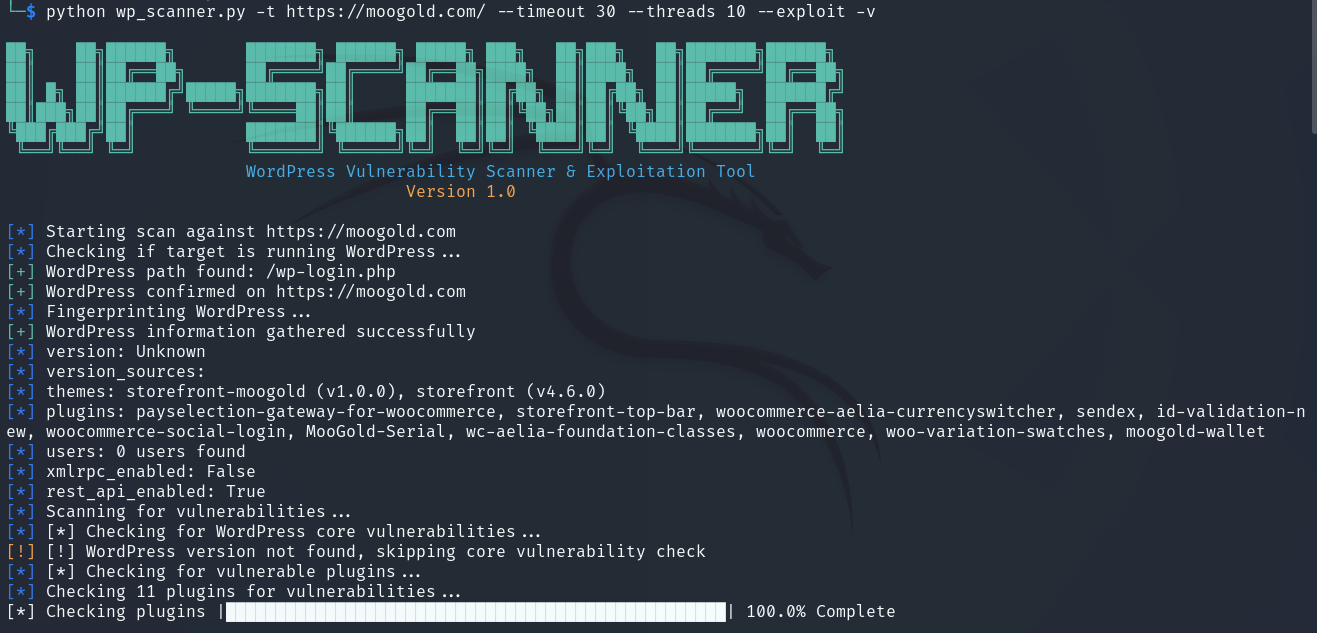
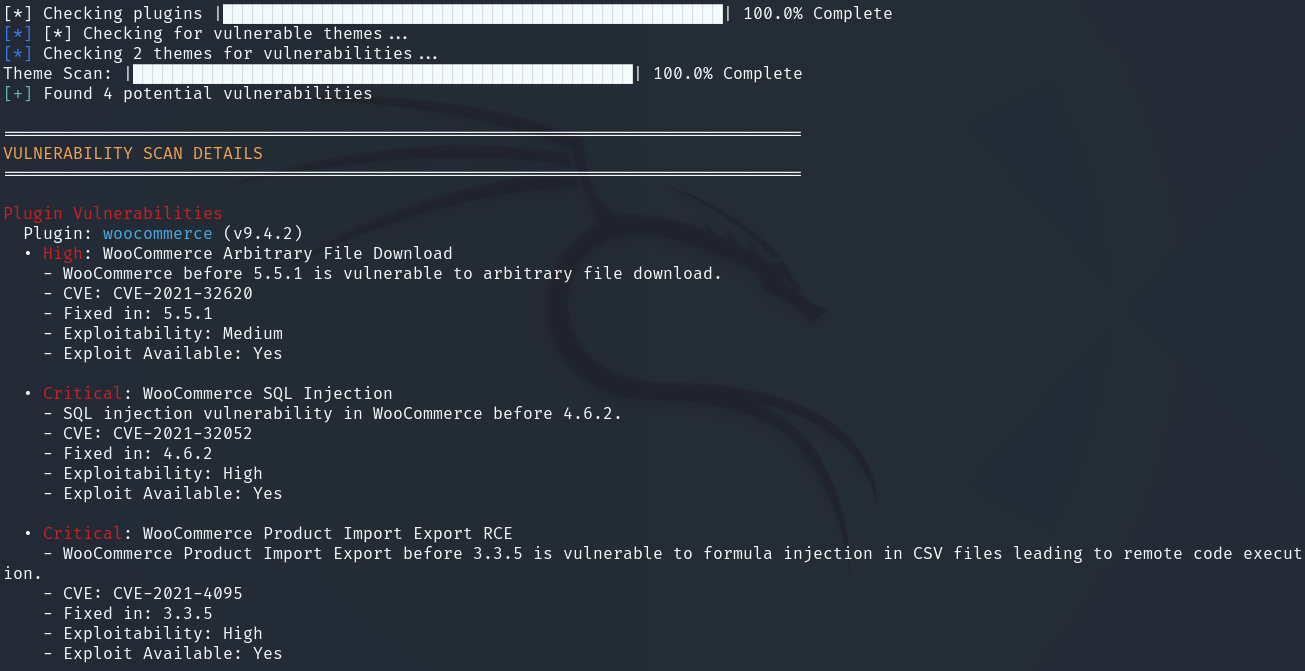
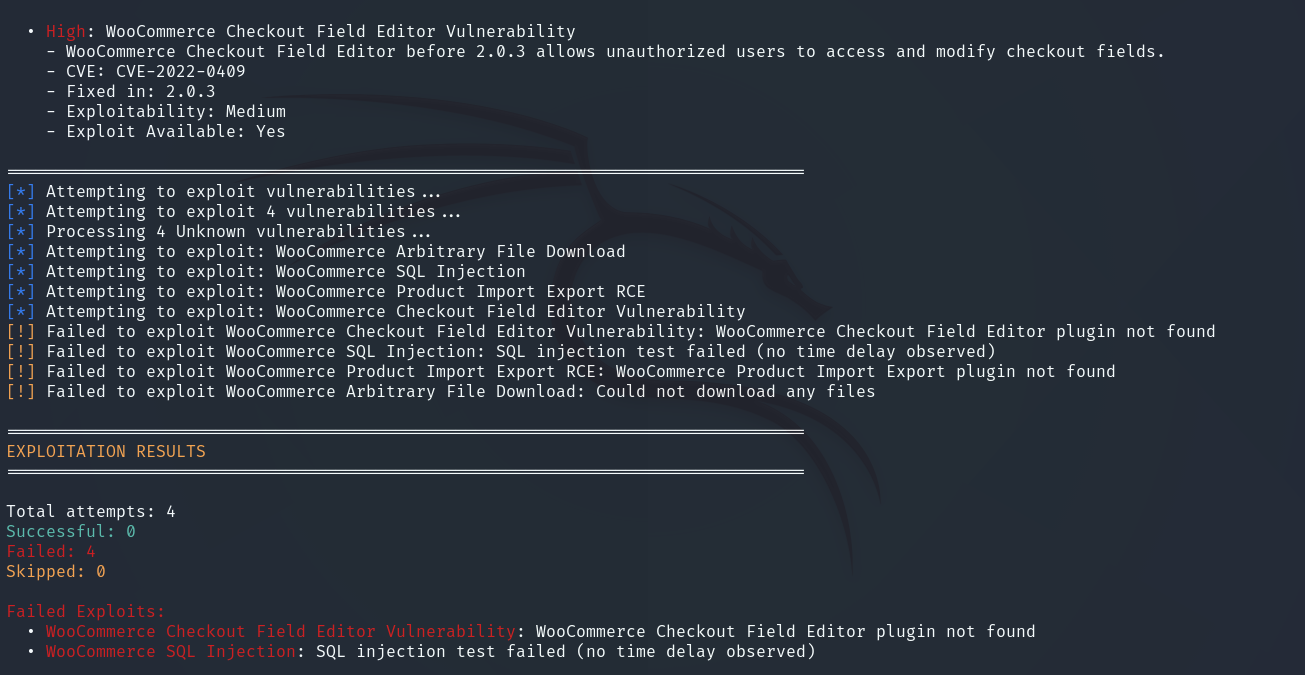
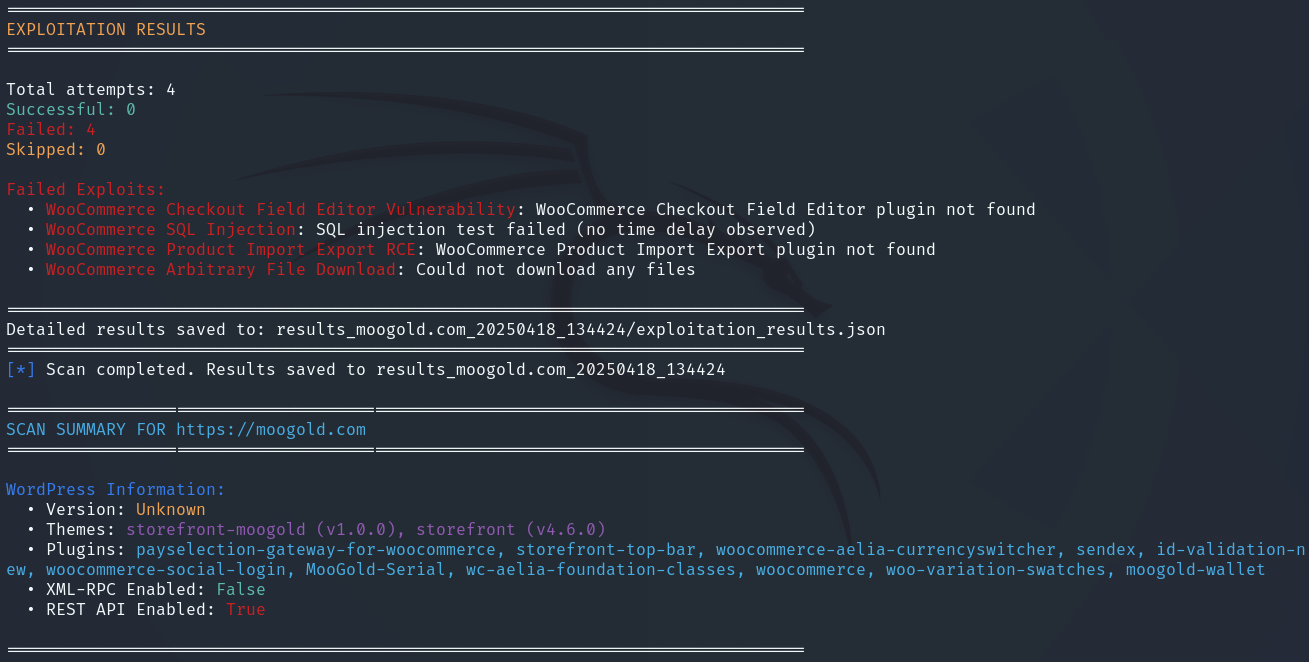
Output Structure
The tool creates a results directory for each scan with the following structure:
results_example.com_20240101_120000/
├── scan_results.log          # Detailed log of the scanning process
├── wp_info.json              # WordPress information (version, themes, plugins, etc.)
├── vulnerabilities.json      # Detected vulnerabilities
└── exploitation_results.json # Results of exploitation attempts (if --exploit is used)
Disclaimer
This tool is intended for ethical use only. Always obtain proper authorization before scanning or attempting to exploit any website. The creators of this tool are not responsible for any misuse or damage caused by this program.
Contributing
Contributions are welcome! Please feel free to submit a Pull Request.
Donations
If you find this tool valuable, consider donating to support ongoing development:
- BTC:
bc1qtkm7dzjp76gx8t9c02pshfd8rzarj6gj9yzglu - ETH:
0x88Aa0E09a5A62919321f38Fb4782A17f4dc91A9B - XMR:
0x6730c52B3369fD22E3ACc6090a3Ee7d5C617aBE0
Author
Created by @Triotion - Telegram
License
This project is licensed under the MIT License - see the LICENSE file for details.