
Ridley
A programmable 3D CAD environment built on turtle graphics and ClojureScript. Describe parts as code, see them as meshes, export them as STL.
Try it in your browser: no installation required.
Overview
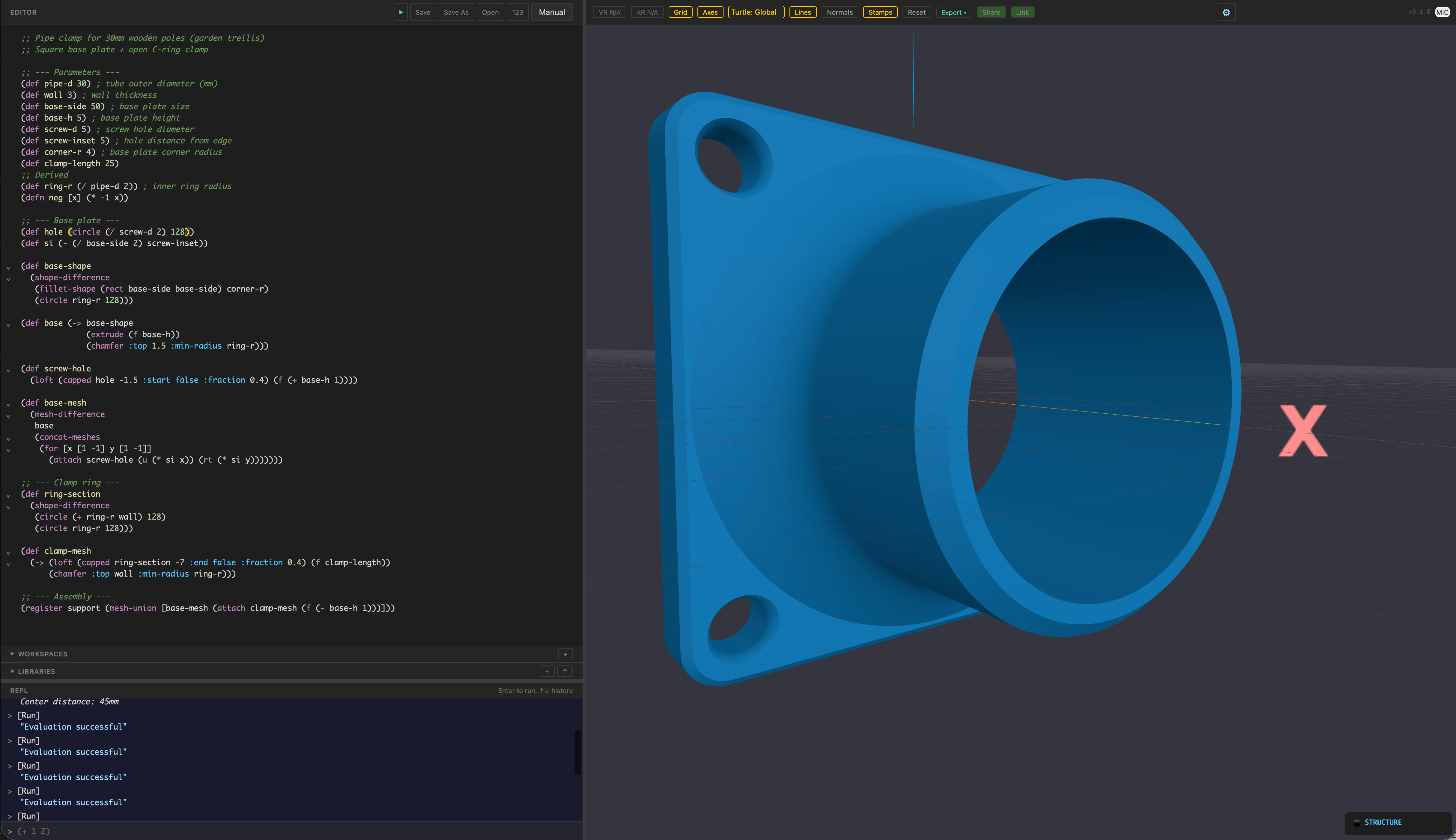
Ridley is a CAD-as-code tool. The model is a ClojureScript program that, when evaluated, produces the scene. The editor lives next to a 3D viewport: write code on the left, see geometry on the right, iterate with a live REPL.
The defining choice is turtle graphics. Every operation happens relative to a moving frame of reference (a "turtle") with a position and a heading. You move forward, turn, draw a path, sweep a profile along it. This is the same metaphor Logo introduced in the 1960s for teaching geometry to children, applied here as a tool for serious mechanical design. The result is code that composes naturally: a part designed in steps, each one local and modifiable, instead of a tree of absolute coordinates.
A few characteristics that distinguish Ridley from other CAD-as-code tools:
- General purpose language: Clojure as full programming language, not a restricted DSL. Write functions, build personal libraries, share them as code.
- Two geometric representations: meshes (universal, fast booleans via Manifold WASM) and signed distance functions (analytic, smooth blends, available in desktop via libfive).
- Live interaction modes: tweak (real-time sliders for numeric literals), pilot (interactive turtle steering), face picking from the viewport. All produce code as output, preserving the textual model.
- Multimodal AI integration: code generation, mesh description, iterative refinement loop with vision feedback.
- Voice and WebXR: alternative input channels designed for headset-first workflows.
For the full picture, see docs/Architecture.md (Italian; English translation planned).
Quick Start
npm install
npx shadow-cljs watch app
# Open http://localhost:9000
A taste of the language
The interface has two panels: the Editor for definitions and a REPL for interactive commands. Both evaluate the same code; the editor rebuilds the whole scene on Run, the REPL accumulates incremental commands.
Movement and primitives
(f 30)            ; move forward along heading
(th 90)           ; turn horizontal (yaw)
(tv 45)           ; turn vertical (pitch)

(box 20)          ; cube at current pose
(sphere 15)       ; sphere
(cyl 10 30)       ; cylinder
Each primitive inherits the turtle's current pose. Rotate first, then place a box, and the box appears rotated.
Sweeping profiles
;; extrude a 2D profile along a turtle path
(extrude (circle 10) (f 30) (th 45) (f 20))

;; loft a profile that twists along the way
(loft (twisted (circle 15) :angle 180) (f 40))

;; loft with a tapered, fluted profile
(loft (fluted (tapered (circle 20) :to 0.6) :flutes 12 :depth 2)
      (f 50))
Boolean operations
(def a (box 20))
(f 10)
(def b (sphere 15))
(mesh-difference a b)
Named scene objects
;; register a mesh under a name; it becomes visible in the viewport
(register :base (extrude (rect 40 40) (f 5)))

;; build something from named pieces
(register :assembly
  (mesh-union
    (get-mesh :base)
    (attach (cyl 5 30) :base)))
Examples
The examples/ directory contains 23 complete models. A few highlights:
| File | What it shows |
|---|---|
supporto.clj |
Parametric pipe clamp ("supporto" = bracket; the model in the screenshot above) |
spiral-shell.clj |
Organic shell with logarithmic spiral growth |
twisted-vase.clj |
Vase with procedural twist and fluting |
embossed-column.clj |
Column with heightmap-based surface displacement |
dice.clj |
Six-sided die with boolean-carved pips |
recursive-tree.clj |
Recursive branching structure |
Documentation
- docs/Architecture.md: comprehensive architectural overview of the project (Italian; English translation planned).
- The interactive manual inside the application (click "Manual" in the toolbar) covers the full language with bilingual descriptions and runnable examples.
- The
dev-docs/directory contains development specs, audits, and design notes for individual subsystems.
Project status
Ridley is developed primarily by a single author with extensive AI assistance for implementation. Architecture and design decisions remain author-driven; AI is used as an implementation accelerator, not as a designer. This model is documented openly in docs/Architecture.md.
The project is in active development as of April 2026. Feature scope is broad and many subsystems are stable, but some areas are explicitly works in progress: voice and WebXR integration are paused pending design work, AI integration efficacy has known limits, certain test clusters were lost in a recent refactor and are being recovered. The architecture document discusses these openly in its technical debt chapter.
Issues and pull requests are welcome but expect slow turnaround. Substantial contributions are best preceded by a discussion in an issue.
Dependencies
- ClojureScript + shadow-cljs
- SCI: Small Clojure Interpreter, evaluates user code at runtime
- Three.js: 3D rendering
- Manifold: mesh boolean operations (WASM)
- Clipper2: 2D path booleans
- CodeMirror 6: code editor
- PeerJS: WebRTC for desktop-headset sync
- opentype.js: font parsing for 3D text
- libfive: signed distance functions (desktop only)
Development
npx shadow-cljs watch app     # dev server with hot reload, port 9000
npx shadow-cljs release app   # production build
npx shadow-cljs compile test  # run test suite (compiles and autoruns)
The desktop variant uses Tauri and requires a Rust toolchain plus CMake (for libfive). See desktop/README.md for build instructions.
License
MIT